
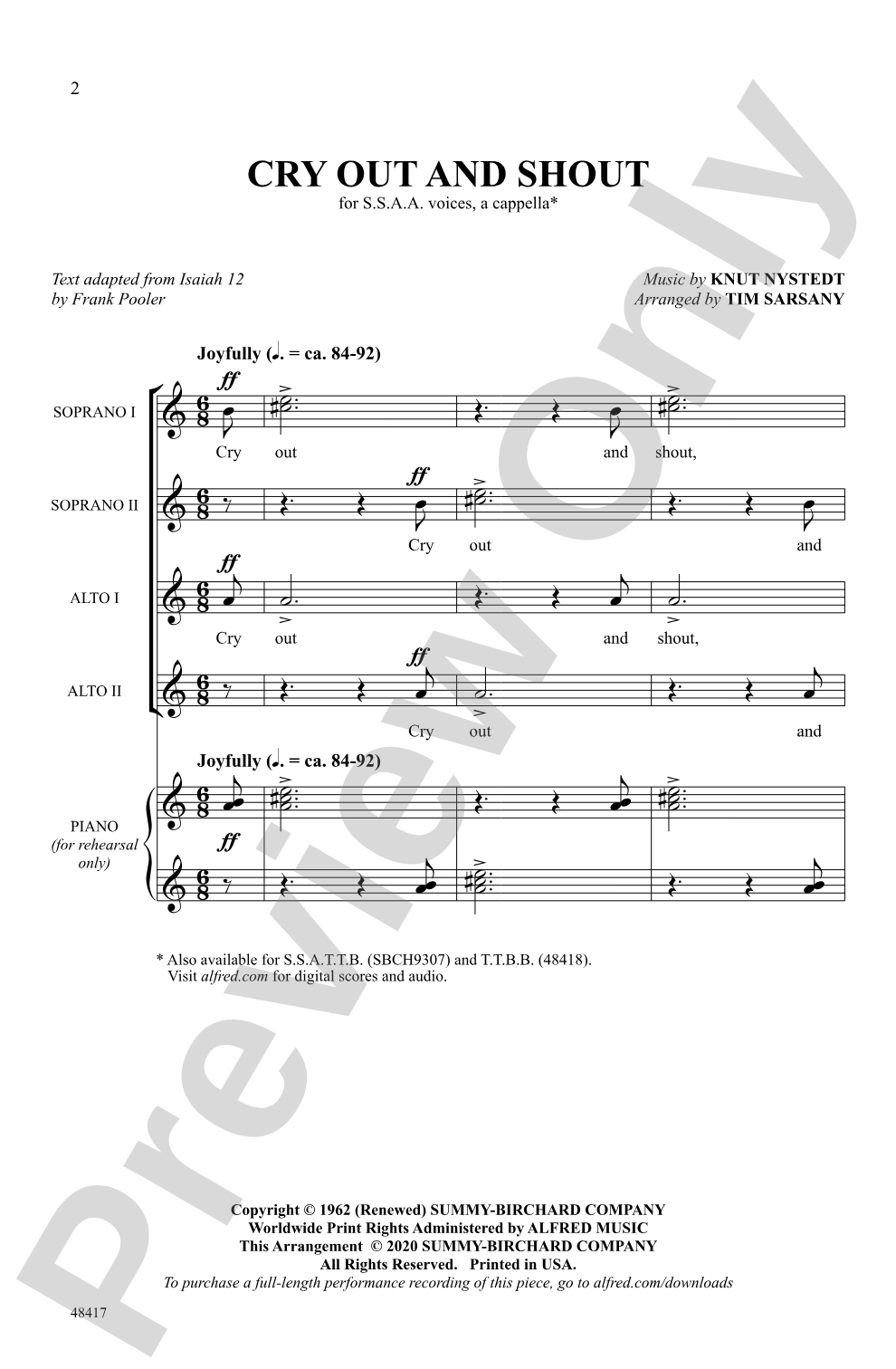
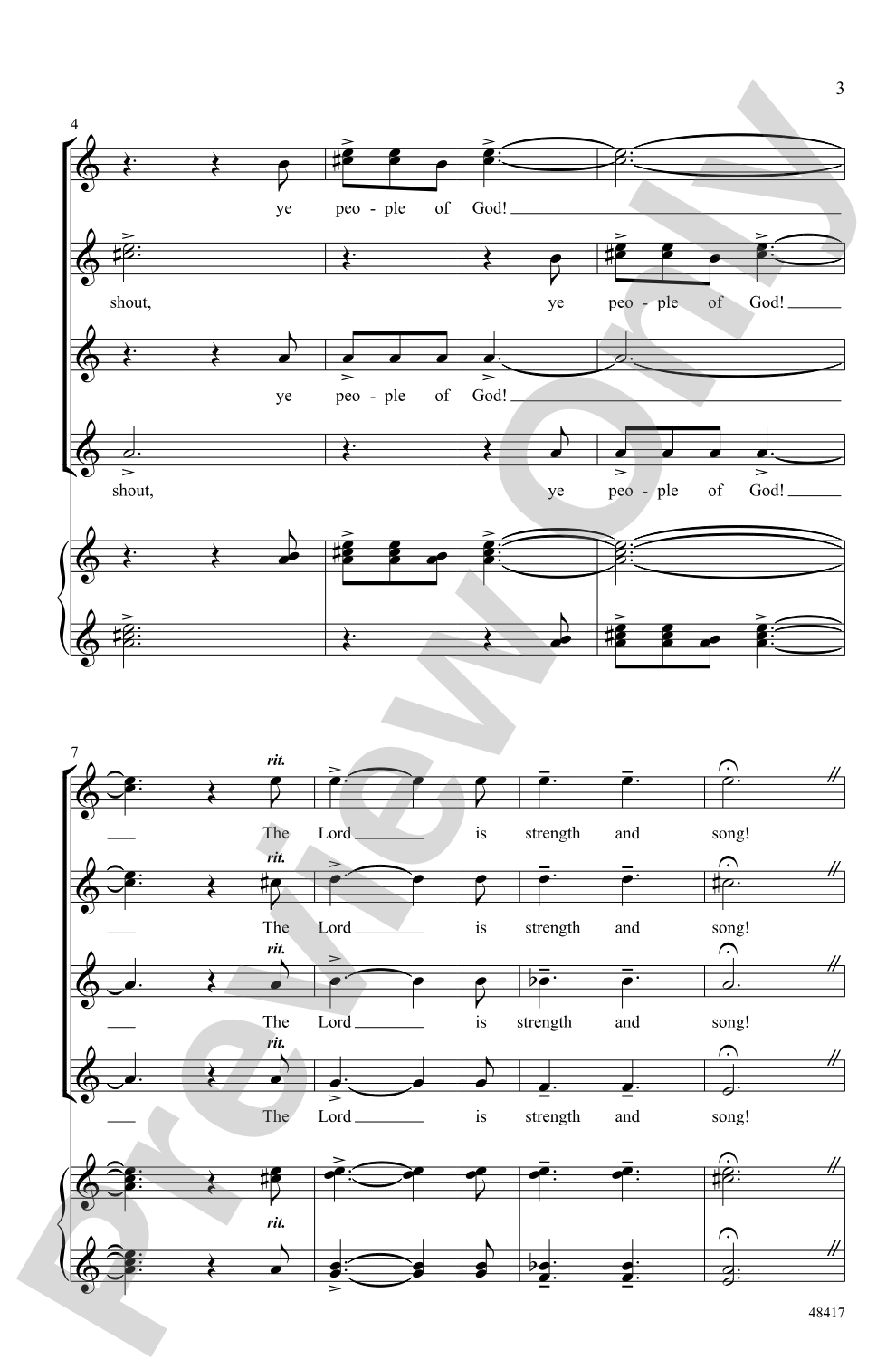

Cry Out and Shout: SSAA, a cappella Choral Octavo
Music by Knut Nystedt / arr. Tim Sarsany
Item: 00-PO-0006423
$2.05
Minimum order quantity: 20 copies
Pickup currently not available
Description
Now available in SSAA and TTBB voicings. Alfred Music commends Dr. Timothy Sarsany for his scholarly adaptations of this long-standing favorite of honor choirs and festival groups. New voicings are carefully crafted to reflect the original. A joyful, tried-and-true a cappella fanfare, not to be missed!


Cry Out and Shout: SSAA, a cappella Choral Octavo isn't in MakeMusic Cloud just yet...but it could be. Let us know you'd like to see it, and you'll help shape what comes next. In the meantime, start a free trial and dive into thousands of interactive titles your students can play along with today.
Request This Title
Tell us you want it.
Start Your Free Trial
Explore everything that's ready to play right now.
Sample Audio
1
Audio File
--:--
0:00
0:00
Sample Video
Additional Details
Series:
Lawson-Gould
Publisher:
Alfred Music
Page Count:
8
SKU:
00-PO-0006423
More about this title
About the Composer: Knut Nystedt
Knut Nystedt (1915-2014) was a Norwegian composer whose sacred choral works became cornerstones of the modern a cappella repertoire. His gift for creating vocal lines that soar naturally while maintaining harmonic sophistication made him essential to honor choirs and festival groups worldwide. Nystedt's output spans motets, cantatas, and liturgical works, many of which explore the intersection of Nordic musical tradition and contemporary harmonic language.
His compositions are prized for their singability across ability levels, even when the harmonic content is complex. Teachers and directors return to Nystedt's catalog again and again because the music rewards both preparation and spontaneity, and because his sacred texts speak to genuine spiritual expression rather than sentiment.
Why we love this
This arrangement preserves everything that made the original a standout in festival and contest settings while opening the piece to SSAA choirs. Sarsany's careful voicing maintains the brilliance and joy of the fanfare without resorting to showy writing; the parts sit naturally and allow singers to focus on the text and expression rather than fighting the range.
What to expect
A joyful outburst of praise wrapped in sophisticated harmony. The piece opens with a sense of exuberance and builds through interlocking vocal lines that feel both contemporary and timeless. Singers feel the text; audiences hear clarity and conviction.
Who it's for
SSAA choirs at the high school and college level, honor choirs, and festival-ready ensembles seeking sacred repertoire with immediate impact. This works equally well for groups working at a foundational level and those with more advanced technique; the writing scales to your ensemble's capabilities.
How to get the most out of it
- Anchor the piece with a confident, unified approach to the text setting. The fanfare quality comes from precision and clarity, not volume.
- Shape the harmonic progressions with slight dynamic inflection. Nystedt's voice-leading rewards careful listening to inner parts, especially in the second sopranos.
- Balance the ensemble by ear during the opening unison passage. A cappella singing exposes any tuning drift immediately, so lock in your fundamental pitch before harmonic complexity enters.
- Resist the urge to rush. The joy in this piece lives in the space between notes and phrases, not in speed.
How to use it
Program this as a concert opener or closer when you need a piece that energizes both singers and listeners. It pairs beautifully with other sacred works from the Lawson-Gould series and carries enough musical substance to stand alone on a short program. Its brevity and impact make it an excellent choice for festival and competition settings where every minute counts.
Skills your students will build
- Singing in four-part harmony with clear voice independence
- Maintaining intonation in a cappella settings without instrumental support
- Shaping harmonic progressions through subtle dynamic control
- Text expression and articulation in sacred choral music
- Ensemble balance when upper voice parts carry the primary melodic material