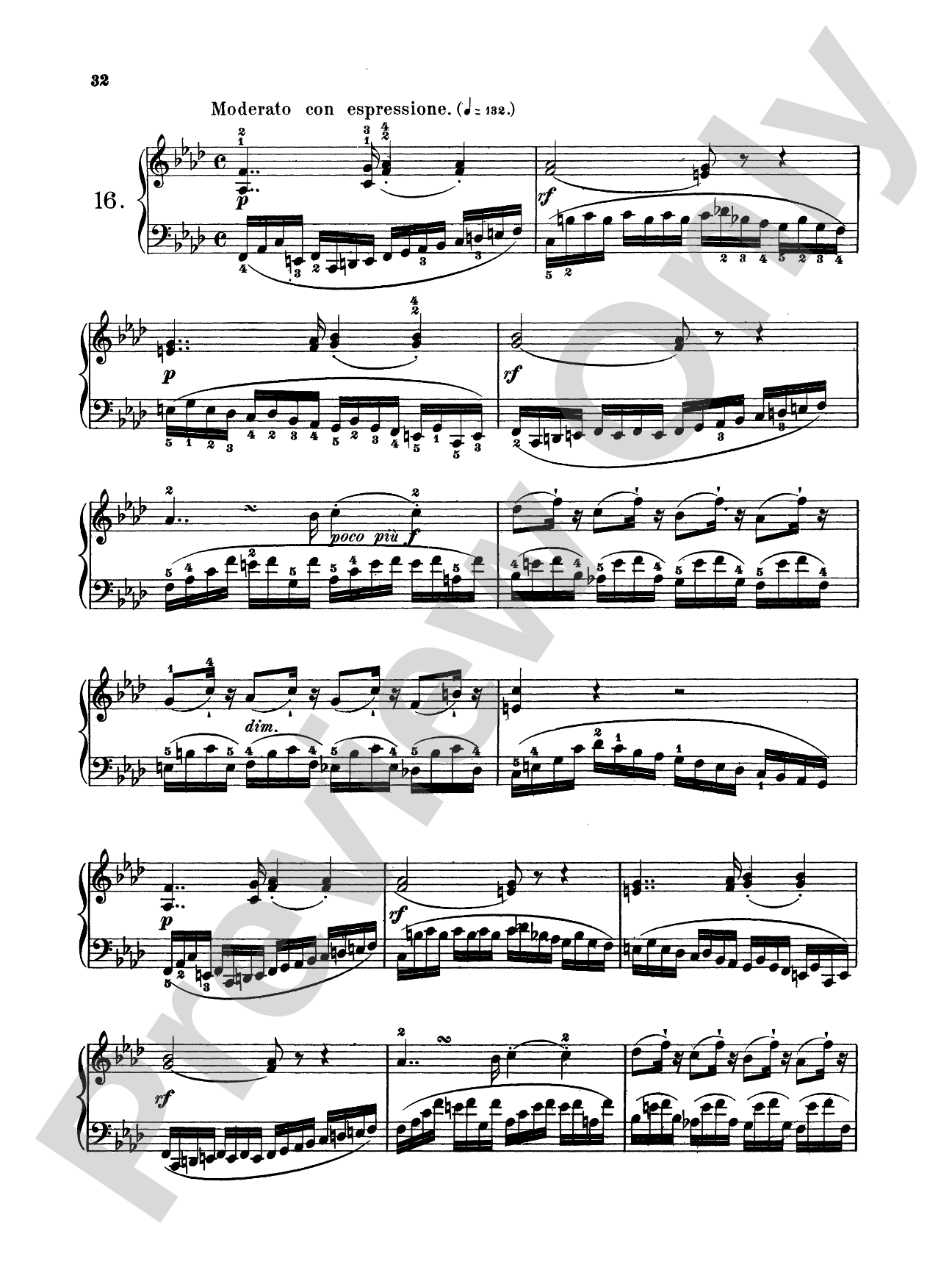
Cramer: Eighty-Four Studies (Volume I) Sheet Music Preview

Cramer: Eighty-Four Studies (Volume I)

By Johann Baptist Cramer

Item: 00-PC-0006380

Digital Download
$0.99
Description
Johann Baptist Cramer (1771--1858) was the son of Wilhelm Cramer, a famous London violinist. He studied piano under Muzio Clementi and enjoyed a worldwide reputation, particularly appreciated by Beethoven. Both were considered the greatest pianists of their time, Beethoven excelling in interpretive expressiveness, Cramer in pure technical perfection. This volume includes technical studies Nos. 1 through 21 of his 84 Studies for piano.

Don't just read it, hear it, play along with it, and watch your students grow with it. In MakeMusic Cloud, Cramer: Eighty-Four Studies (Volume I) comes alive with professional accompaniment, adjustable tempo, and built-in practice tools that turn solo practice into real progress.

Sample Audio
No sample audio found.
Sample Video
Additional Details
Series: Kalmus Edition
Publisher: Alfred Music
Page Count: 48
SKU: 00-PC-0006380

More about this title

About the Composer: Johann Baptist Cramer

Johann Baptist Cramer (1771–1858) stands as one of the two towering keyboard virtuosos of the late Classical and early Romantic periods, the other being Beethoven himself. A student of Muzio Clementi, Cramer built his reputation on crystalline technique and pianistic elegance, earning the admiration of Beethoven despite their different artistic temperaments. While Beethoven moved audiences through interpretive depth and emotional intensity, Cramer commanded respect for his mechanical perfection and refined touch—qualities that made him the most celebrated pianist in Europe during his lifetime.

Cramer's 84 Studies remain cornerstones of piano pedagogy because they balance technical demand with musical substance. Unlike pure finger exercises, these studies embed their challenges within coherent musical ideas, requiring students to solve real interpretive problems alongside mechanical ones. His influence on piano teaching persists through generations of conservatory curricula worldwide.

Why we love this

Cramer's studies occupy the vital middle ground between Czerny's mechanical repetition and the Romantic keyboard literature that follows. Volume I presents essential technical foundations (scales, broken figures, hand independence, evenness) wrapped in musicality that keeps students engaged rather than drained. These 21 studies have shaped generations of pianists precisely because they refuse to sacrifice artistry for utility.

What to expect

These studies pulse with the confident clarity of early 19th-century keyboard writing. Rapid passagework sits comfortably under the hand, lyrical episodes breathe with Romantic sensibility, and rhythmic figures feel propulsive rather than labored. There's an elegance throughout, a sense that technical mastery and graceful musicmaking are not separate pursuits but one unified discipline.

Who it's for

Intermediate to advanced piano students preparing for conservatory entrance, competitive festivals, or serious recital work will find these studies essential. Teachers seeking technically rigorous material that maintains musical integrity and student engagement across an extended practice cycle should prioritize this collection. Adult students returning to piano also benefit from Cramer's balance of challenge and approachable musical context.

How to get the most out of it

  • Approach evenness as phrasing, not just mechanics. Maintain consistent tone color across scalar passages even when the fingering changes; think of the passage as a singing line that happens to move quickly.
  • Anchor your preparation by identifying the harmonic structure beneath each study. Many of Cramer's technical figures follow classical progression patterns, and recognizing the harmony underneath prevents the piece from becoming mere fingerwork.
  • Isolate and practice the hand position shifts in slow motion before tempo work. Many studies contain subtle position changes that catch intermediate students; mapping these physically saves weeks of frustrated practice.
  • Listen to how tempo interacts with your technical security. A study performed slightly slower while maintaining absolute steadiness often sounds more accomplished than a faster performance with wavering control.

How to use it

While these studies function primarily as daily practice material rather than recital pieces, selected studies can anchor recital programs that trace the evolution of piano technique or teaching traditions. Pairing a Cramer study with a contemporary sonata or character piece demonstrates how historical technique supports the demands of later Romantic repertoire. For studio teachers, assigning studies sequentially across a semester or year creates a pedagogical through-line that reinforce specific skills at logical points in the student's development.

Skills your students will build

  • Scalar and broken-figure patterns in multiple keys and hand positions
  • Hand independence and coordination across register changes
  • Evenness and tonal consistency at varying tempos
  • Rhythmic precision within Romantic-era idiomatic figures
  • Sight-reading fluency in classical harmonic progressions
  • Pedal awareness and sustain techniques appropriate to the Classical-Romantic transition

You May Also Like