
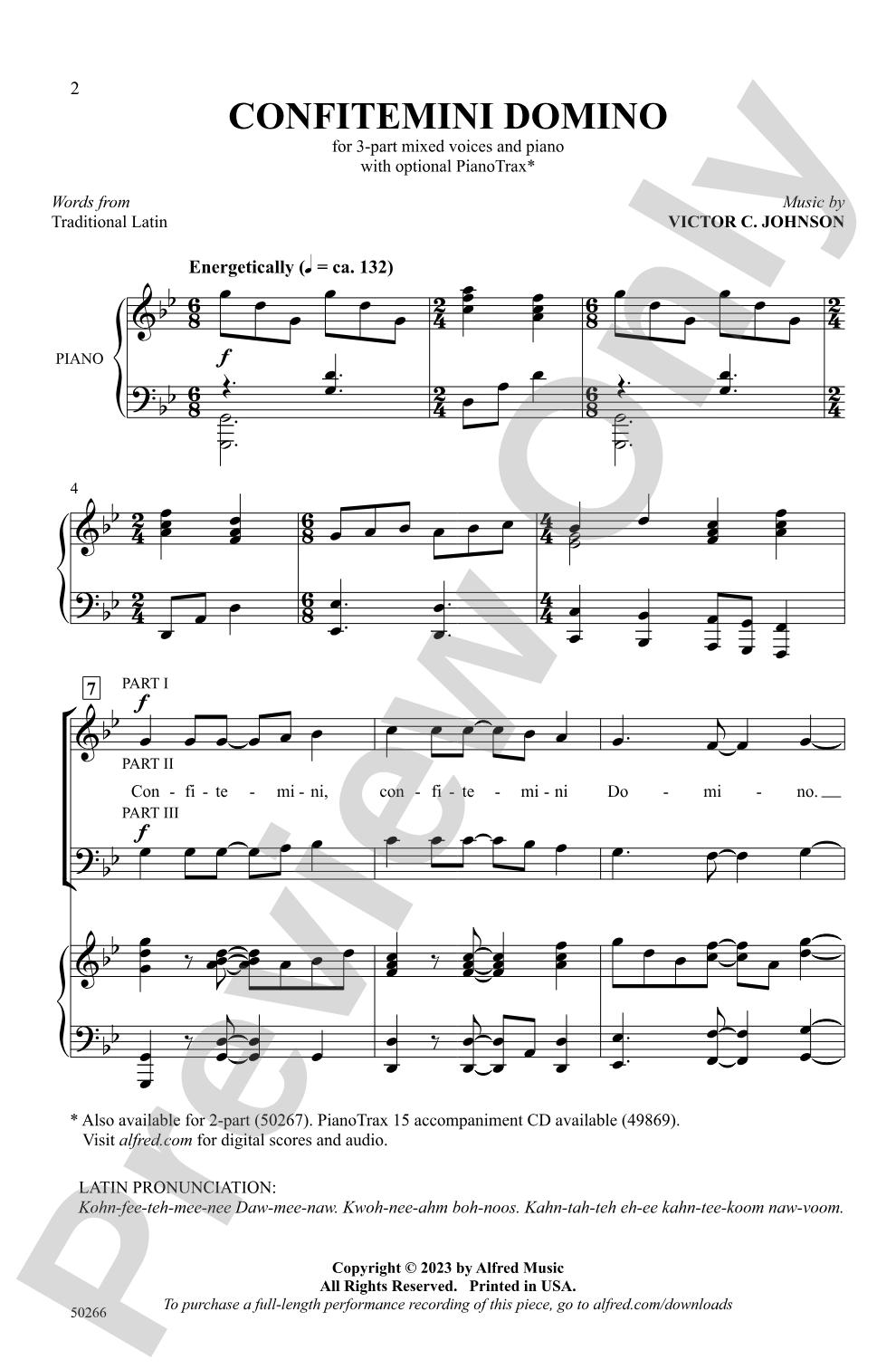
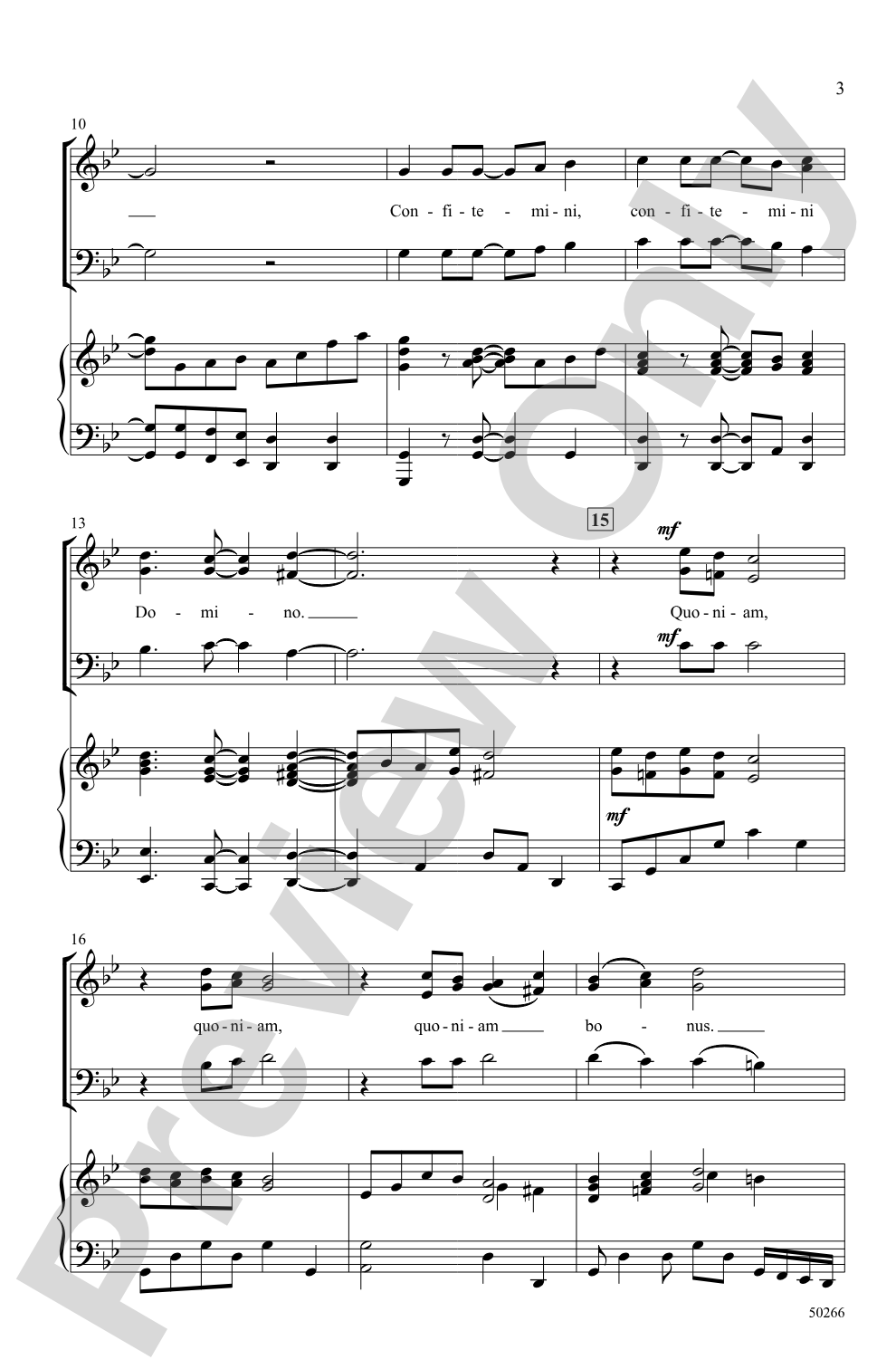

Confitemini Domino: 3-Part Mixed Choral Octavo
Words from Traditional Latin, music by Victor C. Johnson
Item: 00-PO-0007094

$2.05
Minimum order quantity: 20 copies
Pickup currently not available
Related Items
Confitemini Domino: 2-Part Choral Octavo |
$2.05
|
View | |
Confitemini Domino: TB Choral Octavo |
$2.50
|
View | |
Confitemini Domino: PianoTrax Digital Audio Download |
$9.99
|
View | |
Confitemini Domino: 3-Part Mixed Choral Octavo |
$2.05
|
View | |
Confitemini Domino: 2-Part Choral Octavo |
$2.05
|
View | |
Confitemini Domino: TB Choral Octavo |
$2.50
|
View |
Description
Victor C. Johnson's jubilant setting of the traditional Latin text is ideal for developing choirs. The rousing mixed-meter introduction lays the groundwork for a syncopated presentation of the main theme that melts into a reverent middle section. A gradual crescendo and accelerando lead us back to the driving A section. Thrilling!


Don't just read it, hear it, play along with it, and watch your students grow with it. In MakeMusic Cloud, Confitemini Domino: 3-Part Mixed Choral Octavo comes alive with professional accompaniment, adjustable tempo, and built-in practice tools that turn solo practice into real progress.
Open in the Player
Jump straight in and assign it today.
Start Your Free Trial
Open this title and explore the full library in minutes.
Sample Audio
1
Audio File
--:--
0:00
0:00
Sample Video
Additional Details
Series:
Alfred Choral Designs
Publisher:
Alfred Music
Page Count:
12
SKU:
00-PO-0007094
More about this title
About the Composer: Victor C. Johnson

Victor C. Johnson brings decades of hands-on choral experience to his prolific composing career. Based in Dallas, he has spent years directing choirs at all levels, including his tenure as choral director at Ft. Worth Academy of Fine Arts where he led multiple ensembles and served as Artistic Director of the Singing Girls of Texas and Children's Choir of Texas. Currently, he serves as School Choral Editor for Sing! (the educational division of Choristers Guild) and conducts the Dallas Symphony Children's Chorus Mixed Ensemble, the resident youth choir for the Dallas Symphony Orchestra.
With over 500 choral works, vocal solos, and keyboard collections in print, Johnson has established himself as a trusted voice in music education. His professional involvement spans the American Choral Directors Association, Texas Choral Directors Association, National Association for Music Education, AGO, ASCAP, and Phi Mu Alpha Sinfonia, reflecting his commitment to both the choral art and the teaching profession.
Why we love this
Johnson captures something essential in this piece: the energy and pride of a developing choir. The mixed-meter introduction grabs attention immediately, then the syncopated main theme gives your singers a rhythmic anchor they can really dig into, while the reverent middle section proves they can handle contrast and nuance. The arc from drive to reflection back to climax is satisfying to conduct and thrilling to hear.
What to expect
Jubilant and forward-moving. The introduction pulls you in with its rousing mixed-meter pulse, then the syncopated theme locks in with infectious energy. You sink into a serene, reflective moment midway through before the music builds again, gathering speed and intensity until it arrives back at that driving main section with renewed power.
Who it's for
Developing SAB choirs ready to tackle mixed meters and rhythmic complexity without sacrificing musicality. This piece rewards choirs that have steady rhythm section skills and can maintain blend during energetic passages.
How to get the most out of it
- Spend rehearsal time clarifying the mixed-meter introduction so it feels secure rather than tentative; this sets the tone for the entire piece.
- Bring out the syncopation in the main theme with clean articulation and light, forward vowels; this rhythmic groove is what makes the piece memorable.
- Shape the reverent middle section by gradually thinning the texture and lowering dynamic intensity, then tracking the accelerando carefully as you build back to full energy.
- Balance the three parts so that the melody line sings out without burying inner voices, especially during the syncopated sections where all parts contribute to the rhythmic vitality.
How to use it
This works beautifully as a concert opener or as a standalone contest festival piece that showcases both rhythmic precision and lyrical sensitivity. Its 12-page length and moderate difficulty make it an ideal choice for spring programming when choirs have built stamina and technique over the school year.
Skills your students will build
- Reading and performing mixed meters (especially the introduction)
- Syncopation and rhythmic independence across three parts
- Dynamic contrast and phrasing across multiple sections
- Ensemble balance and blend in fast-moving harmonic progressions
- Interpretation of text through musical gesture (sacred Latin text with varied musical moods)