
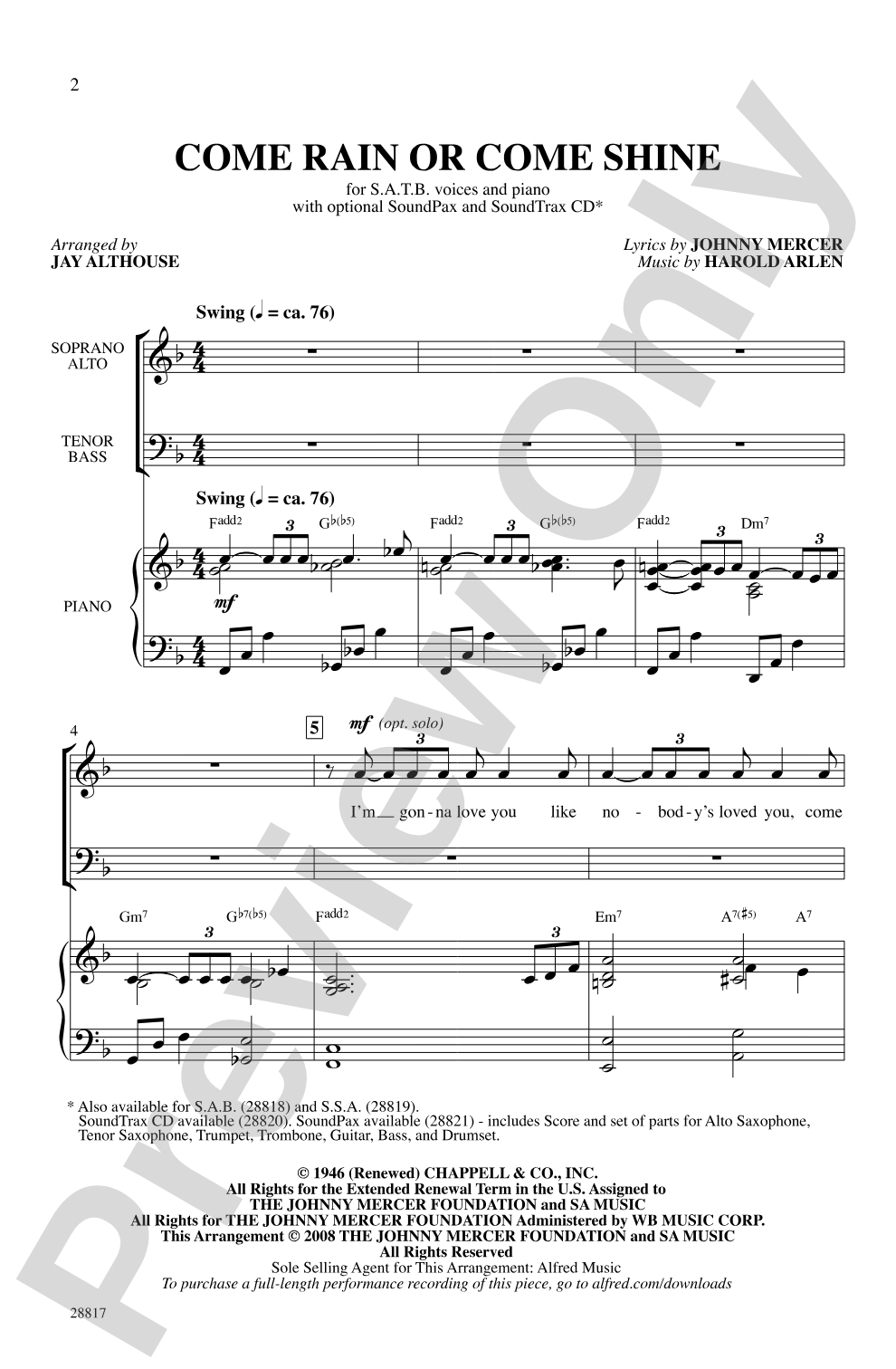
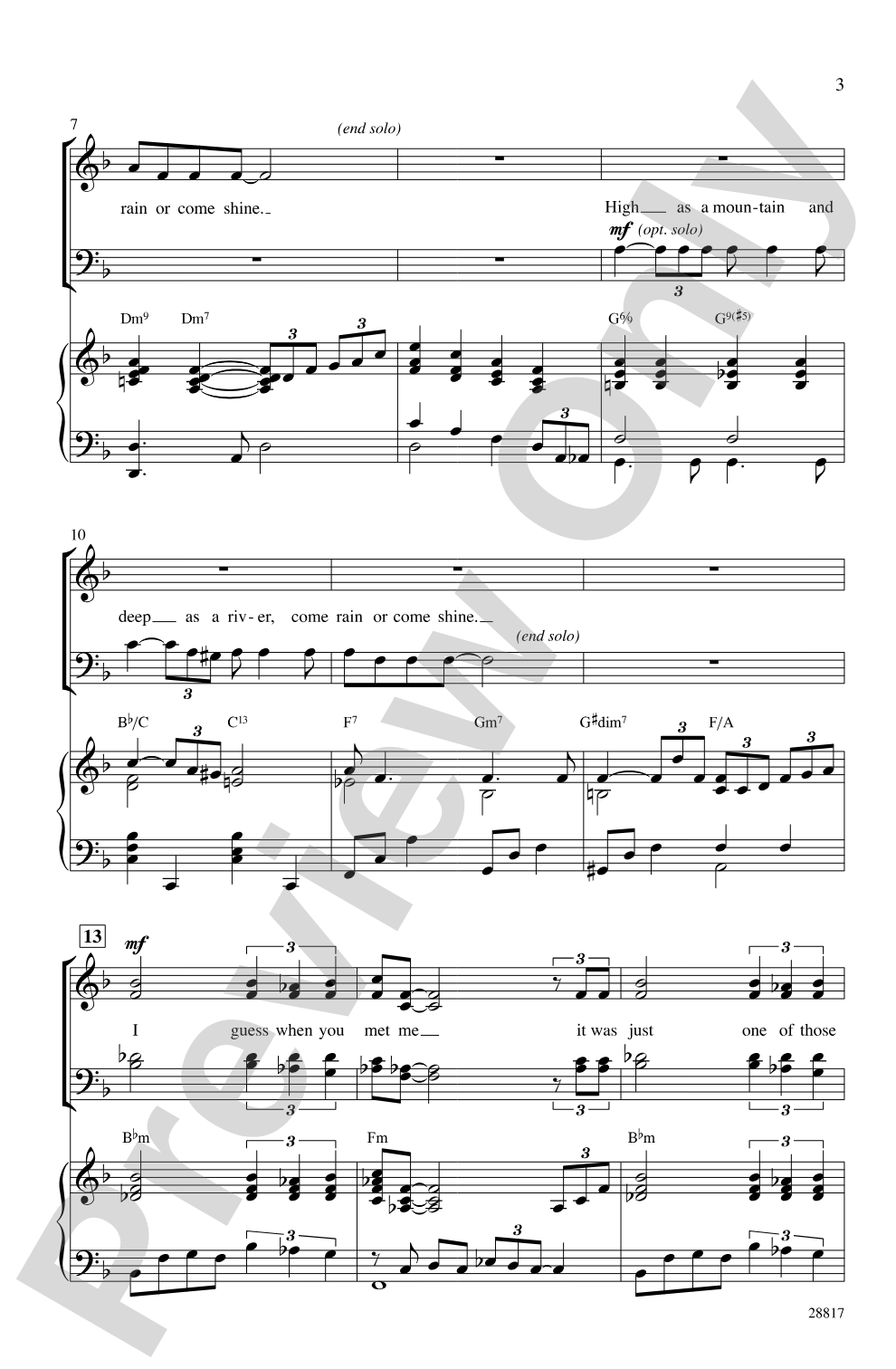

Come Rain or Come Shine: SATB Choral Octavo
Lyrics by Johnny Mercer, music by Harold Arlen / arr. Jay Althouse
Item: 00-PO-0006585
$2.25
Minimum order quantity: 20 copies
One moment…
Related Items
Come Rain or Come Shine: SoundTrax Digital Audio Download |
$27.99
|
View | |
Come Rain or Come Shine: SAB Choral Octavo |
$1.85
|
View | |
Come Rain or Come Shine: SSA Choral Octavo |
$2.25
|
View | |
Come Rain or Come Shine: Choral SoundPax |
$25.00
|
View | |
Come Rain or Come Shine: SATB Choral Octavo |
$2.25
|
View | |
Come Rain or Come Shine: SSA Choral Octavo |
$2.25
|
View | |
Come Rain or Come Shine: Choral Octavo SoundTrax CD |
$27.99
|
View | |
Come Rain or Come Shine: Choral SoundPax |
$25.00
|
View |
Description
This sultry ballad from the Great American Songbook is one of the finest works from the songwriting team of Johnny Mercer and Harold Arlen. The dazzling arrangement has a great piano accompaniment, full choral writing, and a pull-out-the-stops finish. Very appropriate for concert choirs as well as show and jazz groups.


Come Rain or Come Shine: SATB Choral Octavo isn't in MakeMusic Cloud just yet...but it could be. Let us know you'd like to see it, and you'll help shape what comes next. In the meantime, start a free trial and dive into thousands of interactive titles your students can play along with today.
Request This Title
Tell us you want it.
Start Your Free Trial
Explore everything that's ready to play right now.
Sample Audio
1
Audio File
--:--
0:00
0:00
Sample Video
No sample videos found.
Additional Details
Series:
Alfred Archive Edition: Alfred Pop Choral Series
Publisher:
Alfred Music
Page Count:
8
SKU:
00-PO-0006585
More about this title
About the Composer: Harold Arlen
Harold Arlen (1905-1986) composed some of the most memorable melodies in American popular music, with a gift for writing songs that feel both sophisticated and immediately singable. His partnership with lyricist Johnny Mercer produced standards that remain central to the jazz and theater repertoire, including "That's Entertainment," "One for My Baby," and the score to The Wizard of Oz.
Why we love this
Jay Althouse's arrangement captures the sultry warmth of the original without oversimplifying it for student singers. The piano accompaniment is genuinely musical rather than merely functional, and the full choral writing gives every section something substantive to sing while the harmonic language stays grounded enough for developing singers to navigate successfully.
What to expect
The piece unfolds with the unhurried ease of a late-night club performance, intimate and conversational in its opening, then deepening into something more passionate as the arrangement builds. There's sophistication in every harmonic turn, but the melody itself is so natural it never feels overwrought.
Who it's for
Concert choirs wanting to expand beyond art song and light classical repertoire will find this arrangement accessible without being condescending. Show choirs and jazz groups can use it as-is, while traditional choral programs might program it on a pops or spring concert to demonstrate the ensemble's range.
How to get the most out of it
- Let the rhythm section breathe. This ballad relies on the piano's flexibility with tempo and rubato; singers should listen carefully rather than lock into a rigid pulse.
- Shape phrases through vowel consistency in the sustained passages rather than forcing dynamic swells. The arrangement's elegance emerges from clean intonation and supported long tones.
- Balance the soloists (if you assign them) against the full ensemble at the climax. The "pull-out-the-stops finish" works only if the build feels earned rather than simply louder.
- Attend to the jazz harmonies in the inner voices. Second soprano and alto lines carry chromatic movement that defines the song's character; these aren't filler parts.
How to use it
Pair this on a concert with a mix of standards and classical repertoire to show the continuum of vocal writing across American music. It works especially well as a centerpiece for a program exploring the Great American Songbook, or as a memorable closer that leaves audiences in a warm, reflective mood.
Skills your students will build
- Singing jazz harmonies and chromatic voice leading
- Interpreting rubato and flexible phrasing in a ballad context
- Balancing solo and ensemble textures
- Sustaining intonation through extended held notes
- Understanding the stylistic and historical context of mid-20th century popular song