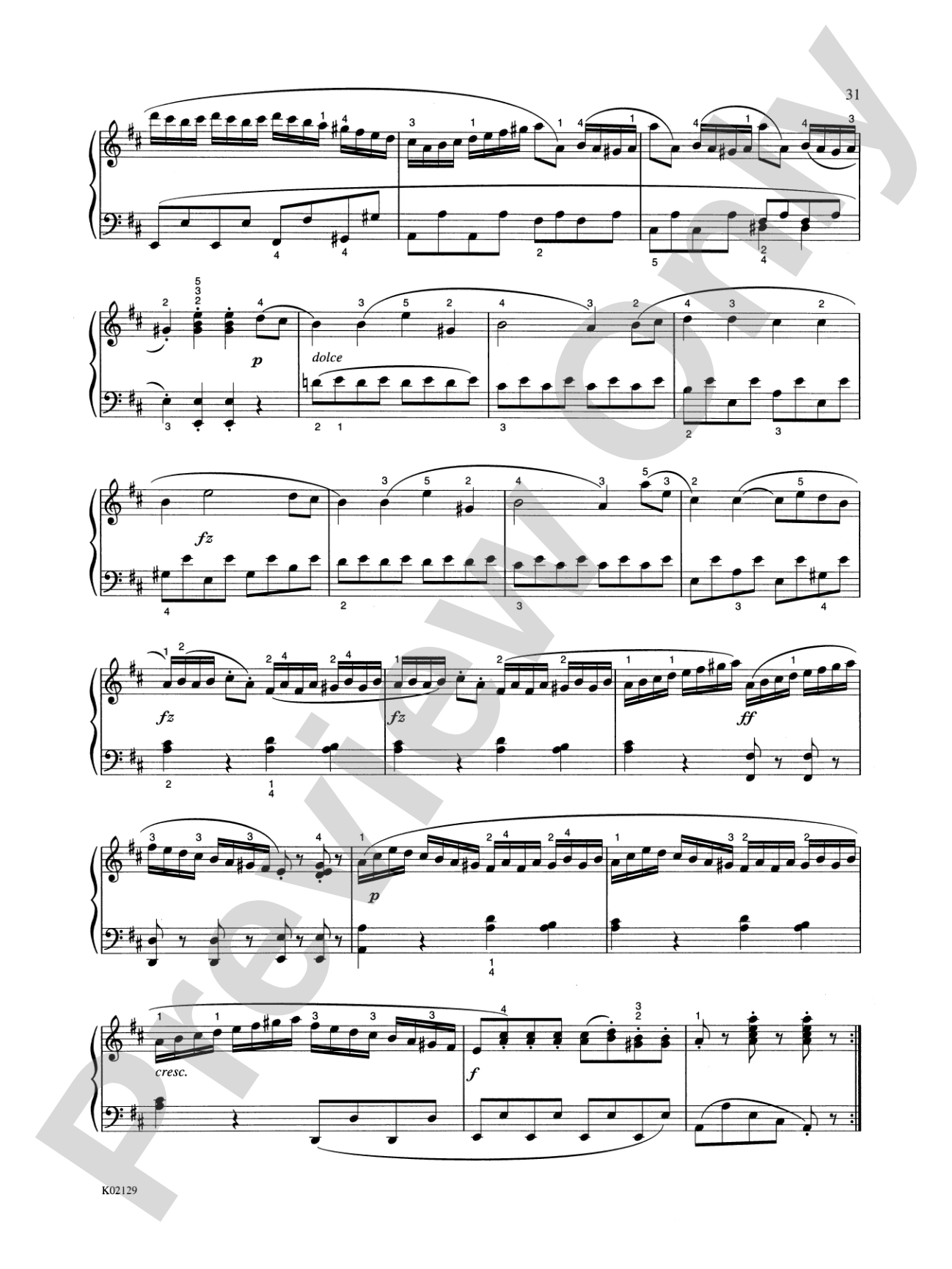
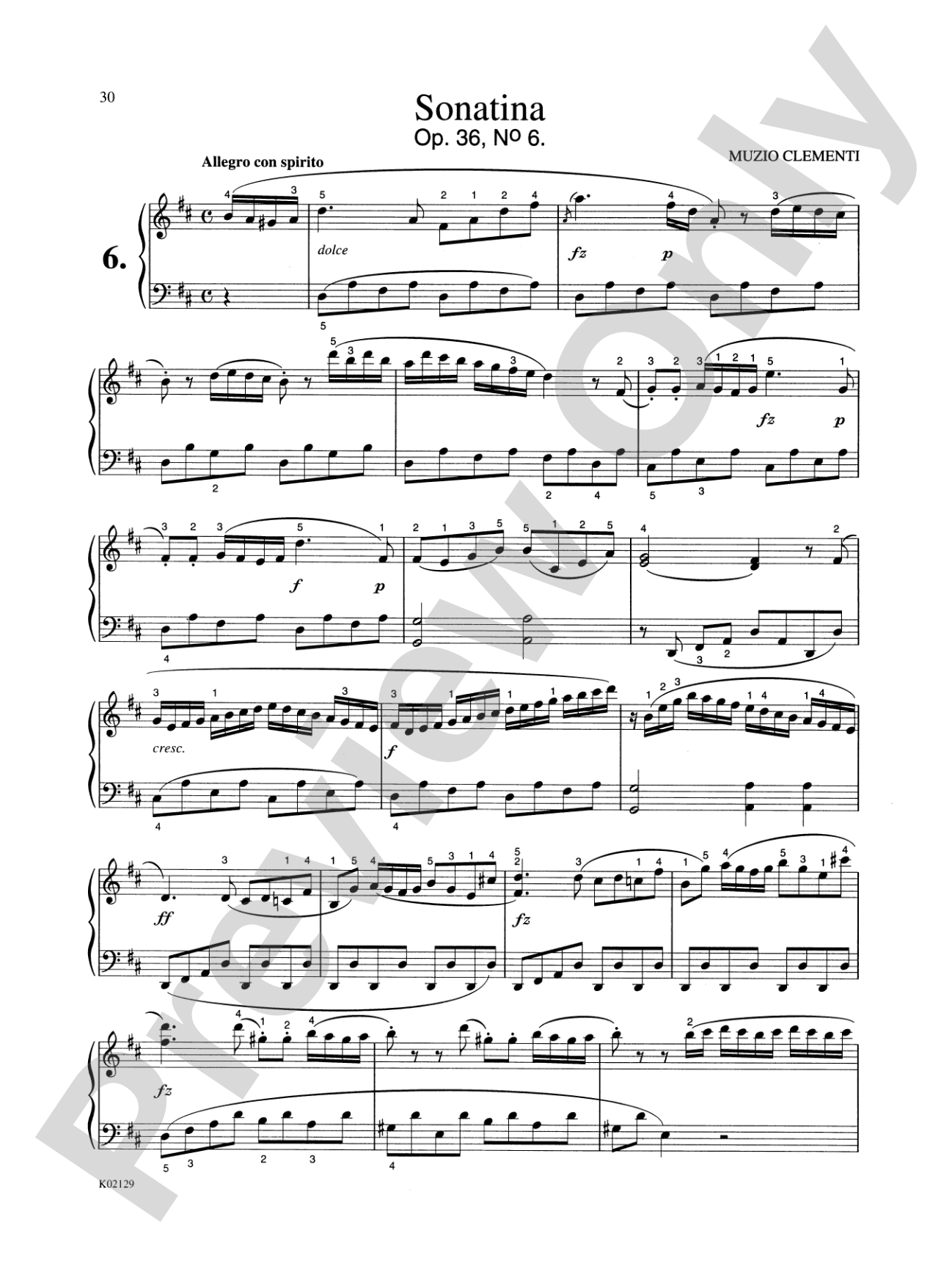
Clementi: Six Sonatinas, Op. 36 Sheet Music Preview

Clementi: Six Sonatinas, Op. 36

By Muzio Clementi

Item: 00-PC-0003747

Digital Download
$0.99
Description
Muzio Clementi (1752--1832) was a famed composer, pianist, pedagogue, conductor, music publisher, editor, and piano manufacturer. Although born in Italy, he spent most of his life in England. In his time, he was known as "the father of the pianoforte," "father of modern piano technique", and "father of Romantic pianistic virtuosity." This collection of his 6 Sonatinas, Opus 36, includes: No. 1 in C major * No. 2 in G major * No. 3 in C major * No. 4 in F major * No. 5 in G major * No. 6 in D major. Newly engraved edition.

Don't just read it, hear it, play along with it, and watch your students grow with it. In MakeMusic Cloud, Clementi: Six Sonatinas, Op. 36 comes alive with professional accompaniment, adjustable tempo, and built-in practice tools that turn solo practice into real progress.

Sample Audio
No sample audio found.
Sample Video
Additional Details
Series: Kalmus Edition
Publisher: Alfred Music
Page Count: 36
SKU: 00-PC-0003747

More about this title

About the Composer: Muzio Clementi

Muzio Clementi (1752-1832) shaped piano music and pedagogy more profoundly than almost any of his contemporaries. An Italian-born virtuoso who made England his home, he bridged the Classical and Romantic eras through his compositions, teaching, and innovations in piano design and technique. His technical demands on the instrument were revolutionary for their time, establishing principles of modern piano playing that remained influential well into the nineteenth century.

Beyond the concert hall, Clementi worked as a music publisher, editor, and manufacturer, giving him unique authority over how music was distributed and performed. His pedagogical approach emphasized musical substance alongside technical development, making his sonatinas enduring teaching tools. Teachers and students still turn to his works because they deliver genuine musical content without sacrificing the systematic skill-building that serious pianists need.

Why we love this

These sonatinas strike an ideal balance between accessibility and artistic substance. They introduce students to Classical form and Romantic expression without the interpretive complexity of later Beethoven, yet they demand enough technical control and musical maturity that intermediate players engage seriously with the material. Each sonatina is genuinely rewarding to perform rather than merely functional.

What to expect

These sonatinas inhabit the threshold between elegance and emotion. The Classical proportions and clear structures feel architecturally satisfying, yet the harmonic language and melodic contours suggest depths of feeling beneath the surface. Playing them feels like learning to speak a language you didn't know you understood.

Who it's for

Intermediate to early advanced pianists ready for the transition from Baroque counterpoint and Mozart to fuller Romantic expression. Teachers working with students who have solid technique and are beginning to explore Classical form with more sophisticated harmonic awareness will find these pieces exactly right for the moment when students can handle genuine musical depth.

How to get the most out of it

  • Balance the melody against supporting voices in slow movements. Clementi's writing often layers lyrical material over accompaniment figures; clarity requires attention to voicing rather than sheer volume.
  • Shape phrases with Romantic sensibility even within Classical forms. The harmonic language hints at expressive possibilities; let rubato and dynamic shaping emerge naturally from the harmonic content.
  • Maintain rhythmic precision in the fast movements while allowing breathing room at phrase endings. The Classical framework requires steady pulse, but mechanical playing flattens the music.
  • Explore the character of each key. Moving from C major through G, F, and D major across the set gives each sonatina distinct sonority; let the tonal color inform your interpretation.

How to use it

Program individual sonatinas as recital staples for intermediate players, or use the full set as a teaching curriculum spanning several months. They also pair naturally with contemporaneous works by Haydn and early Beethoven, allowing you to trace the Classical-to-Romantic transition across a concert program.

Skills your students will build

  • Classical sonata form structure (exposition, development, recapitulation)
  • Voice independence and textural clarity in multi-part writing
  • Harmonic analysis of Classical and proto-Romantic progressions
  • Pedal control in slow movements and accompaniment figures
  • Interpretive choice within formal constraints
  • Technical fluency in Alberti bass patterns and scalar passage work

You May Also Like