
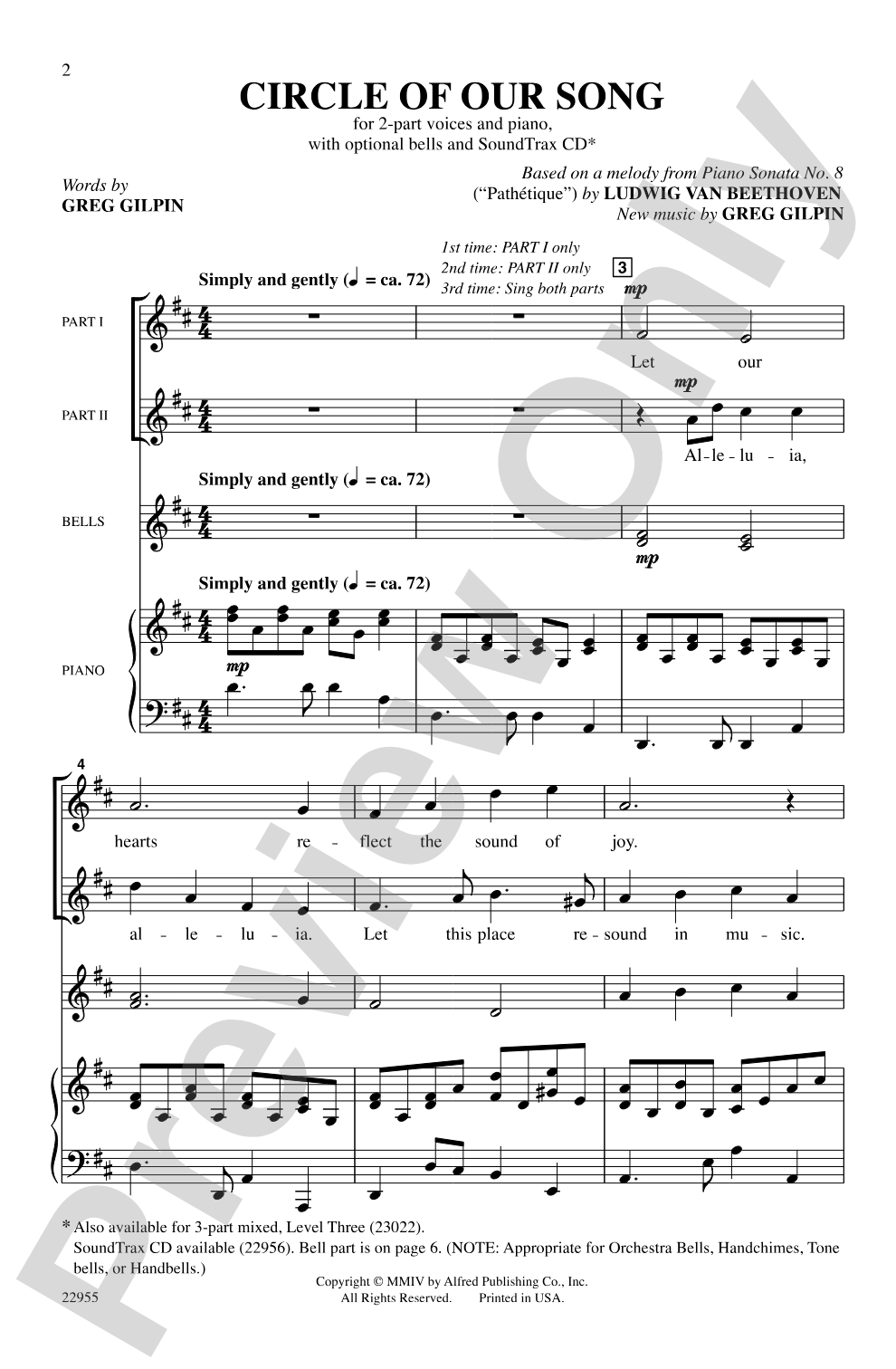

Circle of Our Song: 2-Part Choral Octavo
Music by Greg Gilpin
Item: 00-PO-0007933
$1.65
Minimum order quantity: 20 copies
Pickup currently not available
Description
Directors of developing choirs will delight in this simple partner song by Greg Gilpin, which incorporates the melody from Beethoven's Piano Sonata no. 8, Pathétique. With a text that celebrates the joy of music, and two independent vocal lines that inspire expressive singing in young voices, this piece will take your choir to a new level. An optional bell part is included in the publication, plus a fine SoundTrax CD and a sign language video or DVD are available. Featured on the new staging DVD/Video "On the Stage!" (DVD #23037, Video #23129).


Circle of Our Song: 2-Part Choral Octavo isn't in MakeMusic Cloud just yet...but it could be. Let us know you'd like to see it, and you'll help shape what comes next. In the meantime, start a free trial and dive into thousands of interactive titles your students can play along with today.
Request This Title
Tell us you want it.
Start Your Free Trial
Explore everything that's ready to play right now.
Sample Audio
1
Audio File
--:--
0:00
0:00
Sample Video
No sample videos found.
Additional Details
Series:
Alfred Choral Designs
Publisher:
Alfred Music
Page Count:
8
SKU:
00-PO-0007933
More about this title
About the Composer: Greg Gilpin

Greg Gilpin brings both compositional depth and extensive conducting experience to every piece he writes. An ASCAP award-winning composer and arranger, he has led performances at major venues including Carnegie Hall, Lincoln Center, Ryman Auditorium, Sydney Opera House, Royal Festival Hall, and Harpa Concert Hall. As Director of Educational Choral Publications for Shawnee Press, Gilpin shapes choral music for students across the country, combining his knowledge of what works in rehearsal with his skill at the compositional level.
Beyond choral music, Gilpin's creative reach extends to film scoring (earning Best Score for the short film "Rosie's Rescue" in 2021) and concert arrangements, including a world premiere collaboration with opera singer Angela Brown. A Life Loyal Member of Phi Mu Alpha Sinfonia and active member of ACDA and NAfME, he remains deeply invested in the choral education community.
Why we love this
Gilpin's gift for simplicity without condescension shows here. He takes Beethoven's Pathétique melody and wraps it in text about the joy of singing itself, which gives your singers something genuine to connect to rather than a clever arrangement for its own sake. The partner song structure keeps both lines singable and expressive, yet genuinely independent, so your developing choirs get real two-part writing without getting tangled up in complicated voicing.
What to expect
Beethoven's Pathétique melody carries a quiet dignity here, softened by text that shifts the emotional weight from the sonata's original introspection to celebration. The two vocal lines move around each other with warmth and independence, creating space for expressive singing that feels earned rather than imposed.
Who it's for
Developing choirs ready for genuine two-part writing will find this piece welcoming. It suits middle school choirs, treble choirs in transition, or community choirs building confidence in ensemble singing. The optional bell part and recorded accompaniment mean you can adjust the support level to match your ensemble's needs.
How to get the most out of it
- Balance the Beethoven melody against the second part so neither line dominates. The famous tune will naturally want to grab focus; encourage singers on both parts to listen to each other and find dynamic parity.
- Bring out the text early in rehearsal. The lyrics celebrate music itself, which can fuel genuine expression in young singers if they understand what they're singing about.
- If you include the optional bell part, use it as an anchor for tuning. Bells hold the harmonic space cleanly and can help singers stay centered, especially in ensemble transitions.
- Consider the sign language video as a staging tool even if you're not performing with a full Deaf audience. It adds visual shape to the piece and engages singers who respond to kinesthetic learning.
How to use it
This works beautifully as a graduation or spring concert anchor when you want something substantial but not overwhelming. Pair it alongside lighter secular pieces to show range in your program, or use it as the emotional centerpiece of a concert that emphasizes student growth across the year.
Skills your students will build
- Singing independent melodic lines while maintaining harmonic awareness
- Expressive phrasing in two-part texture
- Familiarity with a Beethoven masterwork through direct musical experience
- Reading music with optional supplementary parts (bells)
- Ensemble blend when melodic material is unevenly distributed