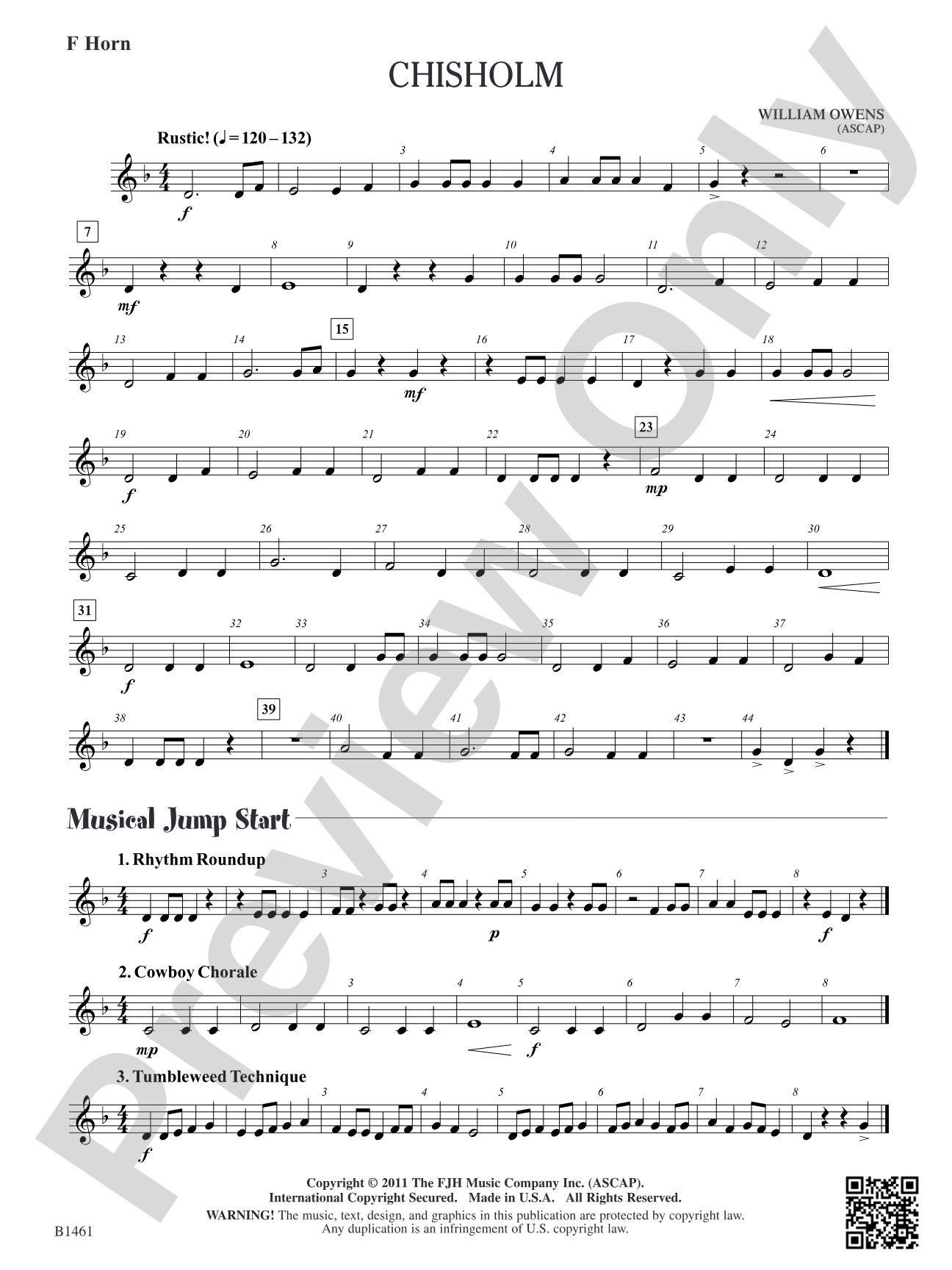
Chisholm: F Horn Sheet Music Preview

Chisholm: F Horn

By William Owens

Level:.5

Item: 98-PC-DB1461_H1

Digital Download
$7.00
Description
Return to the late 19th century with this invigorating work that conjures images of cattlemen rounding up herds and driving them north. Injected with the sound of cattlemen’s whips throughout, melody is shifted around the ensemble as the herd makes its way to its final destination.

Don't just read it, hear it, play along with it, and watch your students grow with it. In MakeMusic Cloud, Chisholm: F Horn comes alive with professional accompaniment, adjustable tempo, and built-in practice tools that turn solo practice into real progress.

Sample Audio
0:00
0:00
Sample Video
Additional Details
Series: FJH Starter Series
Publisher: The FJH Music Company, Inc.
SKU: 98-PC-DB1461_H1

More about this title

About the Composer: William Owens

William Owens

William Owens brings three decades of classroom experience to his compositional work. A 1985 graduate of VanderCook College of Music, he spent 30 years as a band director in Texas before retiring in 2014, giving him deep insight into what young musicians need to play and what conductors need to teach.

Owens has emerged as one of the most prolific composers for developing ensembles, with over 300 published titles across concert band, string orchestra, and chamber settings. His work appears on state and national required music lists, and his compositional approach balances musical substance with pedagogical practicality. He holds membership in ASCAP, TMEA, and Phi Beta Mu International Bandmasters Fraternity, and has received commissions from South Plains College, the American Bandmasters Association, and other major organizations. He resides in Fort Worth, Texas.

Why we love this

Owens writes for emerging bands with remarkable clarity of intent. Chisholm delivers vivid programmatic storytelling through transparent orchestration and strategic melodic placement, giving every section time in the spotlight while maintaining genuine musical direction. The whip effects and cattle-drive imagery engage young players' imaginations without sacrificing compositional integrity, making this a piece that sounds as good as it feels to conduct.

What to expect

Chisholm evokes the determined energy of a cattle drive across open country. Sharp whip cracks punctuate the journey as melodies weave through the ensemble, creating a sense of movement and purpose with an unmistakable Americana character that feels both authentic and animated.

Who it's for

Beginning to early intermediate concert bands looking for engaging programmatic music that rewards clear ensemble playing. The work suits student musicians developing fundamental ensemble balance and sectional independence, as well as directors seeking pieces that spark musical interest while remaining technically accessible.

How to get the most out of it

  • Shape the whip cracks as punctuation between phrases rather than mere sound effects; they reinforce the narrative momentum of the piece.
  • Balance melodic prominence across the ensemble by bringing out each voice as it assumes the lead, ensuring no section dominates when others carry the primary line.
  • Work for consistent forward motion through transitions; the journey northward needs momentum, so avoid letting tempo sag between sections.
  • Establish a secure rhythmic foundation in the lower voices early in rehearsals so upper voices can confidently follow the melodic flow.

How to use it

Perfect for a spring concert highlighting American compositional voices or as a festival selection that showcases early-level musicianship with strong character. The programmatic nature makes it an ideal opener for a concert or contest set where you want to establish energy and audience engagement from the first measure.

Skills your students will build

  • Tracking melodic movement across instrumental sections and responding to cues
  • Maintaining ensemble balance when melody transfers between voices
  • Rhythmic precision and forward motion through sectional transitions
  • Responding to programmatic concepts through musical phrasing and shaping

You May Also Like