
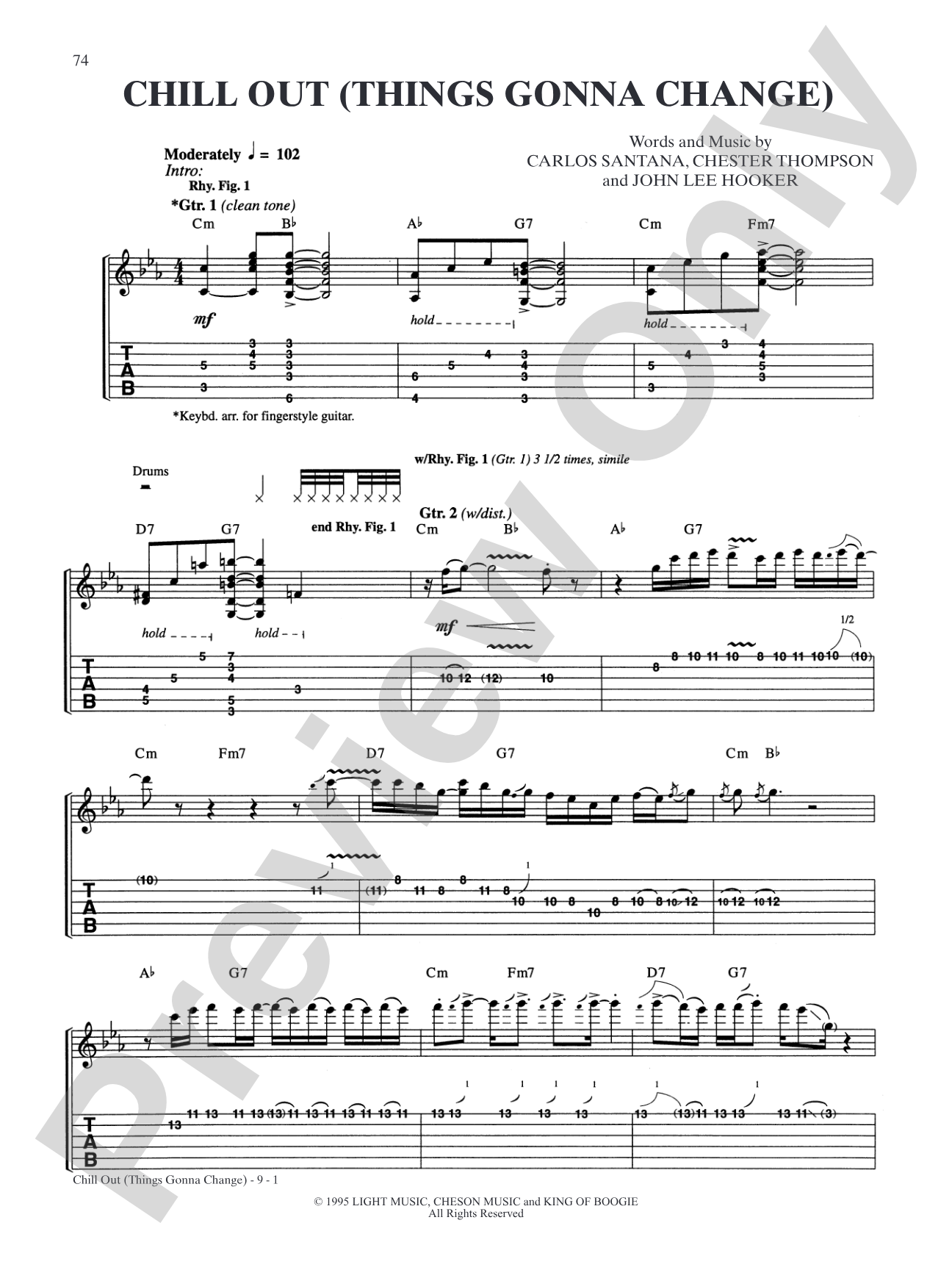
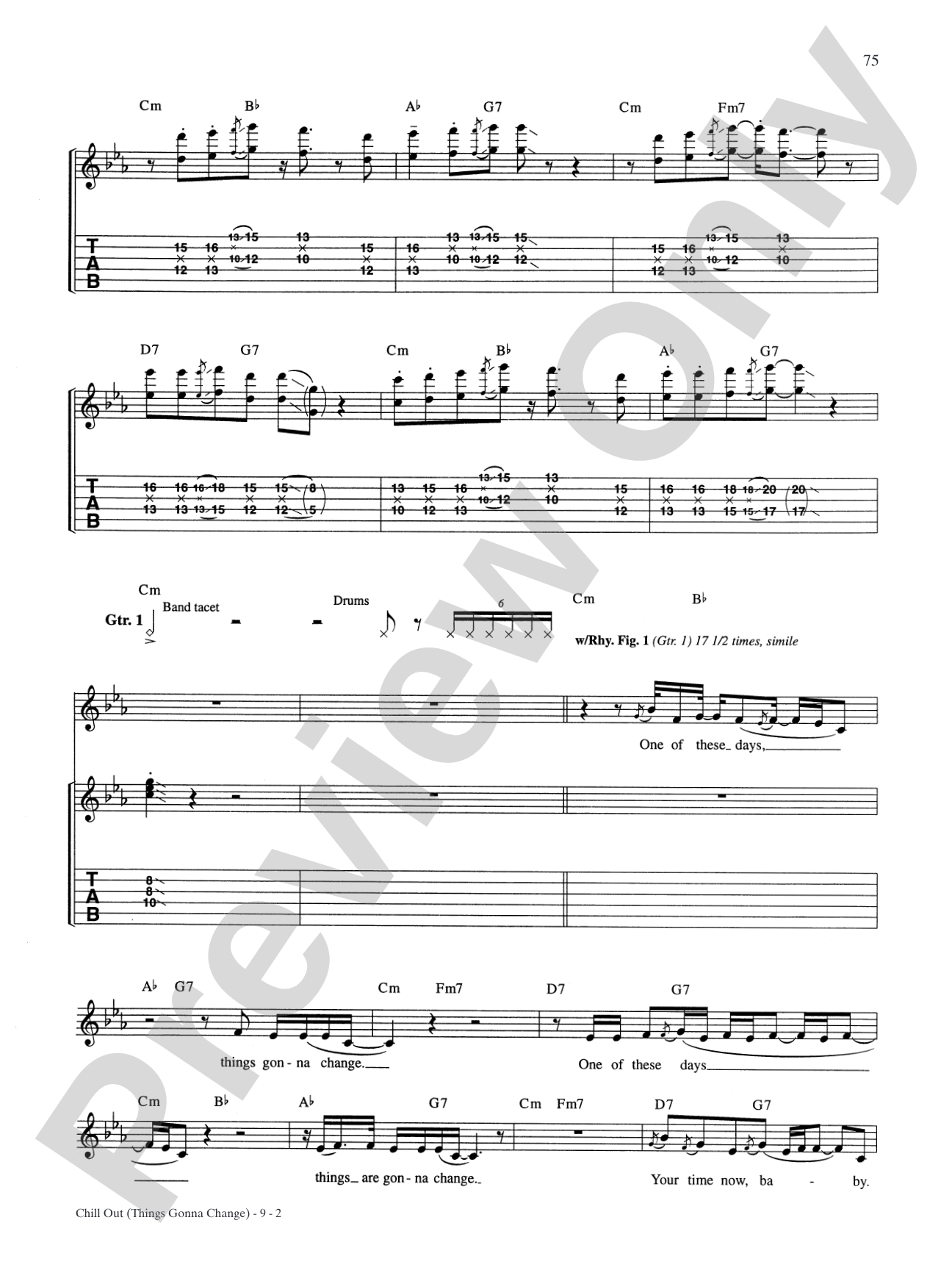

Chill Out (Things Gonna Change): Authentic Guitar TAB
Carlos Santana
Item: 00-PSG-000710
$5.99
One moment…
Related Items
Adouma: Authentic Guitar TAB |
$9.99
|
View | |
Aye, Aye, Aye: Authentic Guitar TAB |
$9.99
|
View | |
Hermes: Authentic Guitar TAB |
$9.99
|
View | |
I'm Feeling You: Authentic Guitar TAB |
$9.99
|
View | |
Novus: Authentic Guitar TAB |
$5.99
|
View | |
Put Your Lights On: Authentic Guitar TAB |
$9.99
|
View | |
Wishing It Was: Authentic Guitar TAB |
$9.99
|
View |
Description
This collector's edition covers great songs from the 3rd and 4th decades of Carlos Santana's amazing four-decade career (the '90s through 2006), covering the albums Milagro, Supernatural, Shaman, and All That I Am. All songs are faithfully transcribed in note-for-note guitar TAB. Titles: Adouma * Africa Bamba * Aye Aye Aye * Brown Skin Girl * The Calling * Chill Out * Con Santana * Corazón Espinado * El Farol * Foo Foo * El Fuego * The Game of Love * Hermes * I Don't Wanna Lose Your Love * I'm Feeling You * Just Feel Better * Life Is for Living * Love of My Life * Make Somebody Happy * Maria Maria * Migra * Novus * Put Your Lights On * Saja/Right On * Smooth * Somewhere in Heaven * Twisted * Victory Is Won * Wings of Grace * Wishing It Was * (Da Le) Yaleo * Your Touch.


Chill Out (Things Gonna Change): Authentic Guitar TAB isn't in MakeMusic Cloud just yet...but it could be. Let us know you'd like to see it, and you'll help shape what comes next. In the meantime, start a free trial and dive into thousands of interactive titles your students can play along with today.
Request This Title
Tell us you want it.
Start Your Free Trial
Explore everything that's ready to play right now.
Sample Audio
No sample audio found.
Sample Video
No sample videos found.
Additional Details
Publisher:
Alfred Music
Page Count:
360
SKU:
00-PSG-000710
More about this title
About the Artist: Santana
Santana emerged in the late 1960s as a transformative force in rock music, fusing Latin percussion, blues guitar, and world music influences into a sound that transcended genre boundaries. Over four decades, the band has sold tens of millions of albums worldwide, earned multiple Grammy Awards, and fundamentally shaped how rock and Latin music intersect in contemporary composition.
Why we love this
This collection captures Santana at a creative peak, when the band balanced commercial momentum with genuine musical ambition. The transcriptions offer guitarists access to some of the most recognizable riffs and solos of the 1990s and 2000s, grounded in genuine Latin percussion arrangements and intricate layering that reveal why these songs endured beyond their chart success.
What to expect
These arrangements pulse with infectious grooves that blend blues-rock energy with the warmth of Latin percussion and world music textures. You'll find yourself moving between driving Latin-influenced rhythms, soulful melody lines, and moments of transcendent musicality that feel both accessible and genuinely sophisticated.
Who it's for
Intermediate to advanced guitarists drawn to Latin rock and fusion styles will find detailed transcriptions of material they love and want to understand. Players building repertoire for recitals, open mics, or ensemble settings will gain both recognizable material and deeper insight into how Santana constructs grooves across multiple albums.
How to get the most out of it
- Pay close attention to the clave rhythm underlying each piece; Santana's grooves sit atop specific Latin percussion patterns that shape the harmonic feel, so internalizing the clave (not just the guitar part) will anchor your phrasing.
- Use the TAB alongside standard notation to verify your hand position and fret choices, especially in passages where multiple fingering options exist; this develops your ability to recognize efficient paths across the fretboard.
- Lock into the percussive elements in your head before adding the melodic or lead lines; Santana's style depends on rhythmic precision that locks with congas and timbales, not just chord accuracy.
- Study the dynamics and articulation marked in the transcriptions; many of Santana's signature sounds come from muted strums, ghost notes, and hammer-ons rather than simple clean picking.
How to use it
Include selections from this collection in a recital focused on contemporary groove-based music or as part of a Latin music showcase. Guitarists can use individual pieces as performance vehicles that demonstrate both technical facility and an understanding of cross-cultural musical vocabulary.
Skills your students will build
- Reading and executing authentic guitar TAB across varied styles and tunings
- Internalizing clave-based rhythmic patterns underlying Latin rock grooves
- Identifying and performing signature Santana techniques: muted strums, hammer-ons, and percussive articulation
- Adapting fingering approaches to accommodate different musical contexts and hand positions
- Understanding how melody, rhythm, and harmonic texture layer in fusion and world music contexts