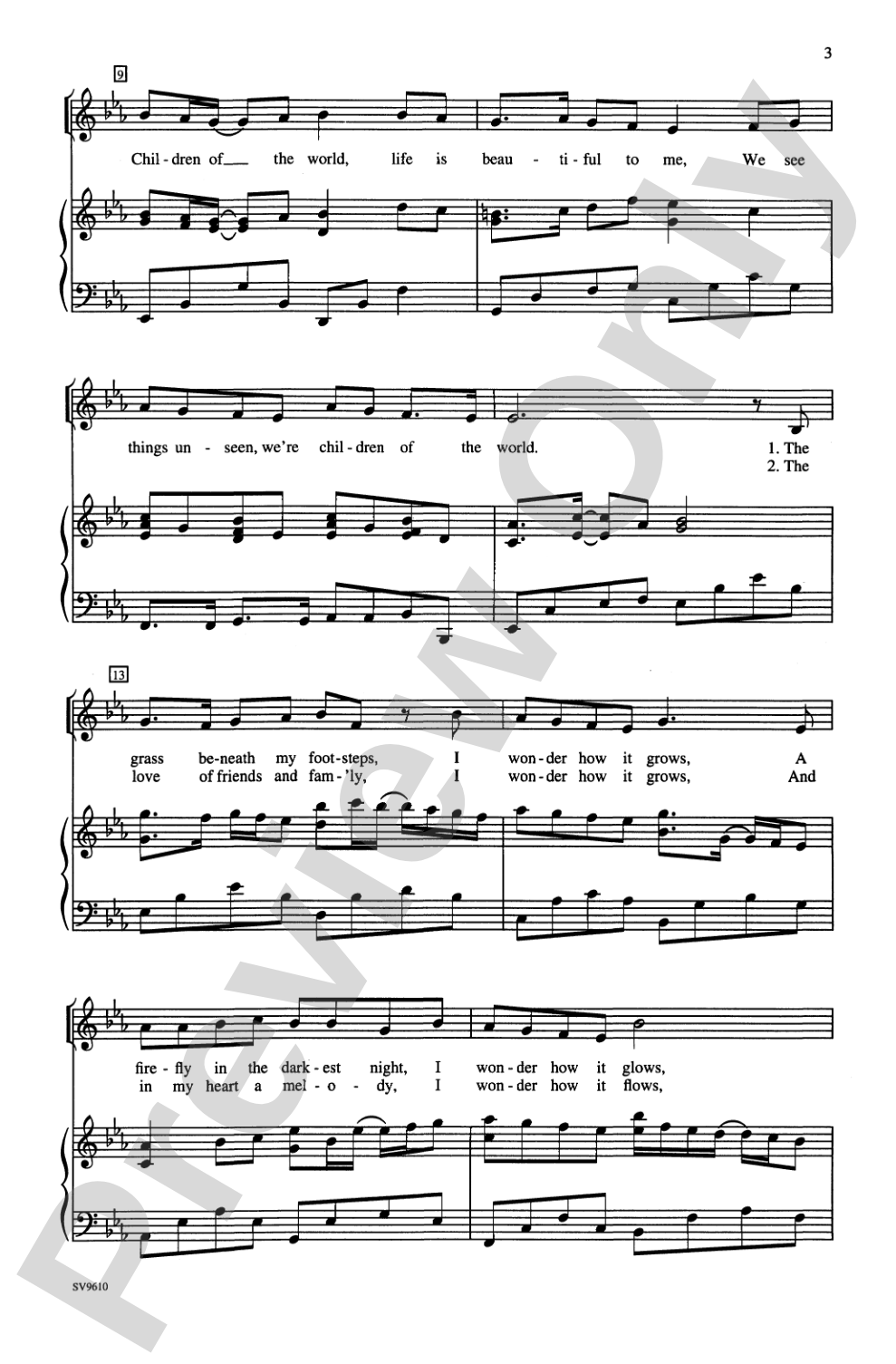
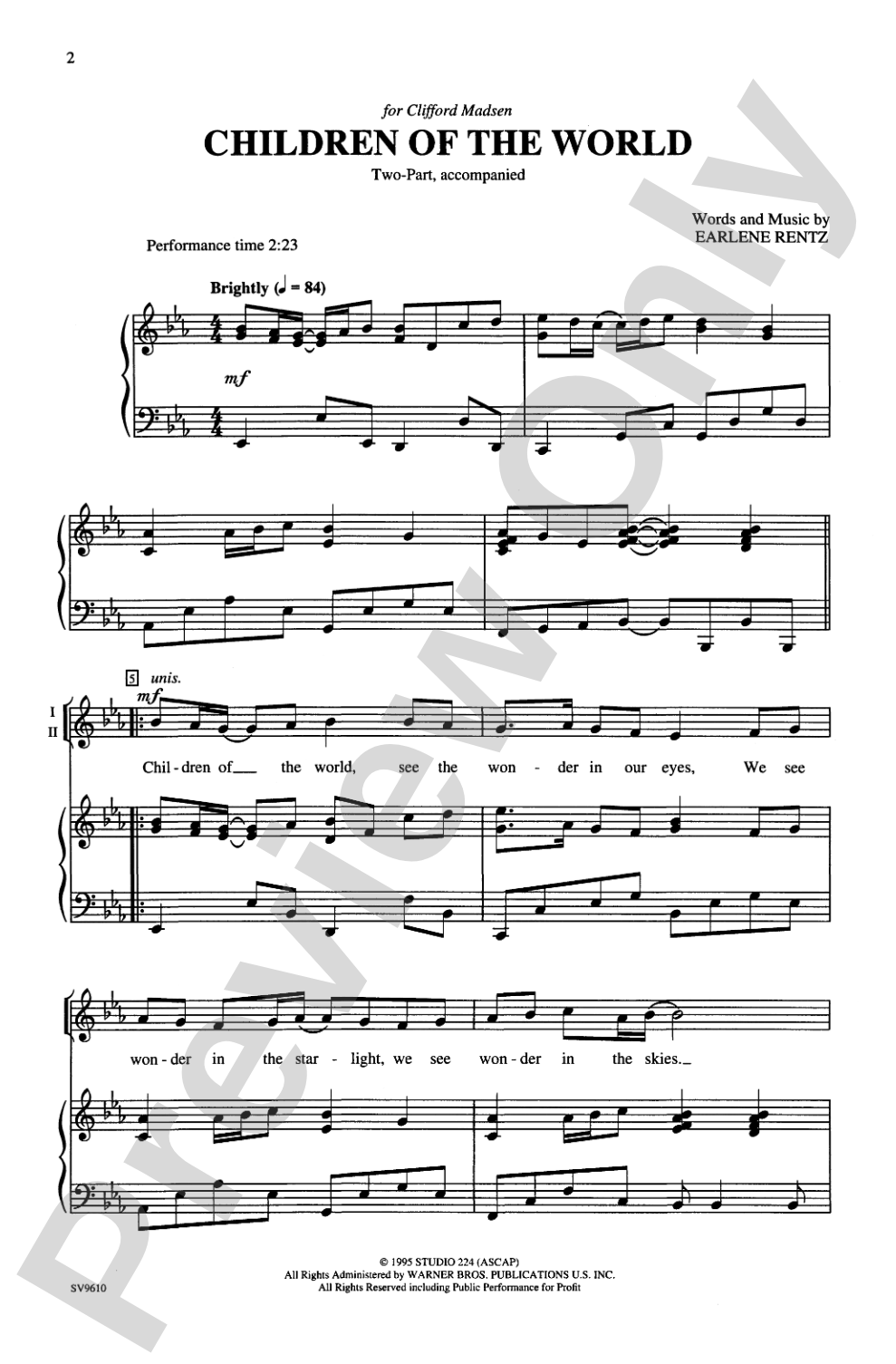
Children of the World Sheet Music Preview

Children of the World: 2-Part Choral Octavo

By Earlene Rentz

Level: Moderate

Item: 00-PO-0002753

Digital Download
$2.25

Minimum order quantity: 20 copies

Description
From its opening line, 'Children of the world, see the wonder in our eyes,' to its closing moments, this delightful selection provides a great message of hope and wonder for all. It is written mostly in unison with a counter-melody introduced as a partner song. Your students will love this one!

Children of the World: 2-Part Choral Octavo isn't in MakeMusic Cloud just yet...but it could be. Let us know you'd like to see it, and you'll help shape what comes next. In the meantime, start a free trial and dive into thousands of interactive titles your students can play along with today.

Sample Audio
No sample audio found.
Sample Video
Additional Details
Series: Alfred Archive Edition: Studio PR Catalog
Publisher: Alfred Music
Page Count: 8
SKU: 00-PO-0002753

More about this title

About the Composer: Earlene Rentz

Earlene Rentz

Earlene Rentz has spent decades in the trenches of choral music education, from elementary classrooms through university seminars. Her seven years directing choral programs across multiple grade levels and her twelve years teaching choral pedagogy at the collegiate level gave her direct insight into what students need to sing and what teachers need to teach.

Rentz's prolific catalog exceeds 700 published choral works distributed across 17 publishers, and her conducting experience spans All-State Choirs in Georgia, Florida, Kentucky, and Alabama. Her compositions reflect a deep understanding of both student capability and the joy that comes from singing meaningful music together.

Why we love this

Rentz built this piece on the pedagogical sweet spot: mostly unison writing that keeps the ensemble unified and confident, with a partner song structure that introduces harmonic thinking without overwhelming developing singers. The text carries genuine emotional weight without being heavy, and your students will actually want to sing it rather than endure it.

What to expect

From the first phrase, this piece radiates warmth and optimism. The mostly unison texture creates a sense of collective unity, while the partner song element adds textural interest that keeps the ear engaged without demanding technical virtuosity. It feels like hope sung from the heart.

Who it's for

This octavo works beautifully with upper elementary through middle school choirs who are ready to explore simple partner song writing without the complexity of full SATB scoring. It suits both concert settings and assembly performances where you want to deliver an uplifting, singable moment.

How to get the most out of it

  • Shape the opening phrase 'Children of the world, see the wonder in our eyes' with a natural arc that mirrors the uplifting sentiment. Avoid pressing the tempo; let the wonder breathe.
  • When the counter-melody enters as a partner song, balance the two lines carefully in rehearsal. Isolate each part separately first, then blend them by having half the choir sustain the unison line while the other half sings the counter-melody.
  • Use the unison foundation as your anchor for intonation. When singers feel secure in their primary line, the harmonies will find pitch more easily.
  • Bring out the message through clear text delivery. Words like 'wonder' and 'hope' deserve intentional articulation so the audience hears what you're celebrating.

How to use it

Program this during a spring or year-end concert where celebration and forward-looking sentiment fit the occasion. It pairs well with more energetic selections and serves as an effective emotional anchor point that reminds audiences why choral music matters. The accessible difficulty makes it a smart choice for combined-grade performances or community choir collaborations.

Skills your students will build

  • Singing unison with secure intonation and blend
  • Reading and performing a counter-melody against a unison line
  • Partner song awareness and independence
  • Text expression and message delivery in secular repertoire

You May Also Like