
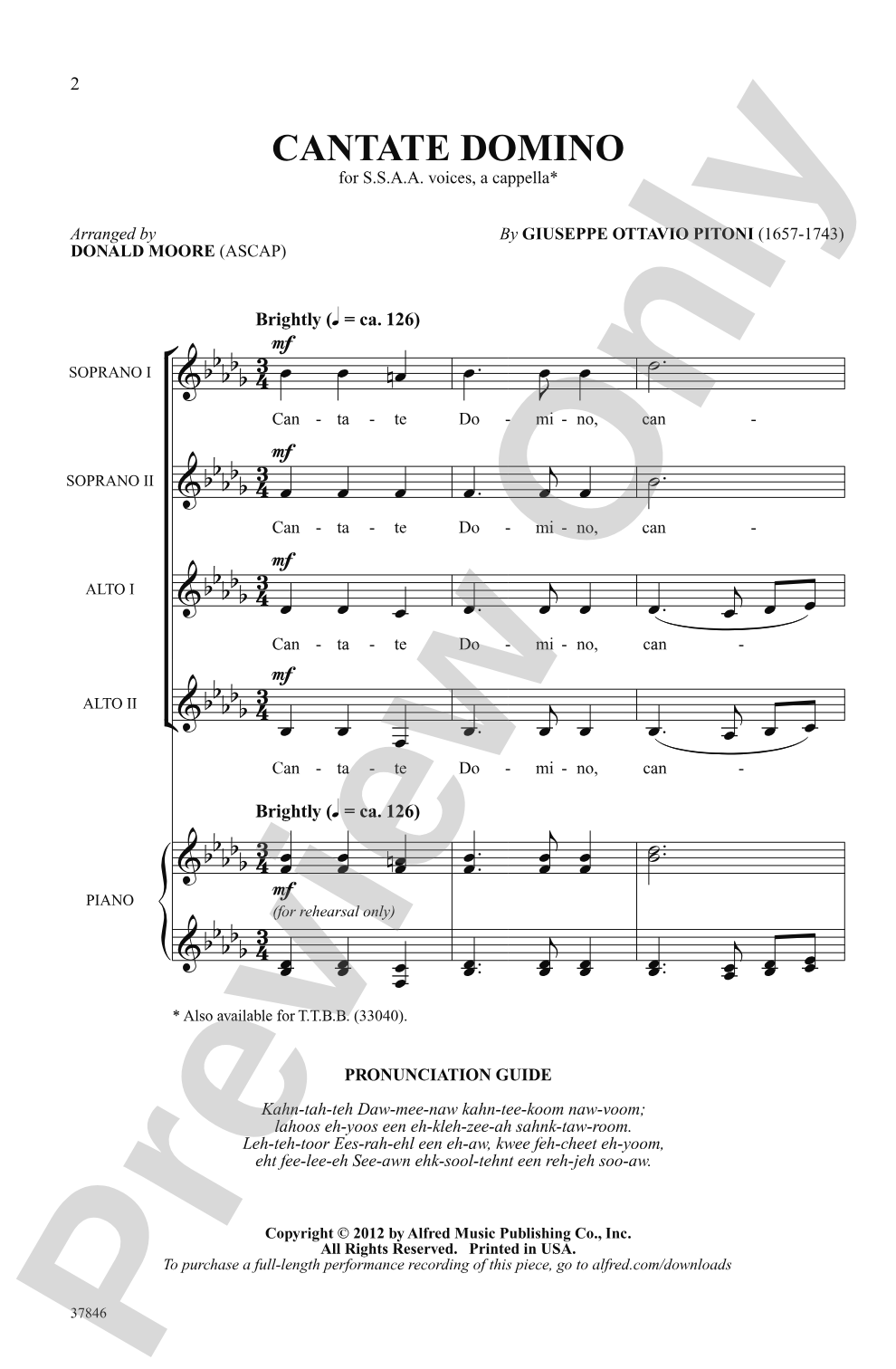
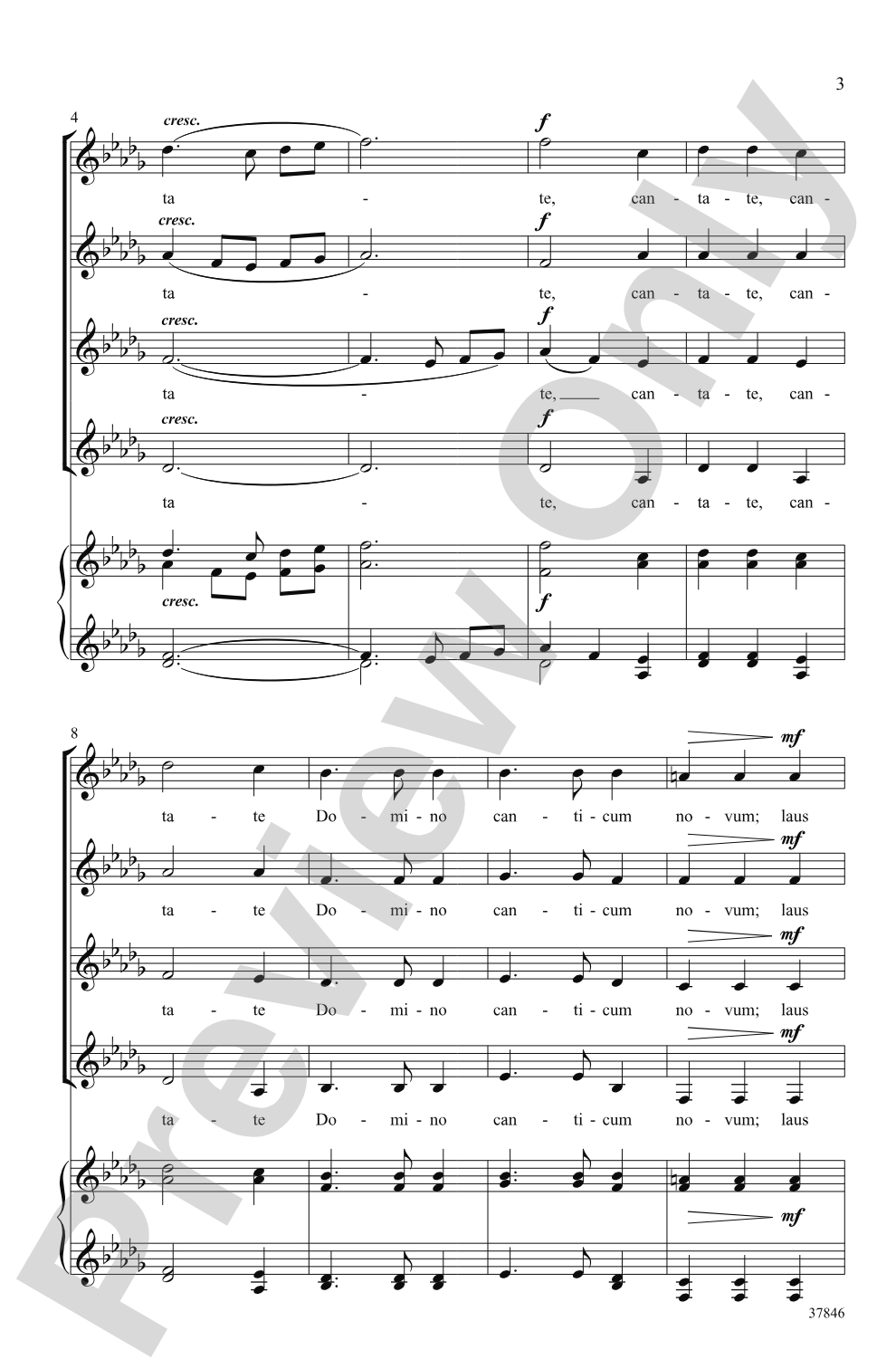

Cantate Domino: SSAA, a cappella Choral Octavo
By Giuseppe Ottavio Pitoni / arr. Donald Moore
Item: 00-PO-0001217
$1.80
Minimum order quantity: 20 copies
Pickup currently not available
Description
Now available for a cappella SSAA choirs, Pitoni's Baroque motet is one of the great masterpieces of the choral repertoire. Top-notch concert and contest literature.


Cantate Domino: SSAA, a cappella Choral Octavo isn't in MakeMusic Cloud just yet...but it could be. Let us know you'd like to see it, and you'll help shape what comes next. In the meantime, start a free trial and dive into thousands of interactive titles your students can play along with today.
Request This Title
Tell us you want it.
Start Your Free Trial
Explore everything that's ready to play right now.
Sample Audio
1
Audio File
--:--
0:00
0:00
Sample Video
No sample videos found.
Additional Details
Series:
Alfred Choral Designs
Publisher:
Alfred Music
Page Count:
8
SKU:
00-PO-0001217
More about this title
About the Composer: Giuseppe Ottavio Pitoni
Giuseppe Ottavio Pitoni (1561-1643) was a Roman maestro di cappella whose mastery of polyphonic writing defined the late Renaissance and early Baroque sacred tradition. His motets, including Cantate Domino, showcase the crystalline counterpoint and harmonic sophistication that made him one of the most respected composers of his generation at the Papal Chapel.
Pitoni's influence extended well beyond his lifetime through his students and the enduring quality of his sacred works. His ability to balance textural clarity with emotional depth made his compositions ideally suited to both liturgical and concert settings, a distinction that remains relevant to choral directors today.
Why we love this
This arrangement gives upper-voice choirs access to one of the most substantial works in the choral canon without requiring a full SATB lineup. Moore's adaptation preserves the architectural integrity of Pitoni's counterpoint while creating the right weight and blend for SSAA voices, making it genuinely performable at the highest competitive and concert levels.
What to expect
Cantate Domino exudes the spacious elegance of the Baroque chapel, with voices interweaving in a luminous texture that feels both intimate and grand. The piece radiates quiet confidence, its transparent counterpoint creating moments of surprising harmonic beauty without ever breaking into virtuosity or drama.
Who it's for
SSAA choirs with solid reading skills and experience balancing multiple independent melodic lines. This works equally well for high school select choirs, college women's ensembles, and community choirs with strong singers who relish Baroque counterpoint.
How to get the most out of it
- Shape each phrase through the natural arc of the text rather than mechanical phrasing; let the Latin accentuation guide your breath points and tonal direction.
- Balance the four parts as equal voices in dialogue. Avoid letting the highest soprano dominate; Pitoni's polyphonic writing demands that each line have its moment of melodic importance.
- Attend closely to the harmonic rhythm underneath the counterpoint. Small ritardandi at cadential points will clarify the harmonic structure without disrupting the forward motion of the piece.
- Use tuning strategically at moments where parts move in parallel motion or converge; a cappella SSAA sonority depends on clean unison and interval accuracy in these passages.
How to use it
This pairs naturally with other Renaissance and Baroque sacred works on a liturgical or concert program, where it can anchor a thematic set on sacred texts. Alternatively, program it as a showpiece for your upper-voice ensemble on a mixed repertoire concert; audiences consistently respond to the craftsmanship and purity of sound it allows.
Skills your students will build
- Singing independent polyphonic lines while maintaining awareness of harmonic function
- Balancing four-part SSAA texture with equal voice weight
- Reading and performing Baroque sacred repertoire with stylistic authenticity
- Achieving intonation accuracy in a cappella singing across multiple part-crossing moments
- Shaping musical phrases according to Latin text prosody and cadential structure