
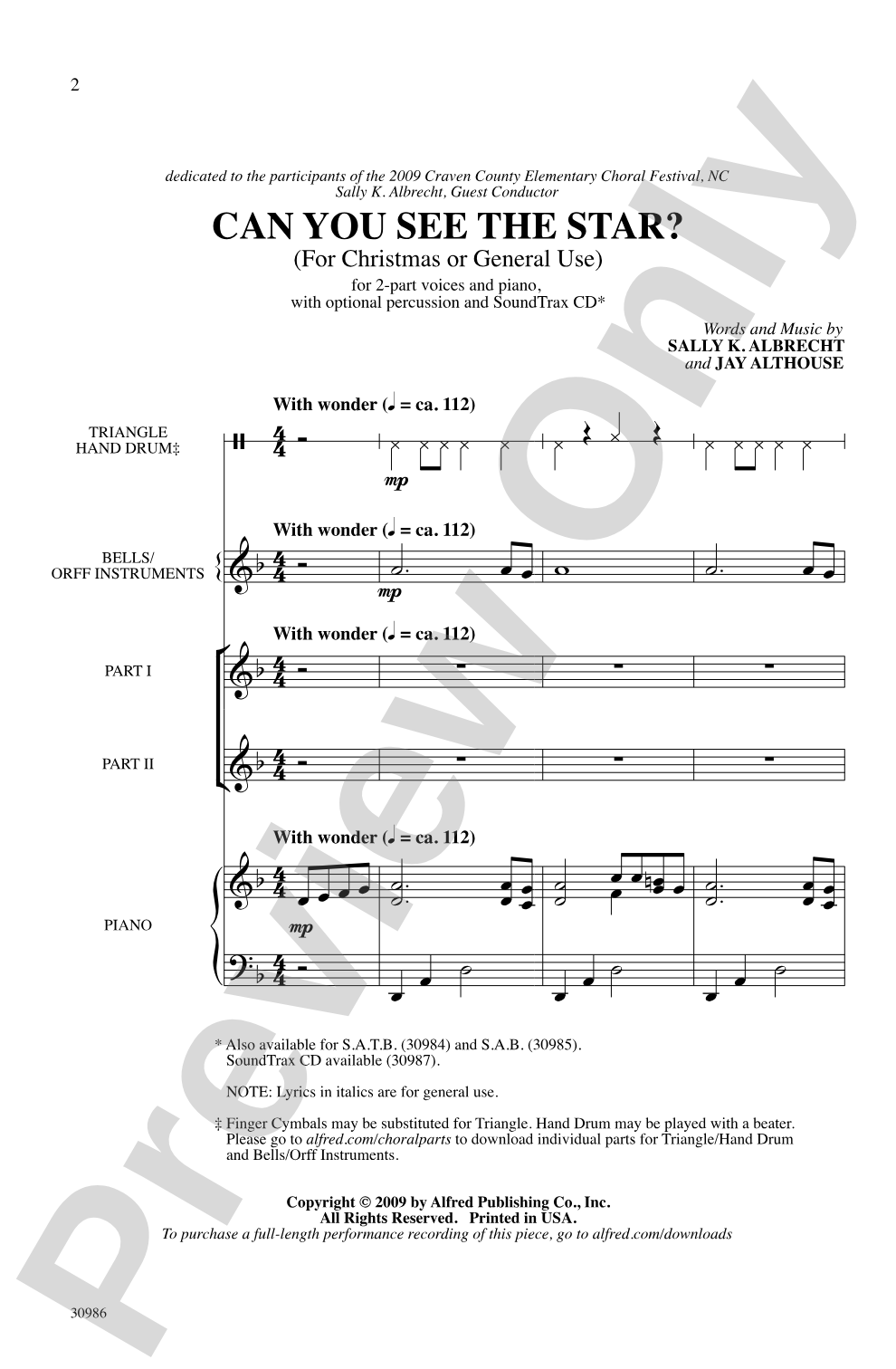

Can You See the Star?: 2-Part Choral Octavo
Words and music by Sally K. Albrecht and Jay Althouse
Item: 00-PO-0000734
$1.75
Minimum order quantity: 20 copies
Pickup currently not available
Related Items
Can You See the Star?: SoundTrax Digital Audio Download |
$24.95
|
View | |
Can You See the Star?: SATB Choral Octavo |
$1.75
|
View | |
Can You See the Star?: SAB Choral Octavo |
$1.75
|
View | |
Can You See the Star?: SATB Choral Octavo |
$1.75
|
View | |
Can You See the Star?: SAB Choral Octavo |
$1.75
|
View | |
Can You See the Star?: 2-Part Choral Octavo |
$1.75
|
View | |
Can You See the Star?: Choral Octavo SoundTrax CD |
$27.99
|
View |
Description
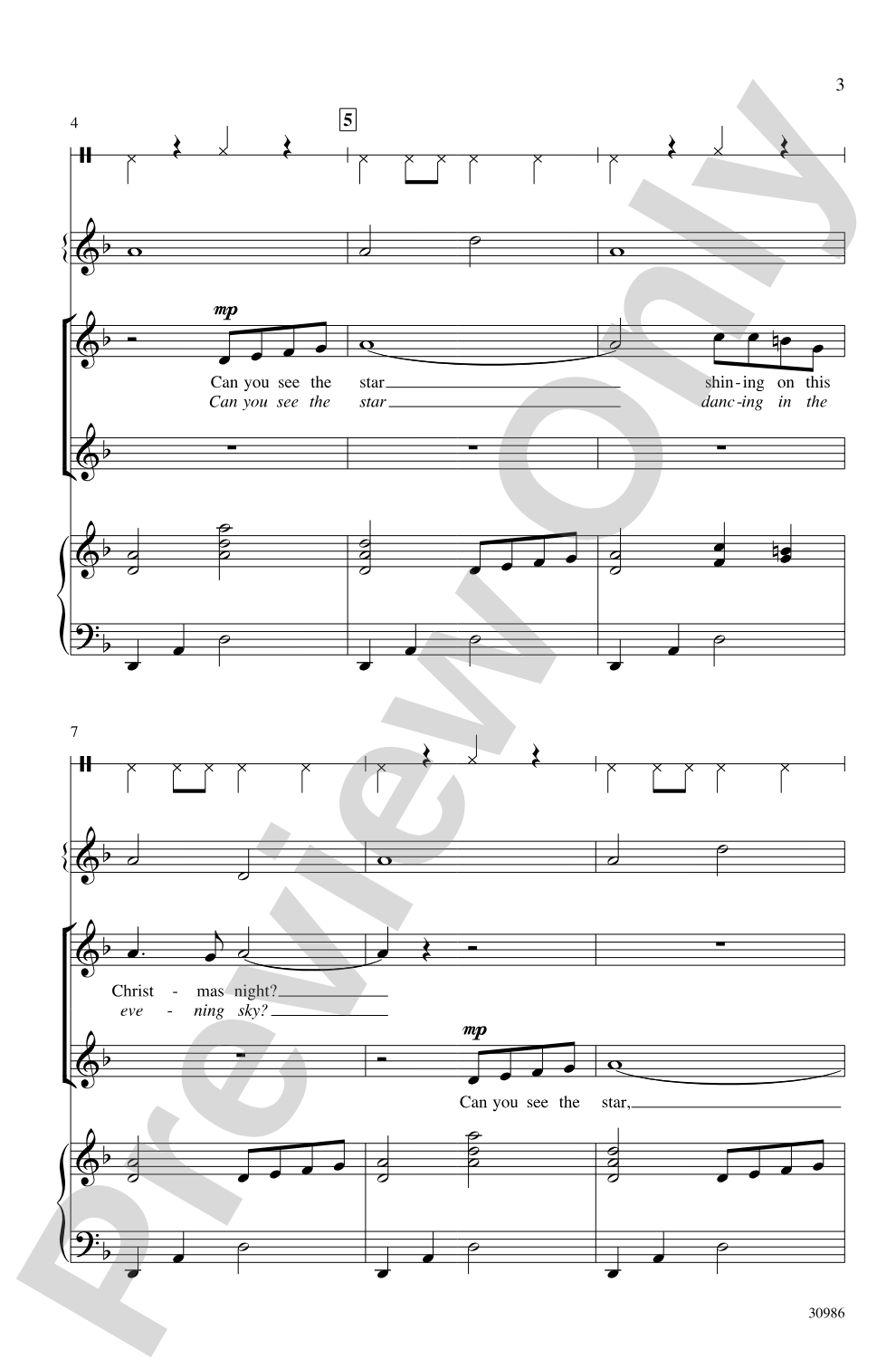
A multi-use choral featuring two texts---one for Christmas and one for general use. The minor key echo-format melody on the verses contrasts with a sparkling major key sound on the chorus. Percussion parts are available free, online. Church or school use.


Can You See the Star?: 2-Part Choral Octavo isn't in MakeMusic Cloud just yet...but it could be. Let us know you'd like to see it, and you'll help shape what comes next. In the meantime, start a free trial and dive into thousands of interactive titles your students can play along with today.
Request This Title
Tell us you want it.
Start Your Free Trial
Explore everything that's ready to play right now.
Sample Audio
1
Audio File
--:--
0:00
0:00
Sample Video
No sample videos found.
Additional Details
Series:
Alfred Choral Designs
Publisher:
Alfred Music
Page Count:
12
SKU:
00-PO-0000734
More about this title
About the Composer: Sally K. Albrecht

Sally K. Albrecht has shaped American choral music for decades as a composer, conductor, and clinician with particular expertise in choral movement. Since 1987, she has received the ASCAP Special Music Award annually and maintains over 600 published choral works alongside 75 larger musicals and songbooks. She served for more than thirty years as Director of School Choral, Vocal, and Elementary Publications at major educational music publishers, including Alfred Music, and has conducted honor choirs at Lincoln Center, Carnegie Hall, and The Kennedy Center.
Holding degrees from Rollins College (B.A. in Music and Theater, 1976), the University of Miami (M.A. in Drama, 1977; M.M. in Accompanying, 1979), she has taught at Oakland University, Jersey City State College, and Meredith College. A native of Cleveland, Ohio, Albrecht has been honored as a Distinguished Alumna by both the University of Miami Frost School of Music and Rollins College, where she serves on the Board of Trustees. She received the Pillar of Leadership award from Omicron Delta Kappa National Leadership Honor Society and resides in Wake Forest, North Carolina, with her husband, composer and arranger Jay Althouse.
Why we love this
The dual-text design solves the real scheduling problem of needing one piece that works for December concerts and spring or year-round programming without feeling forced. The tonal shift from minor-key verses to major-key chorus creates genuine musical drama that engages young singers and holds audience attention, and the free online percussion parts transform a simple octavo into a fuller, more dynamic choral experience.
What to expect
The piece opens with an introspective, searching quality in the minor key, then breaks into warmth and clarity as the chorus moves to the major. The echo-format melody creates intimacy in the verses before the chorus offers a moment of resolution and light, making it feel both contemplative and uplifting.
Who it's for
Church and school choirs working with younger singers, unchanged voices, or singers new to part-singing. The 2-part voicing accommodates mixed groups and allows singers to experience harmonic texture without the complexity of three or four independent lines.
How to get the most out of it
- Shape the minor-key echo sections with clear dynamic contrast between the initial phrase and its response; this articulates the call-and-answer texture without requiring independent voice parts.
- Allow the major-key chorus to bloom with brightness after the verses; the tonal shift rewards careful preparation and makes the uplift feel earned.
- Layer in the optional percussion parts to add texture and forward momentum, especially if your singers are still building confidence with independent parts.
How to use it
Program this as a seasonal opener during winter concerts, or use the general-text version as a spring recital or assembly piece that benefits from a more intimate, meditative quality. The moderate length and accessible range make it ideal for pairing with shorter works or as a transition piece within a larger concert arc.
Skills your students will build
- Singing in minor and major tonalities within a single piece
- Responding to echo and call-and-response melodic writing
- Coordinating with optional percussion accompaniment
- Sustaining tone quality across contrasting dynamics and emotional content