
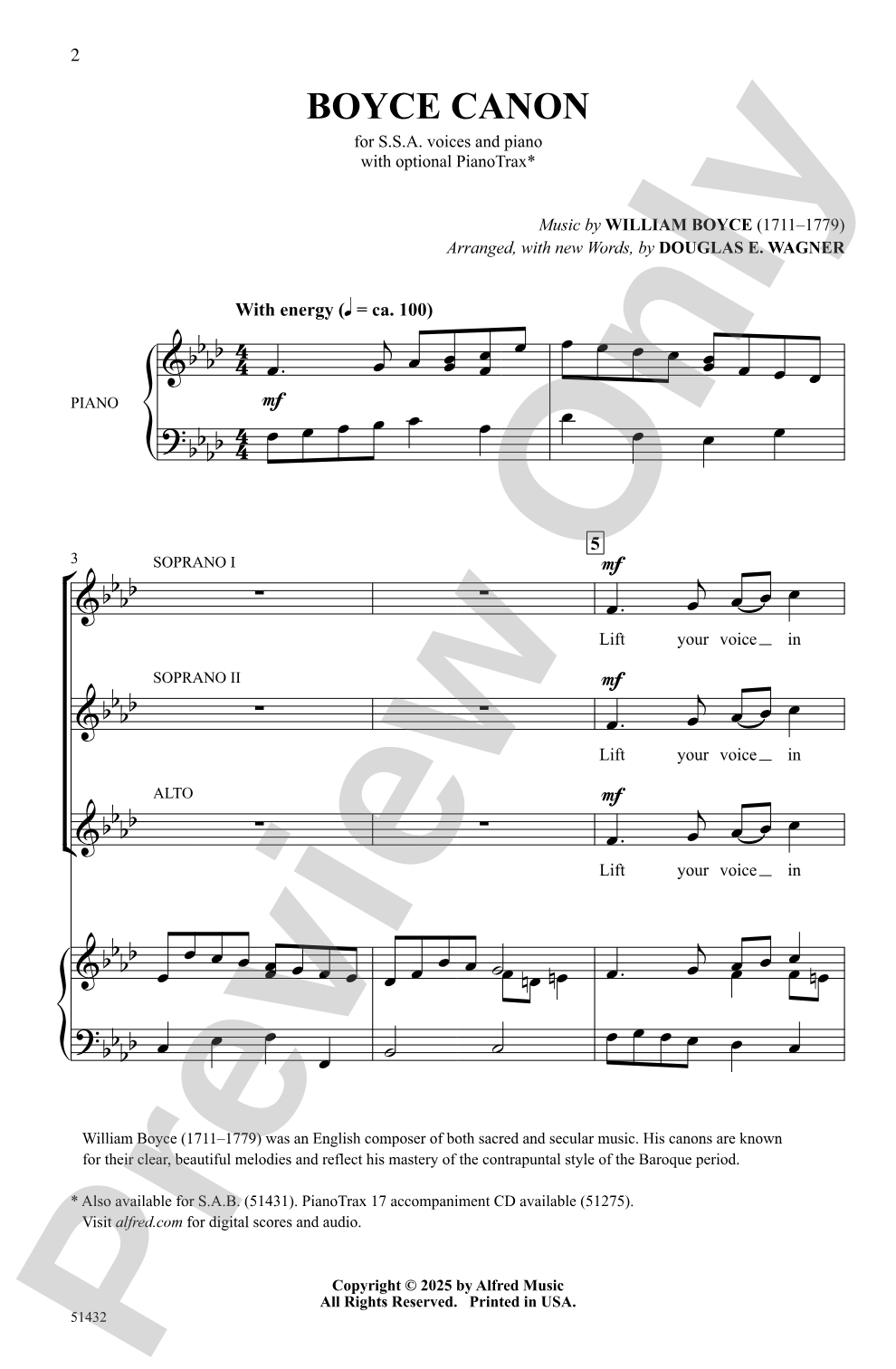

Boyce Canon: SSA Choral Octavo
Music by William Boyce / arr., with new words, by Douglas E. Wagner
Item: 00-PO-0007448
$2.30
Minimum order quantity: 20 copies
Pickup currently not available
Description
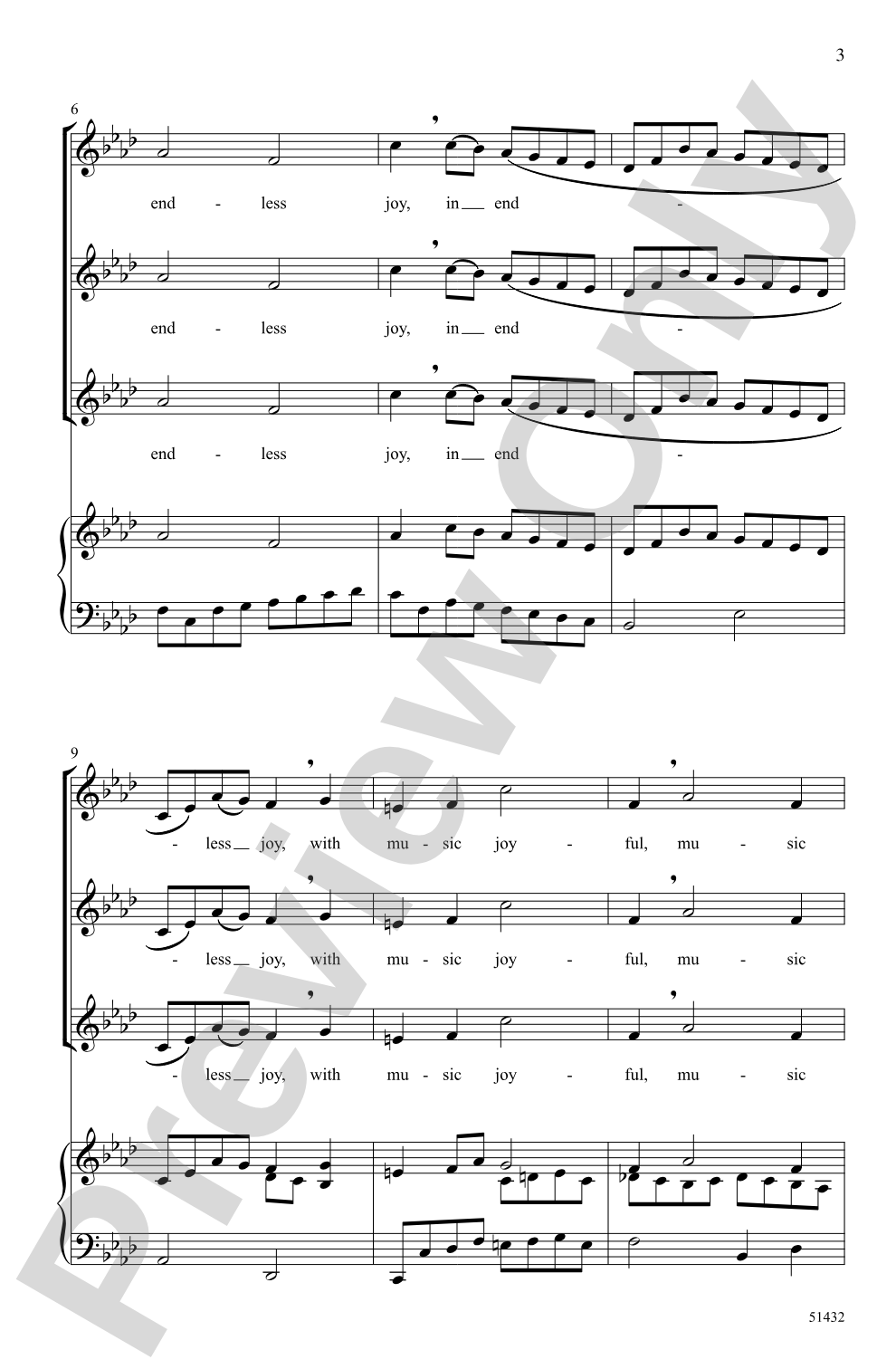
William Boyce's beautiful Baroque melody is introduced in unison, and then sung as a canon in this accessible masterwork arrangement. Newly penned secular lyrics serve as an invitation to "lift your voice in endless joy." This piece is ideal for reinforcing skills, as well as developing vocal technique. Use as a warm-up and then program for concert, contest, or festival.


Discover MakeMusic Cloud: thousands of interactive titles your students can play along with today.
Sample Audio
1
Audio File
--:--
0:00
0:00
Sample Video
Additional Details
Series:
Alfred Choral Designs
Publisher:
Alfred Music
Page Count:
12
SKU:
00-PO-0007448
More about this title
About the Composer: William Boyce
William Boyce (1711-1779) was one of England's most influential composers of the eighteenth century. A prolific writer of sacred and secular vocal music, Boyce served as organist at the Chapel Royal and became one of the most celebrated musicians of his era, leaving behind a legacy of dignified, expressive compositions that remain central to the Baroque choral repertoire.
Boyce's gift for melody is evident throughout his works. His ability to write singable, memorable lines that accommodate both amateur and professional voices made his music accessible to choirs of varying abilities. His secular works, in particular, showcase the elegance and proportional clarity that defined English Baroque style.
Why we love this
This arrangement takes a stunning Baroque melody and frames it as a teaching tool without sacrificing musical integrity. The unison introduction settles singers into the material before the canon structure deepens their engagement with the text and tune. What makes this particularly valuable is that it works equally well as a technical exercise in voice independence and as a concert piece worth programming on its own merits.
What to expect
The unison opening establishes a sense of collective purpose before the canon playfully separates the voices into conversation with themselves. There's an elegant restraint to the piece that feels both joyful and dignified, inviting singers to lift their voices without requiring dramatic intensity.
Who it's for
This octavo serves choirs developing independence between voices and singers building fundamental technique around a melody that rewards careful attention. It works for intermediate to advanced youth choirs, collegiate ensembles, and community choirs looking for accessible Baroque literature with substance.
How to get the most out of it
- Start the unison section with clear vowel alignment across your SSA voicing. Boyce's melody sits naturally for all three parts, so balance the line rather than pushing individual voices forward.
- In the canon, establish the entrances cleanly by rehearsing the canon entries separately before combining them. Each voice needs confidence in its own line to avoid collapsing into unison.
- Shape the phrase arcs subtly rather than with dramatic dynamic shifts. Baroque style favors clarity of line over aggressive expression.
- If using the recorded accompaniment, rehearse first without it so singers internalize the melodic line independently, then add the accompaniment as a reinforcement.
How to use it
Program this as a strategic opener on a concert where you want to showcase choral clarity and control, or nest it into a set of Baroque sacred and secular pieces. It also serves beautifully as a warm-up song that earns its place on the final program.
Skills your students will build
- Canon singing and voice independence
- Baroque articulation and phrasing
- Unison to part transition
- Singing a sustained melodic line across ensemble texture
- Intonation within a capella or accompanied contexts