
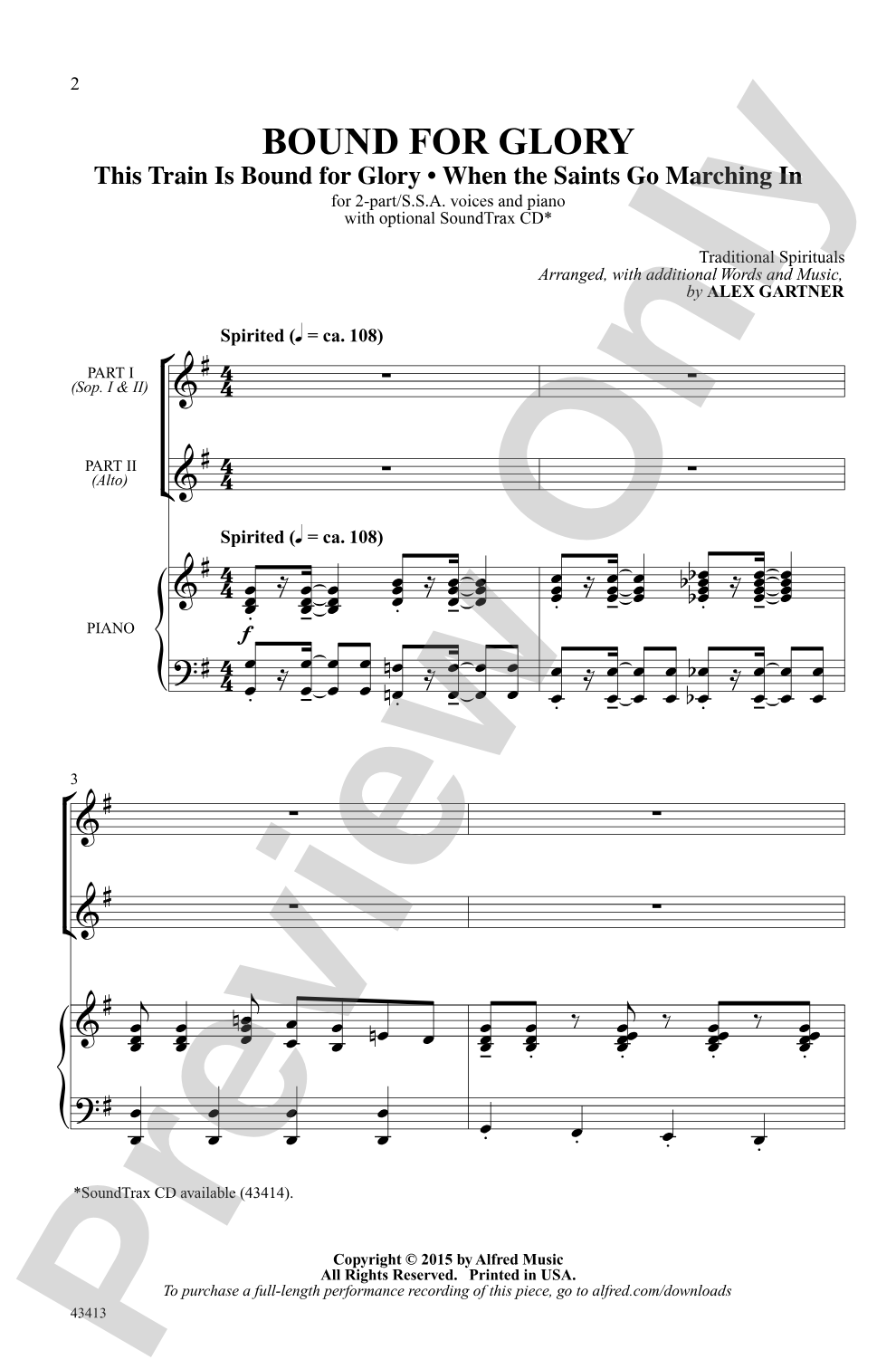
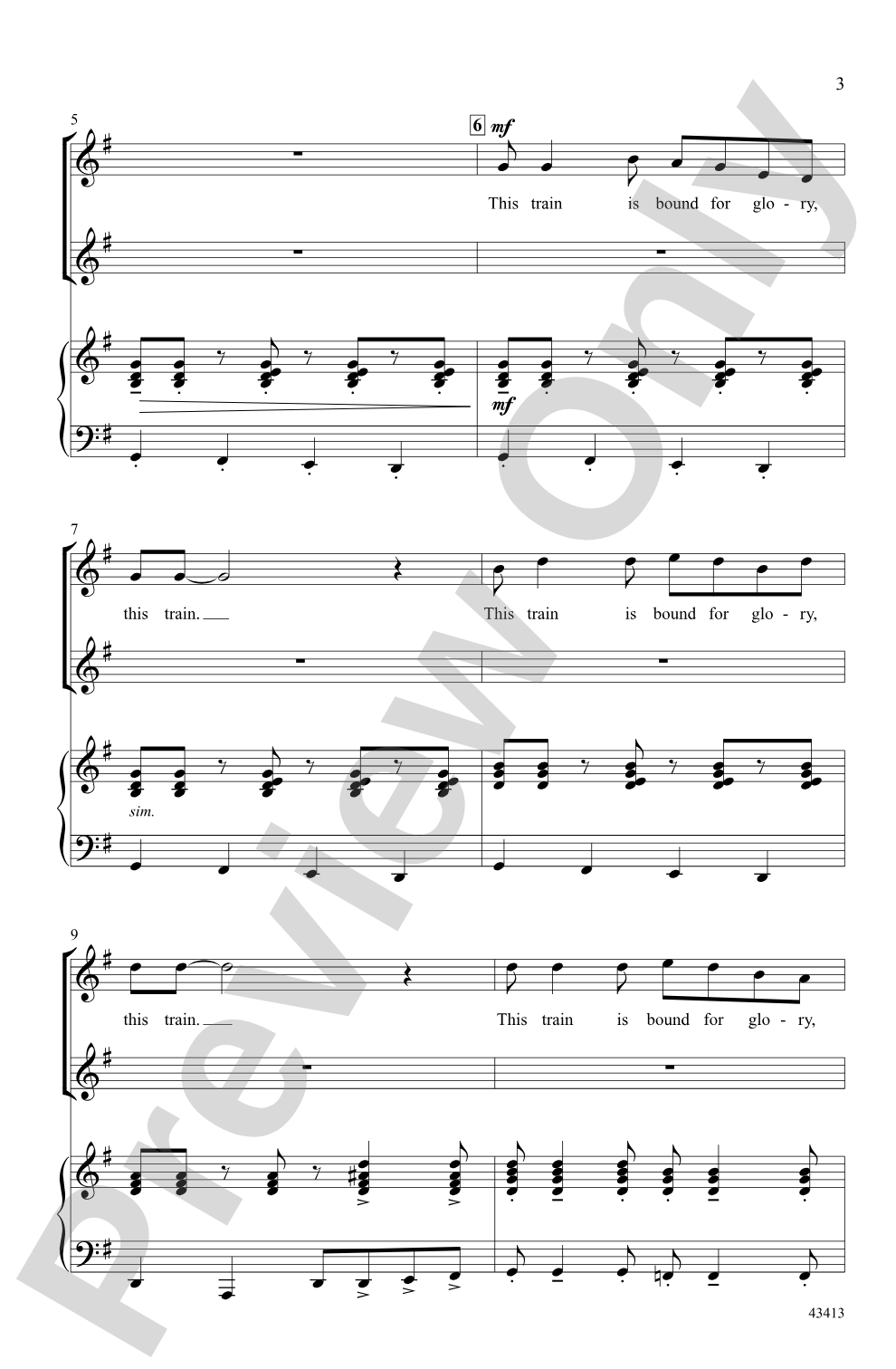

Bound for Glory: 2-Part / SSA Choral Octavo
Traditional Spirituals / arr., with additional words and music, by Alex Gartner
Item: 00-PO-0003349
$2.05
Minimum order quantity: 20 copies
Pickup currently not available
Description
Step one: sing a familiar spiritual; step two: combine with a catchy partner melody; step three: introduce "When the Saints Go Marching In;" and then . . . put 'em all together for an ingenious triple partner song! All aboard!


Bound for Glory: 2-Part / SSA Choral Octavo isn't in MakeMusic Cloud just yet...but it could be. Let us know you'd like to see it, and you'll help shape what comes next. In the meantime, start a free trial and dive into thousands of interactive titles your students can play along with today.
Request This Title
Tell us you want it.
Start Your Free Trial
Explore everything that's ready to play right now.
Sample Audio
1
Audio File
--:--
0:00
0:00
Sample Video
No sample videos found.
Additional Details
Series:
Alfred Choral Designs
Publisher:
Alfred Music
Page Count:
12
SKU:
00-PO-0003349
More about this title
About the Arranger: Alex Gartner

Alex Gartner brings together his experience as a choral director, clinician, and keyboardist to create accessible yet musically engaging arrangements for treble choirs. Based in Cincinnati, he serves as assistant director of the Cincinnati Children's Choir at the University of Cincinnati College-Conservatory of Music, and also directs traditional music at Epiphany United Methodist Church while leading the Forest-Aires Women's Chorus as artistic director.
Gartner holds a bachelor of music degree in vocal music education from CCM and has earned recognition for his contributions to choral music, including the 2012 John Leman Award for outstanding musical leadership. He is an active member of ACDA, Chorus America, and the Ohio Music Education Association.
Why we love this
This arrangement proves that clever compositional thinking doesn't require complex harmony or extended ranges. The layering strategy of partner songs transforms familiar material into something that feels genuinely inventive, and the logic of building from one melody to three keeps singers engaged with the architecture itself. Gartner's understanding of how young choirs learn makes this both pedagogically sound and satisfying to perform.
What to expect
There's genuine delight in watching all three melodies click into place. The piece has the energetic momentum of a spiritual combined with the satisfying geometry of a well-crafted partner song. It feels celebratory without being saccharine, familiar without being tired.
Who it's for
Directors working with 2-part or SSA treble choirs looking for repertoire that teaches voice independence while keeping singers motivated by recognizable material. This works equally well for intermediate middle school choirs ready for partner song technique and high school choirs seeking concert programming with strong audience appeal.
How to get the most out of it
- Introduce each melody independently before combining them. Let singers hear how the spiritual sits against the partner melody, then add 'When the Saints Go Marching In' so the layering reveals itself gradually.
- Establish a clear harmonic center early; the interplay between the melodies can feel unstable if the underlying pulse isn't anchored in the accompaniment.
- Consider the balance between parts as melodies stack. Mark entrances in rehearsal so no single line disappears when all three are sounding.
- Record a run-through at performance tempo and listen back. Hearing how the melodies interact from the audience perspective often clarifies which moments need adjustment.
How to use it
Program this as a showcase moment that demonstrates your singers' ability to manage layered textures and independence of line. It pairs well with spirituals or traditional sacred repertoire and works as a strong opener or closer that engages audiences immediately.
Skills your students will build
- Singing independent melodic lines while hearing other parts
- Maintaining rhythmic precision in a partner song texture
- Blending multiple familiar melodies into unified texture
- Understanding call-and-response and song layering as arrangement techniques