
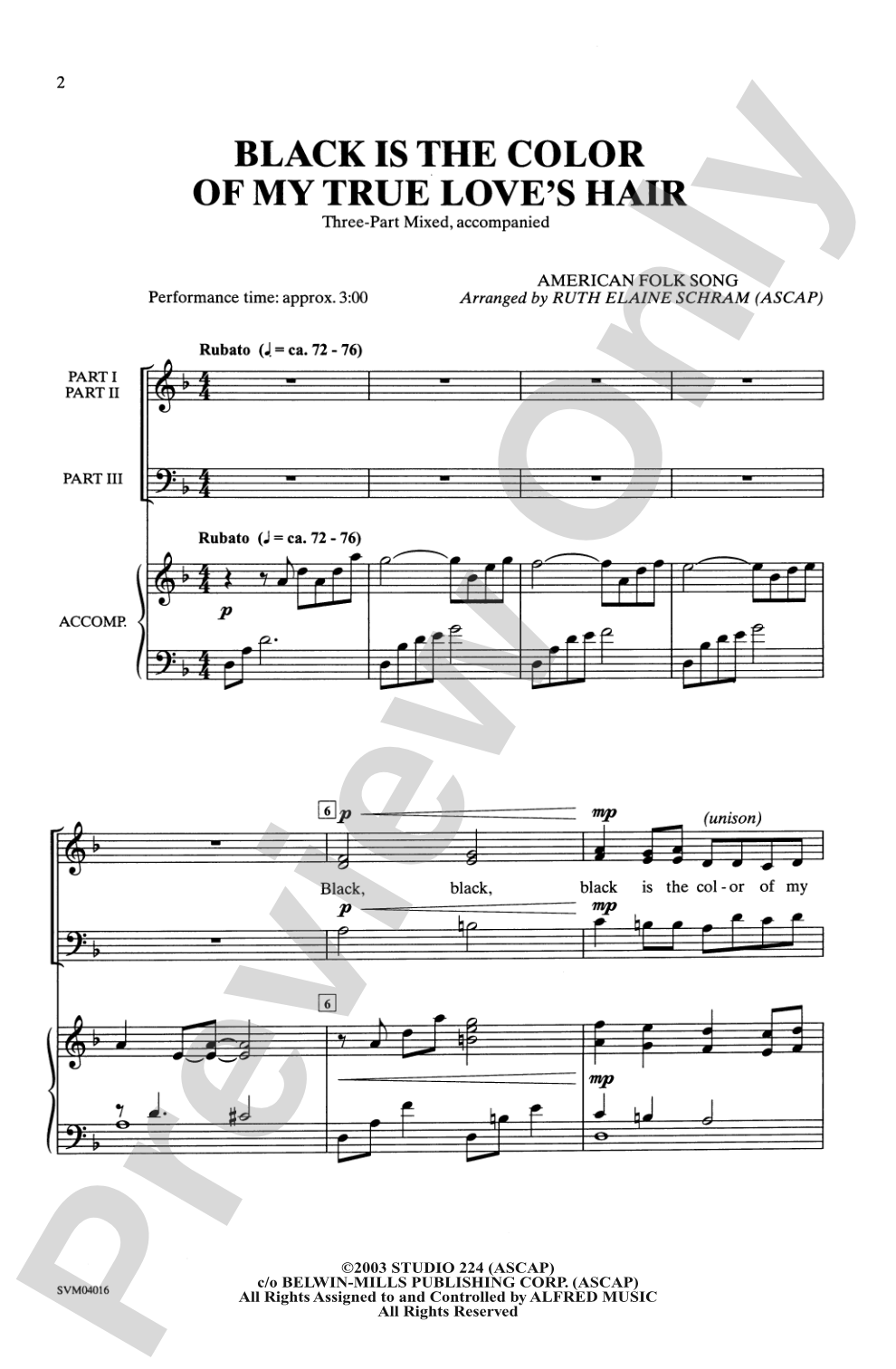
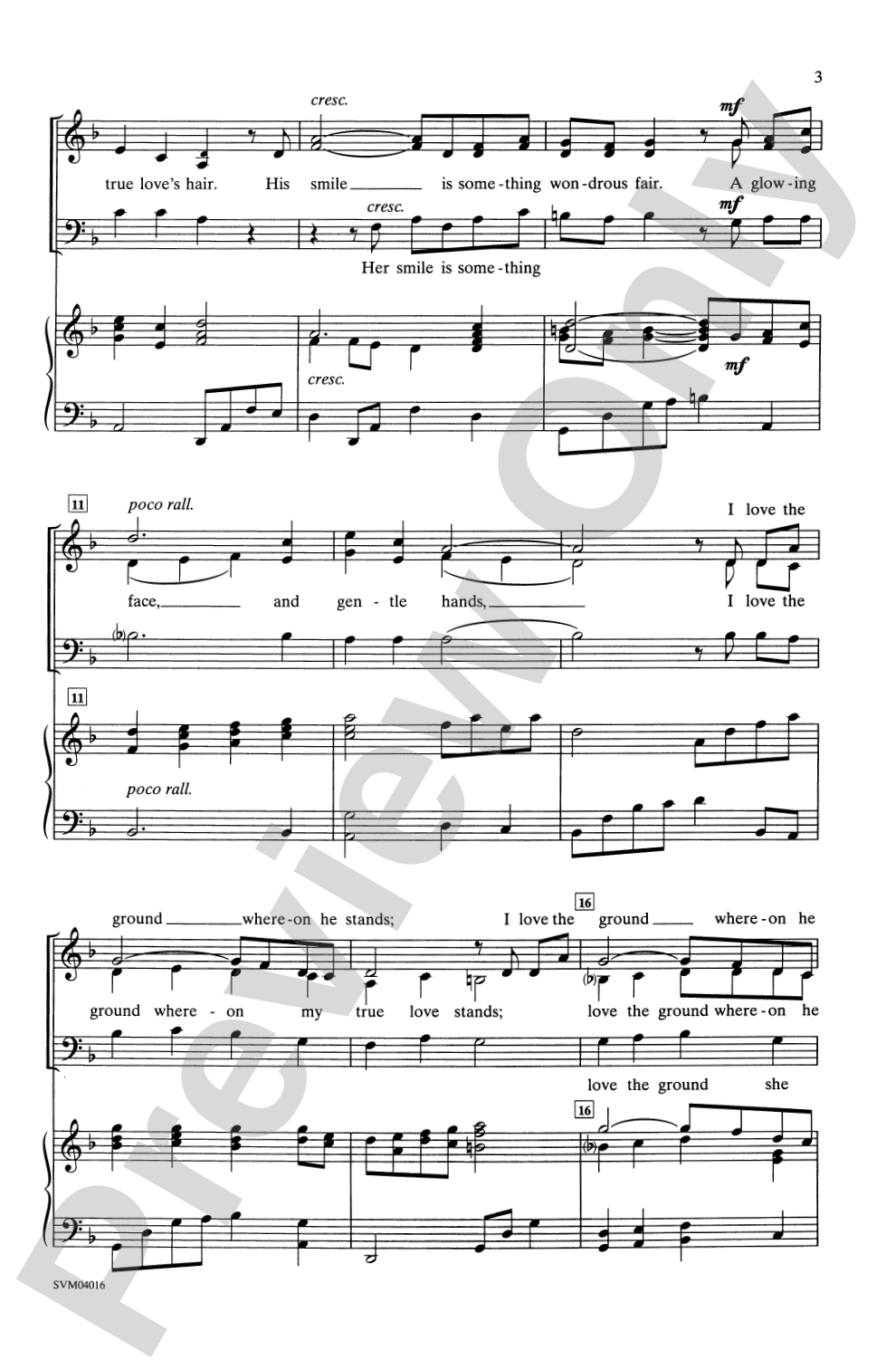

Black Is the Color of My True Love's Hair: 3-Part Mixed Choral Octavo
American Folk Song / arr. Ruth Elaine Schram
Level: Moderate
Item: 00-PO-0006814
$2.25
Minimum order quantity: 20 copies
Pickup currently not available
Related Items
Black Is the Color of My True Love's Hair: SATB Choral Octavo |
$2.25
|
View | |
Black Is the Color of My True Love's Hair: TTBB Choral Octavo |
$1.65
|
View | |
Black Is the Color of My True Love's Hair: SATB Choral Octavo |
$2.25
|
View | |
Black Is the Color of My True Love's Hair: 3-Part Mixed Choral Octavo |
$2.25
|
View | |
Black Is the Color of My True Love's Hair: TTBB Choral Octavo |
$1.65
|
View |
Description
This traditional folk melody is brought to life with sensitive and rich choral sounds by Ruth Elaine Schram. The arrangement is fresh and easy to sing. It will be a welcome addition to any concert program.


Black Is the Color of My True Love's Hair: 3-Part Mixed Choral Octavo isn't in MakeMusic Cloud just yet...but it could be. Let us know you'd like to see it, and you'll help shape what comes next. In the meantime, start a free trial and dive into thousands of interactive titles your students can play along with today.
Request This Title
Tell us you want it.
Start Your Free Trial
Explore everything that's ready to play right now.
Sample Audio
No sample audio found.
Sample Video
No sample videos found.
Additional Details
Publisher:
Alfred Music
Page Count:
8
SKU:
00-PO-0006814
More about this title
About the Arranger: Ruth Elaine Schram
Ruth Elaine Schram is a composer and arranger whose work spans choral, instrumental, and vocal music for educational settings. Her arrangements are known for balancing accessibility with musical substance, creating pieces that engage singers while respecting the integrity of the source material.
Why we love this
Schram's treatment of this Appalachian standard captures the tender melancholy of the melody without overcomplicating the vocal writing. The three-part mixed voicing sits naturally for developing choirs, and the arrangement's warmth makes it equally effective in concert or worship contexts.
What to expect
The piece carries the quiet intimacy of its folk origins, with Schram's arrangement deepening that reflective quality through supportive harmonies and gentle voice leading. There's a wistfulness here that invites singers to connect emotionally with the text.
Who it's for
This octavo works well for choirs at the Grade 3 level who are ready to move beyond unison arrangements but still need straightforward, singable voicing. It suits both community and school ensembles seeking accessible repertoire with genuine musical depth.
How to get the most out of it
- Let the soprano line breathe as the primary carrier of the melody; the inner voices should support without competing for attention.
- Sustain long tones with consistent support, since the arrangement relies on harmonic richness rather than rhythmic drive.
- Shape phrases through dynamic contour rather than tempo variation; a steady pulse allows the text painting to emerge naturally.
- Balance the three parts so that each voice part is heard distinctly, especially during moments when the melody moves between sections.
How to use it
Program this as a moving anchor piece in a concert focused on American folk traditions or as a contrasting slower selection between more energetic works. Its moderate length and emotional directness also make it suitable for memorial or special occasion programming.
Skills your students will build
- Blending three independent voice parts while maintaining clear part identity
- Sustaining legato line through longer note values
- Interpreting text with musical sensitivity in a secular context
- Reading and performing SAB voicing in treble-heavy tessitura