
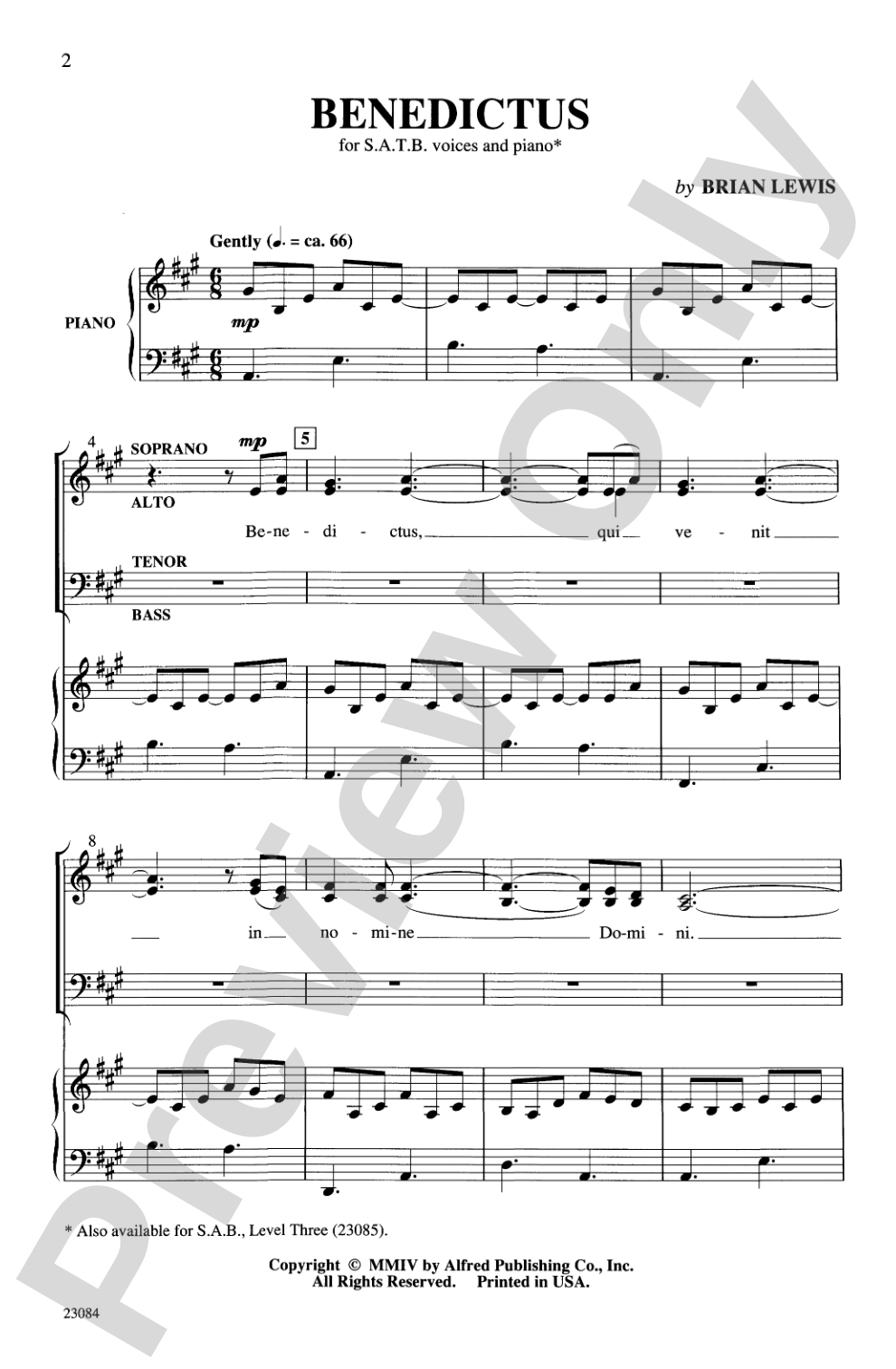
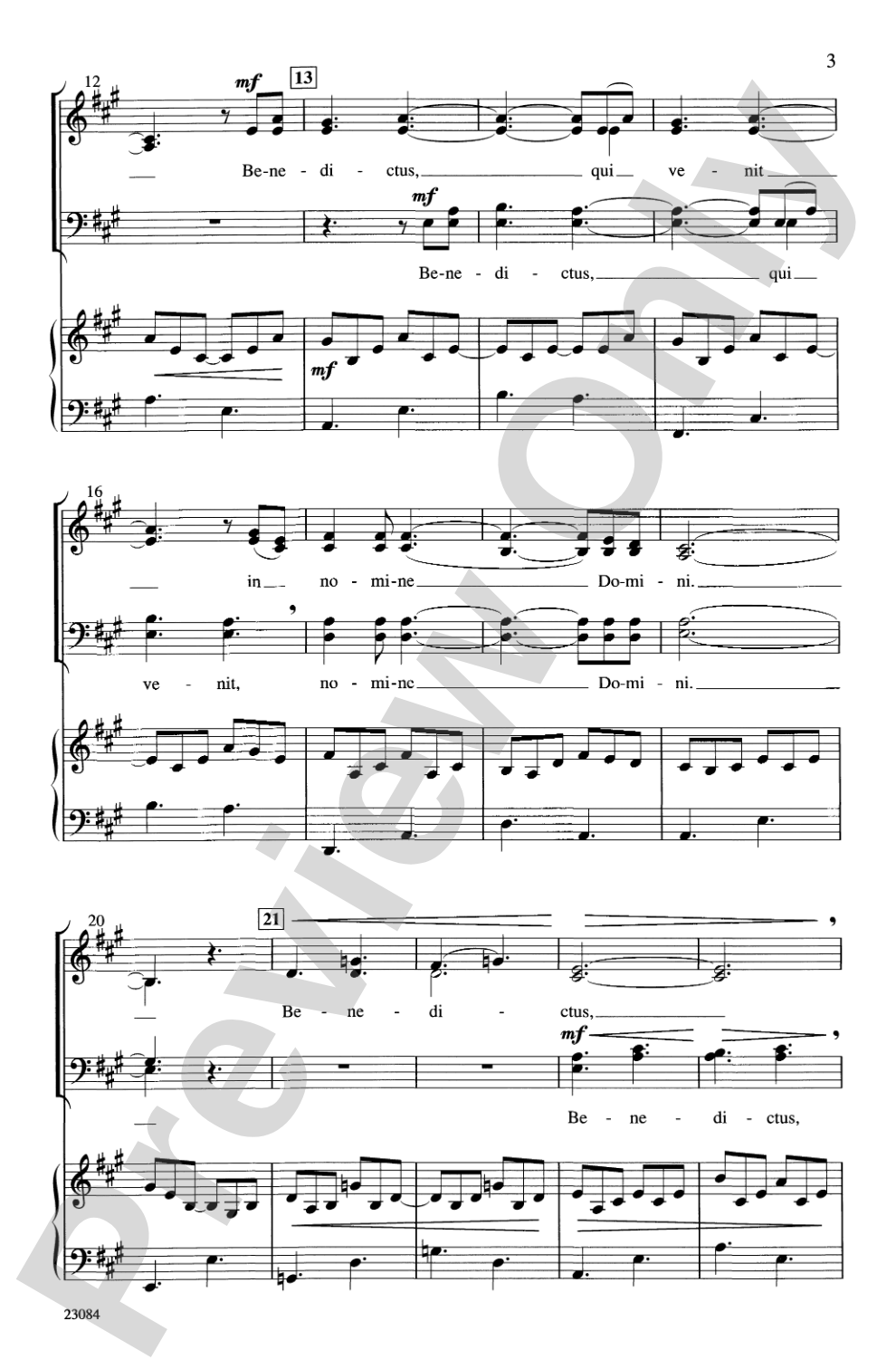

Benedictus: SATB Choral Octavo
Music by Brian Lewis
Item: 00-PO-0003159
$2.05
Minimum order quantity: 20 copies
Pickup currently not available
Related Items
Benedictus: SAB Choral Octavo |
$2.05
|
View | |
Benedictus: SSAA Choral Octavo |
$2.25
|
View | |
Benedictus: 2-Part Choral Octavo |
$2.05
|
View | |
Benedictus: SATB Choral Octavo |
$2.05
|
View | |
Benedictus: SAB Choral Octavo |
$2.05
|
View | |
Benedictus: SSAA Choral Octavo |
$2.25
|
View | |
Benedictus: 2-Part Choral Octavo |
$2.40
|
View |
Description
For the discerning choir, a lovely setting of the Latin "Benedictus." A haunting melodic motive is underscored by a gently lilting piano accompaniment as your choir performs this highly expressive and sophisticated work. Each voice part sings in its most comfortable range as the hushed opening builds to a dramatic forte "Hosanna" in the middle of the piece, and then gradually fades as the opening statement returns. Top quality, contemporary choral writing. Translation and pronunciation guides are in the publication. This title is available in Music Prodigy.


Benedictus: SATB Choral Octavo isn't in MakeMusic Cloud just yet...but it could be. Let us know you'd like to see it, and you'll help shape what comes next. In the meantime, start a free trial and dive into thousands of interactive titles your students can play along with today.
Request This Title
Tell us you want it.
Start Your Free Trial
Explore everything that's ready to play right now.
Sample Audio
1
Audio File
--:--
0:00
0:00
Sample Video
Additional Details
Series:
Alfred Choral Designs
Publisher:
Alfred Music
Page Count:
8
SKU:
00-PO-0003159
More about this title
About the Composer: Brian Lewis

Brian Lewis studied composition at Baldwin-Wallace Conservatory in Berea, Ohio, then earned his Master of Music in Conducting from Western Michigan University along with his teaching certification. His career has spanned public school music education in Michigan, film and television scoring through the USC program, and commissioned work for high school choirs, including Sanctus performed by ensembles at Portage Northern High School.
Lewis brings both pedagogical insight and sophisticated compositional craft to his choral writing. His background in scoring for media informs his sensitivity to texture, dynamics, and emotional arc—qualities evident in pieces designed for singers who respond to nuance and expressive depth.
Why we love this
The architecture here is elegant and purposeful. Lewis constructs a piece that respects the lyric capabilities of each voice while building toward a genuinely dramatic moment; the Hosanna feels earned, not imposed. Choirs at this level will connect with writing that trusts them to shape phrases and balance text with musicality rather than relying on technical difficulty.
What to expect
A meditation that opens in shadow and silence, building toward a moment of radiance before settling back into contemplation. The piano accompaniment lilts gently beneath the voices, creating a sense of movement even in stillness. The harmonic language is contemporary yet accessible, creating an emotional landscape that feels both intimate and expansive.
Who it's for
This octavo suits choirs with solid ensemble skills and singers who understand phrasing and dynamic control. It works equally well for concert programs and contest programming where sophisticated contemporary sacred music is valued.
How to get the most out of it
- Shape the opening melodic motive with gentle direction even at a hushed dynamic; the lilt in the piano part suggests forward movement, so avoid letting the beginning sound static.
- Prepare the Hosanna section by tracking how the texture and harmonic rhythm intensify leading into it; the contrast will land cleanly if earlier restraint is genuine.
- Attend closely to the pronunciation guides provided in the score; Latin text sung with clarity will enhance the work's expressive sophistication.
- Balance the return to the opening statement so it feels like a purposeful resolution rather than repetition; slight adjustments to tempo or weight can deepen the sense of closure.
How to use it
This piece serves beautifully as a thoughtful anchor in a concert of sacred music, offering contrast to both high-energy work and more austere settings of liturgical texts. Its eight pages and moderate difficulty make it feasible for the second half of the season when singers have developed ensemble cohesion.
Skills your students will build
- Sustained legit singing in exposed passages
- Dynamic control across a wide range (ppp to ff)
- Shaping melodic contour within choral texture
- Latin text pronunciation and articulation
- Ensemble balance between voices and piano accompaniment
- Interpretive choices that support dramatic structure