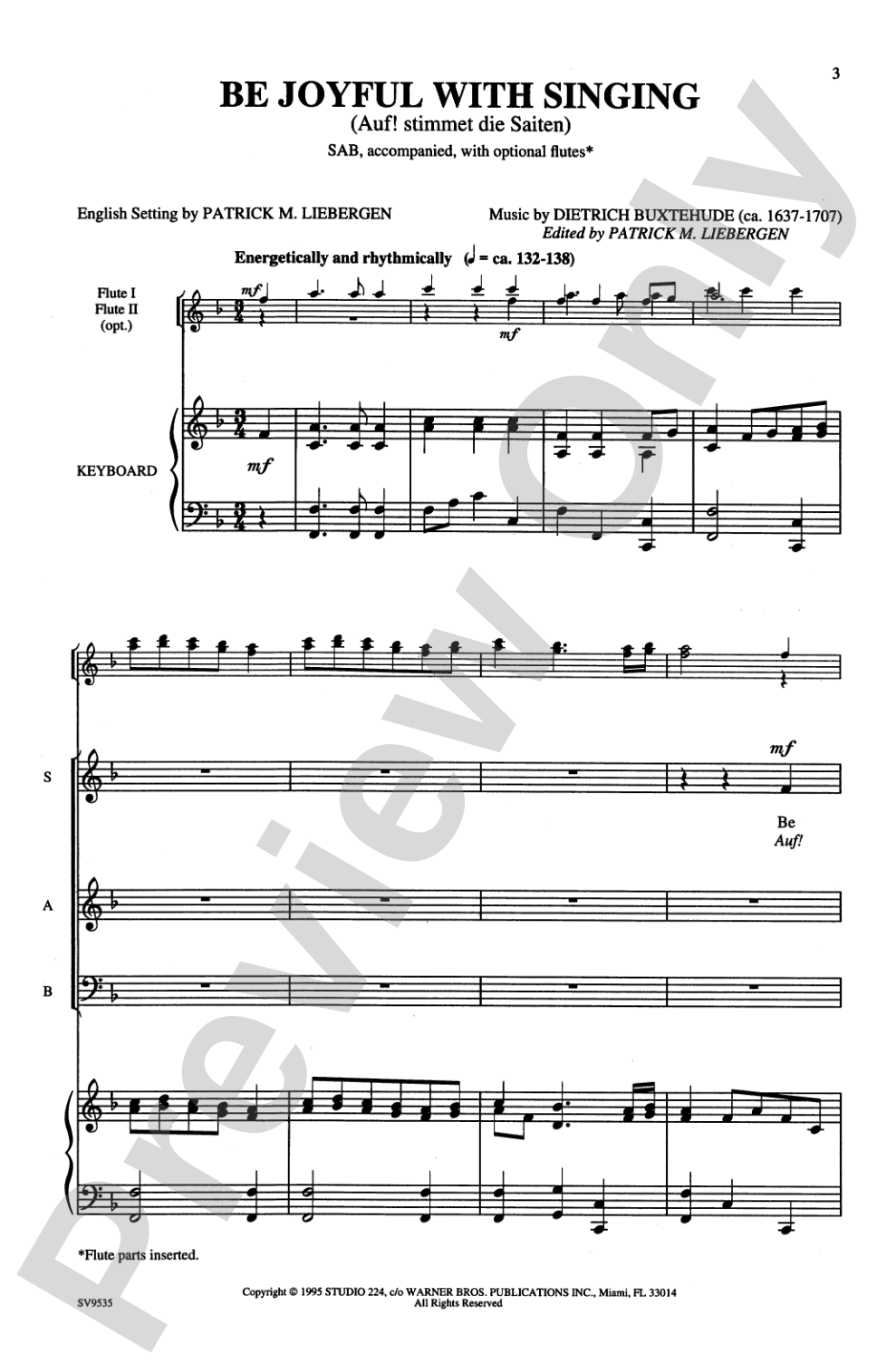
Be Joyful with Singing Sheet Music Preview

Be Joyful with Singing: SAB Choral Octavo

Auf! stimmet die Saiten

By Dietrich Buxtehude / ed. Patrick M. Liebergen

Level: Moderately Easy

Item: 00-PO-0002751

Digital Download
$2.25

Minimum order quantity: 20 copies

Description
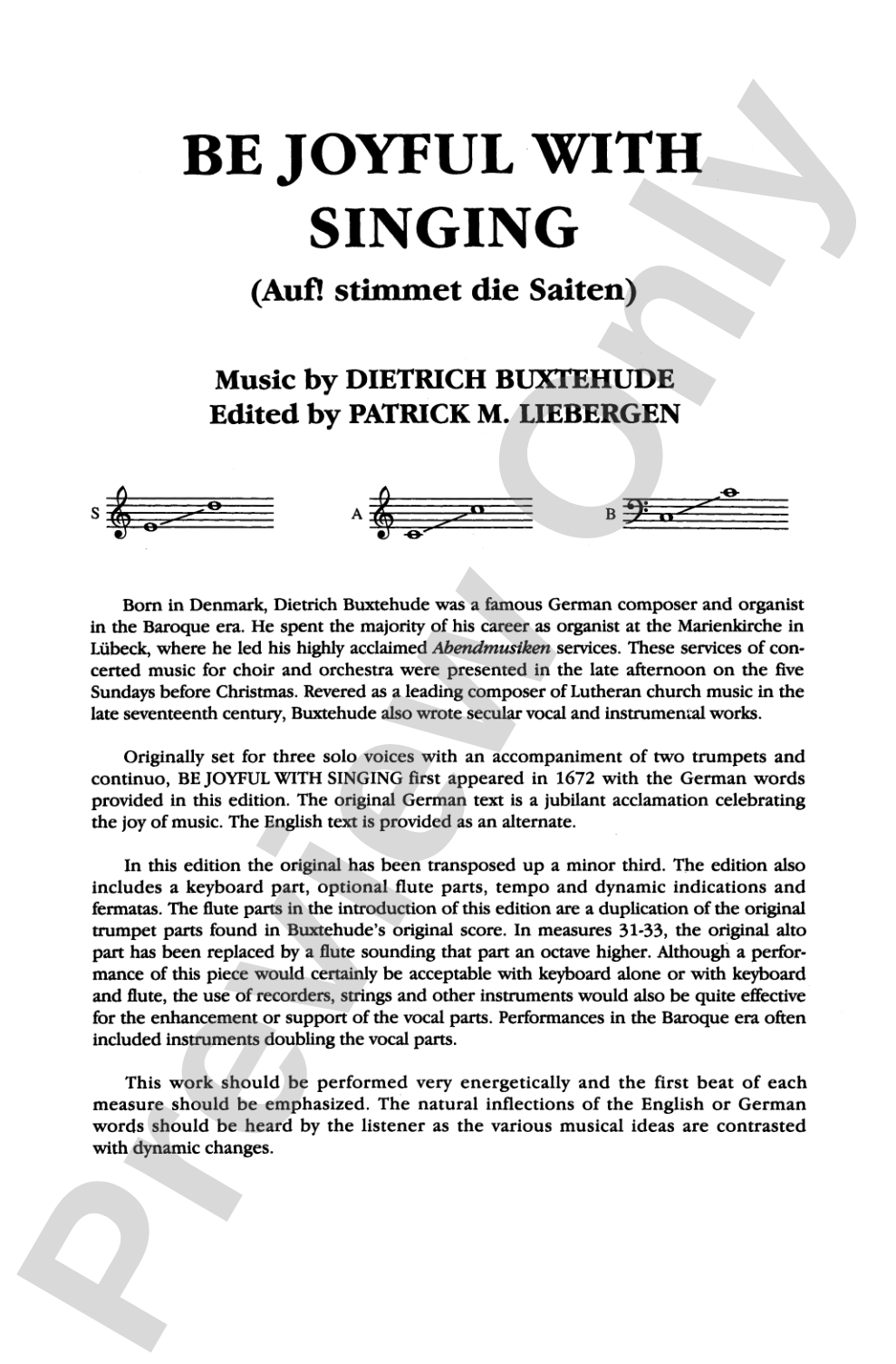
An excellent contest or festival work, this up-beat Baroque piece can be performed with standard accompaniment or with the addition of two flutes. An outstanding addition to the choral repertoire. Baritone part only goes to C. This work is accessible in every way, and can be sung in English or German. In our Easy Choral Masterworks Series.

Be Joyful with Singing: SAB Choral Octavo isn't in MakeMusic Cloud just yet...but it could be. Let us know you'd like to see it, and you'll help shape what comes next. In the meantime, start a free trial and dive into thousands of interactive titles your students can play along with today.

Sample Audio
No sample audio found.
Sample Video
Additional Details
Series: Alfred Archive Edition: Belwin Festival Series
Publisher: Alfred Music
Page Count: 12
SKU: 00-PO-0002751
Instrumentation: Opt. Flutes

More about this title

About the Composer: Dietrich Buxtehude

Dietrich Buxtehude (1637-1707) was a German-Danish organist and composer whose sacred and secular works defined the Baroque style across northern Europe. His compositional reach extended well beyond the organ works he is famous for; his vocal music demonstrates the same contrapuntal mastery and harmonic inventiveness that made him a model for composers like Bach and Handel.

Buxtehude's output includes cantatas, sacred concertos, and secular songs that showcase the range of musical expression available in the Baroque era. For choral musicians, his works offer a direct window into 17th-century German compositional practice while remaining immediate and rewarding to perform.

Why we love this

This arrangement makes Baroque choral writing genuinely accessible without sacrificing authenticity or musical interest. The optional flute parts add textural sophistication for groups ready to expand beyond voices alone, while the English text option removes a common barrier to programming early music. It's substantial enough for a festival submission yet simple enough to serve as a building block for students developing their comfort with historical repertoire.

What to expect

Bright energy and joyfulness shine through the piece despite its historical age, with the text and music aligned to lift rather than introspect. The writing sits comfortably in the singers' ranges while maintaining the rhythmic vitality that makes Baroque secular music so appealing.

Who it's for

This works well for treble or mixed choirs at the intermediate level, including high school ensembles, community choirs, and advanced middle school groups. It serves equally well as a contest entry or a teaching piece, offering singers their first solid experience with genuine Baroque composition.

How to get the most out of it

  • Shape the phrases according to the text meaning rather than mechanical phrase length; Baroque composers expected singers to breathe where words naturally complete thoughts.
  • If adding the optional flutes, ensure they double the soprano line clearly in early rehearsals so singers lock onto the contrapuntal structure before the flutes become decorative.
  • Balance the three voices so no single part dominates; SAB writing at this level requires careful attention to middle-voice independence, especially in any imitative passages.
  • Keep articulation light and uniform across the choir; Baroque style benefits from clarity and forward motion rather than heavy vocal weight.

How to use it

Open a concert with this to establish a Baroque mood without requiring a full suite of period works, or pair it alongside other accessible Baroque pieces to build a thematic program. Its moderate difficulty and uplifting character also suit it to community performances or festival competitions where you want to represent the choir's range without taking excessive rehearsal time away from longer works.

Skills your students will build

  • Reading and performing Baroque melodic contours and text underlay
  • Balancing three independent vocal lines
  • Singing in English and German text (if both versions are used)
  • Interpreting period-appropriate phrasing and articulation
  • Coordinating with optional instrumental doubling

You May Also Like