
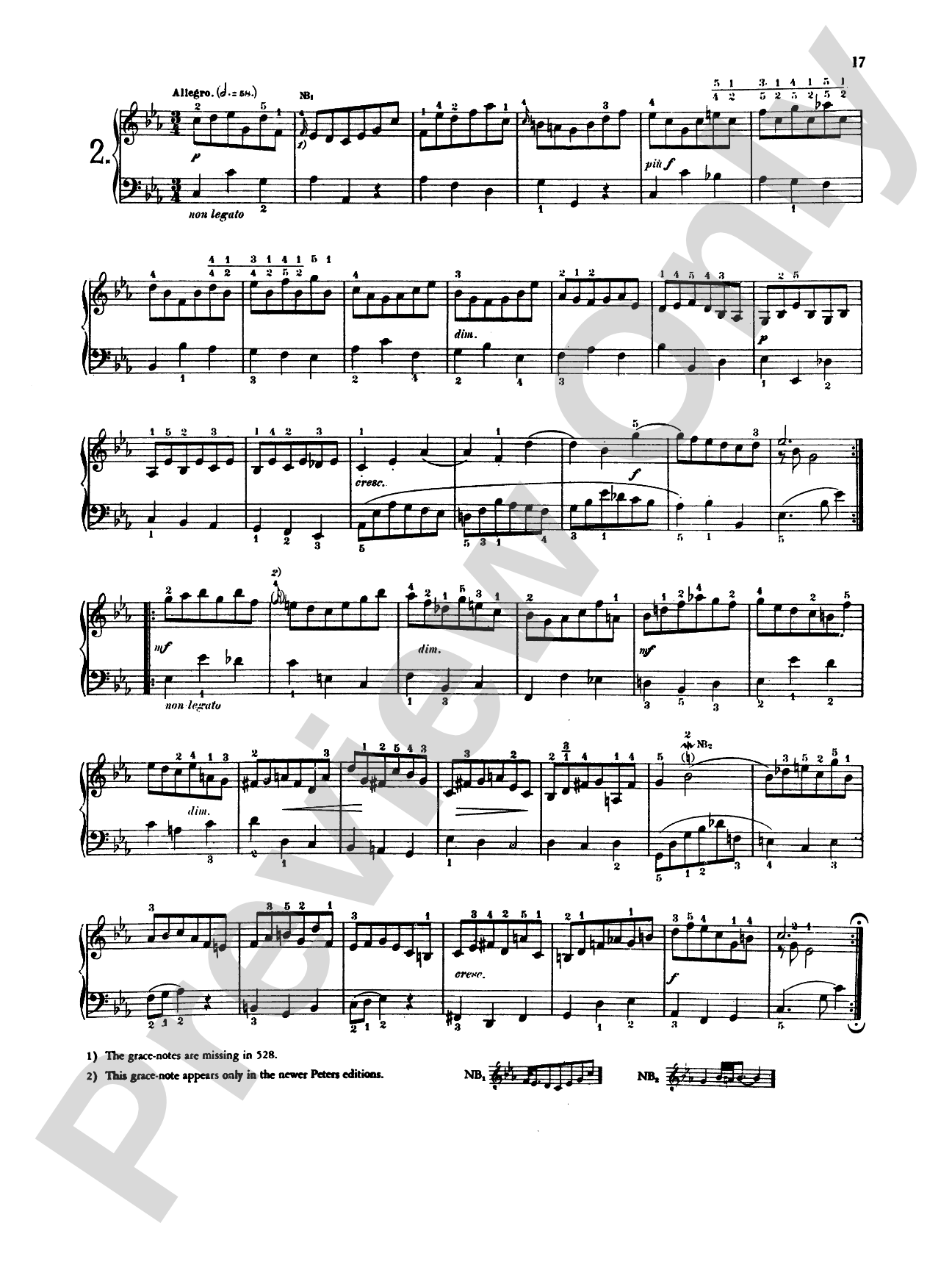

Bach: Six Little Preludes (Ed. Hans Bischoff)
By Johann Sebastian Bach / ed. Hans Bischoff
Item: 00-PC-0004927
$0.99
Pickup currently not available
Description
Dr. Hans Bischoff edited the Six Little Preludes of Johann Sebastian Bach, using the sources he states as "an old Hoffmeister printing as well as the editions issued by Peters. Dynamics, fingering, and tempo markings have been added, along with footnotes regarding execution of Bach's ornamentation. 21 pages.


Don't just read it, hear it, play along with it, and watch your students grow with it. In MakeMusic Cloud, Bach: Six Little Preludes (Ed. Hans Bischoff) comes alive with professional accompaniment, adjustable tempo, and built-in practice tools that turn solo practice into real progress.
Open in the Player
Jump straight in and assign it today.
Start Your Free Trial
Open this title and explore the full library in minutes.
Sample Audio
No sample audio found.
Sample Video
No sample videos found.
Additional Details
Series:
Kalmus Edition
Publisher:
Alfred Music
Page Count:
8
SKU:
00-PC-0004927
More about this title
About the Composer: Johann Sebastian Bach
Johann Sebastian Bach (1685-1750) stands as one of history's most consequential composers, whose systematic exploration of harmony, counterpoint, and keyboard technique shaped centuries of musical thought. His works for solo keyboard instruments represent laboratories for compositional craft, where he investigated the expressive and technical possibilities of the instrument with precision and imagination. For piano teachers and students, Bach remains essential study; his music demands clarity of voice leading, independence of hands, and intellectual engagement with structure that deepens musicianship across all subsequent repertoire.
Why we love this
Bischoff's edition grounds these foundational pieces in performance reality through thoughtful fingering, dynamics, and execution notes on ornamentation, making Bach's baroque keyboard idiom accessible without sacrificing authenticity. The Little Preludes themselves function as gateways to Bach's compositional logic; each brief work teaches a specific technical or textural concept that students can absorb and apply immediately. Programming these establishes a solid anchor point in any curriculum and gives intermediate pianists tangible entry into counterpoint and voice independence before tackling larger works.
What to expect
These short works radiate clarity and purpose. Each unfolds as a miniature conversation between the hands, unadorned yet intricate, inviting the performer into Bach's logical architecture. Despite their brevity, they possess real musical substance; they do not feel like exercises, but rather like small windows into the deliberate, inventive mind of a master craftsman.
Who it's for
Intermediate pianists ready to engage with Baroque voice leading and ornamentation in manageable, focused contexts. Piano teachers seeking repertoire that consolidates technical fundamentals (scales, hand independence, basic counterpoint) while introducing students to Bach's compositional approach. Students preparing for classical music theory study benefit from working through these pieces as practical grounding in harmonic and linear thinking.
How to get the most out of it
- Treat each prelude as a study in one primary texture or technical idea: identify what Bach is exploring in each piece (hand independence, scale work, broken chord patterns) and let that purpose shape your practice priorities and musical decisions.
- Observe the added tempo markings and dynamics as editorial guidance, not sacred text; use them to understand the character each prelude should convey, then refine them based on your instrument's response and your own musical instinct.
- Practice ornamentation separately from the main melodic line using Bischoff's footnotes as your guide; once the ornament sits comfortably in your hand, reintegrate it so it flows naturally within the phrase rather than interrupting it.
- Balance clarity in outer voices with attention to inner voices; Bach writes for four-part texture throughout, and even brief pieces reward the listener when every line remains audible and purposeful.
How to use it
Pair one or two Little Preludes with a larger Bach work (a two-part Invention or French Suite movement) to create a Bach recital segment that shows both the composer's intimate pedagogical voice and his more expansive writing. They also serve as excellent opening pieces in student recitals, establishing a tone of musical seriousness without requiring the technical command or stamina demanded by later-period works.
Skills your students will build
- Voice independence and hand coordination across Baroque two-part and four-part textures
- Execution of Baroque ornaments (trills, mordents, turns) with fluidity and stylistic appropriateness
- Recognition and performance of harmonic progressions typical of early 18th-century keyboard music
- Sight-reading within Baroque notation and manuscript conventions
- Phrasing and articulation aligned with Baroque melodic idiom rather than Romantic sensibility