

Ave Verum Corpus: SATB Choral Octavo
Music by Wolfgang Amadeus Mozart / arr. Russell Robinson
Level: Moderate
Item: 00-PO-0002716

$2.40
Minimum order quantity: 20 copies
Pickup currently not available
Description
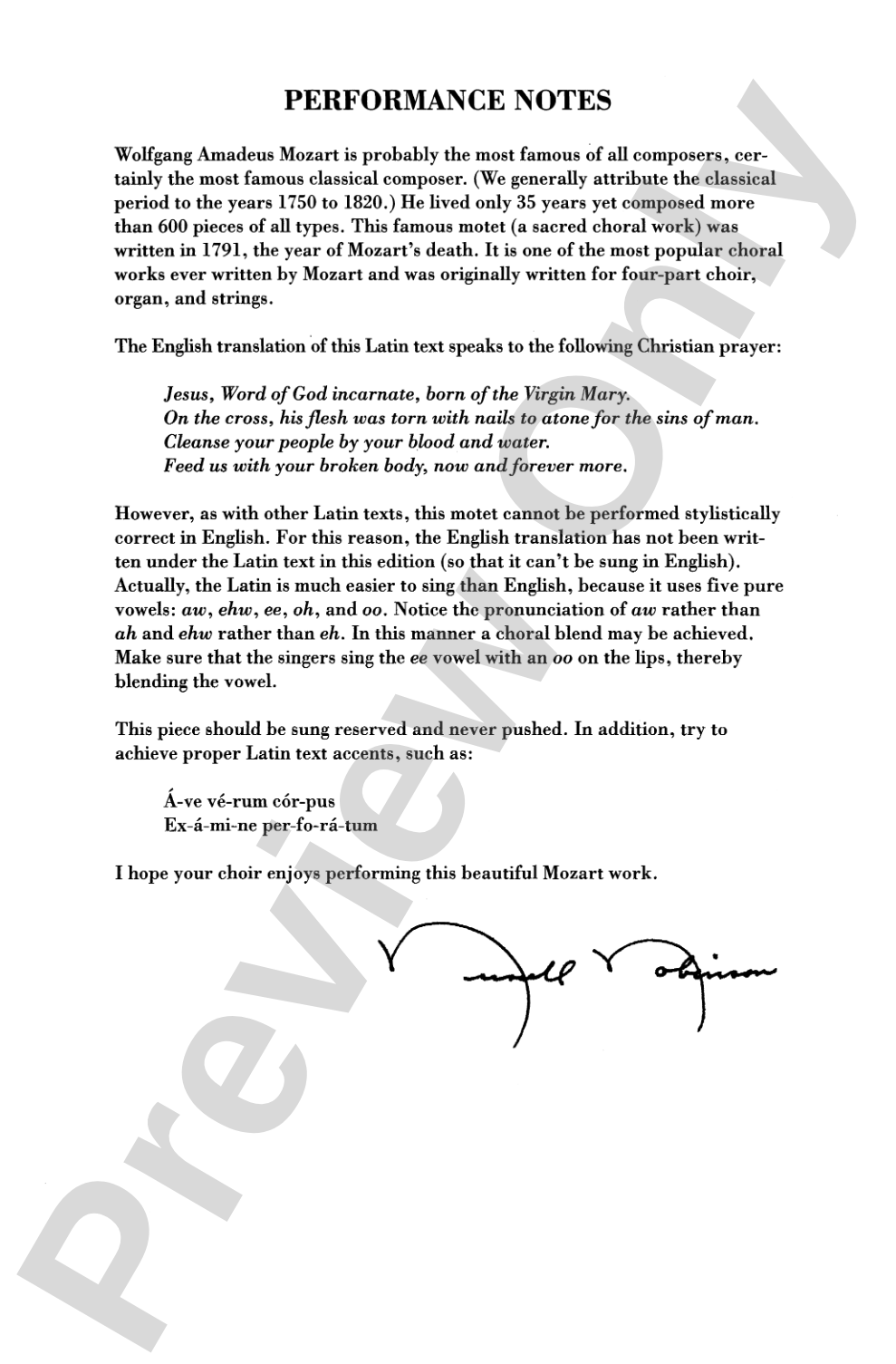
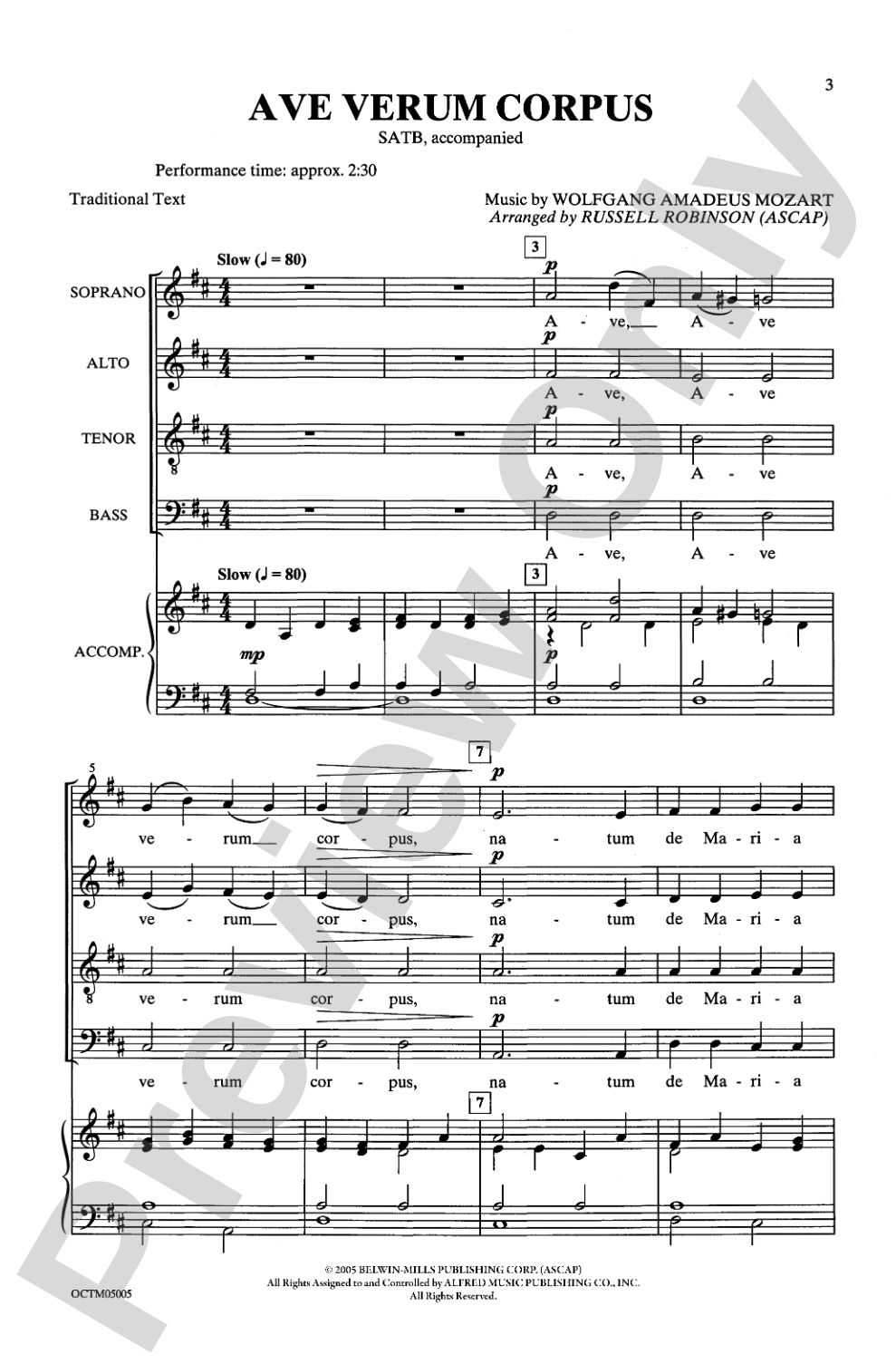
Originally written for four-part chorus, organ and strings, this motet is one of the most frequently performed Mozart choral works. Russell Robinson has adapted this work for our Developing SATB Repertoire series. Now your younger singers can experience the beauty of Mozart.


Don't just read it, hear it, play along with it, and watch your students grow with it. In MakeMusic Cloud, Ave Verum Corpus: SATB Choral Octavo comes alive with professional accompaniment, adjustable tempo, and built-in practice tools that turn solo practice into real progress.
Open in the Player
Jump straight in and assign it today.
Start Your Free Trial
Open this title and explore the full library in minutes.
Sample Audio
1
Audio File
--:--
0:00
0:00
Sample Video
No sample videos found.
Additional Details
Series:
Alfred Archive Edition: Developing SATB Repertoire Series
Publisher:
Alfred Music
Page Count:
8
SKU:
00-PO-0002716
More about this title
About the Composer: Wolfgang Amadeus Mozart
Wolfgang Amadeus Mozart (1756-1791) composed across every major genre of his era, from opera and symphony to chamber music and sacred works. His output was staggering in both volume and quality; he produced over 600 compositions during his lifetime, many of which remain cornerstones of the repertoire. Ave Verum Corpus, written late in his life, distills his mastery into a brief, profound meditation on faith and beauty.
Mozart's sacred music for choir reveals a composer deeply attuned to the human voice. His choral writing balances technical sophistication with accessibility, making his works teachable at multiple levels without sacrificing musical integrity. This arrangement honors that principle, opening his artistry to younger singers while preserving the essence of his original vision.
Why we love this
This adaptation gives developing choirs genuine Mozart without demanding advanced technique or maturity. The text carries profound spiritual weight, and Robinson's arrangement preserves the work's harmonic beauty while scaling the ranges and demands to fit Grade 3 singers. It's a pathway into classical sacred repertoire that your singers will sing with real understanding.
What to expect
Ave Verum Corpus emerges quietly, almost devotional, with a gentle harmonic language that invites contemplation. The writing radiates restraint and sincerity; there are no dramatic flourishes, only the sustained meditation of voices moving together in faith. Singing it creates a sense of reverence without requiring operatic grandeur.
Who it's for
Grade 3 SATB choirs with developing vocal control and music-reading skills. This arrangement serves singers ready to engage with classical sacred literature but who may not yet have the vocal range or sophistication for the original scoring. It works equally well for high school choirs seeking a shorter, manageable addition to a spring concert and for middle school ensembles building confidence in traditional four-part writing.
How to get the most out of it
- Shape the phrase arcs through sustained legit tone rather than dynamic swells; Mozart's long lines benefit from consistent supported singing throughout.
- Balance the voices so the soprano line sings clearly without dominance; this piece asks for blend that still projects each voice independently.
- Allow space between sections to let the text breathe and settle. Resist rushing into repeated phrases; silence is part of the reverence.
- Mark breath points carefully in rehearsal so all voices understand where air is taken; unified breath placement strengthens ensemble cohesion in this intimate setting.
How to use it
This piece fits naturally into a Holy Week or Lenten concert, where its liturgical origins and spiritual depth align with seasonal programming. It also serves as an excellent transition piece between larger concert works, offering a moment of stillness and focus. The eight-page length and moderate demands make it an ideal addition when you're programming mixed repertoire and need something that uplifts without exhausting your singers.
Skills your students will build
- Sustaining pure vowels and legit tone through long phrases
- Voice independence within four-part homophonic writing
- Approaching classical sacred text with appropriate reverence and clarity
- Reading and performing classical harmonic progressions and cadence points
- Blending within a choir while maintaining individual vocal security