

Ave Verum Corpus: 2-Part Choral Octavo
Music by Wolfgang Amadeus Mozart / arr. Russell Robinson
Item: 00-PO-0002703

$2.25
Minimum order quantity: 20 copies
Pickup currently not available
Description
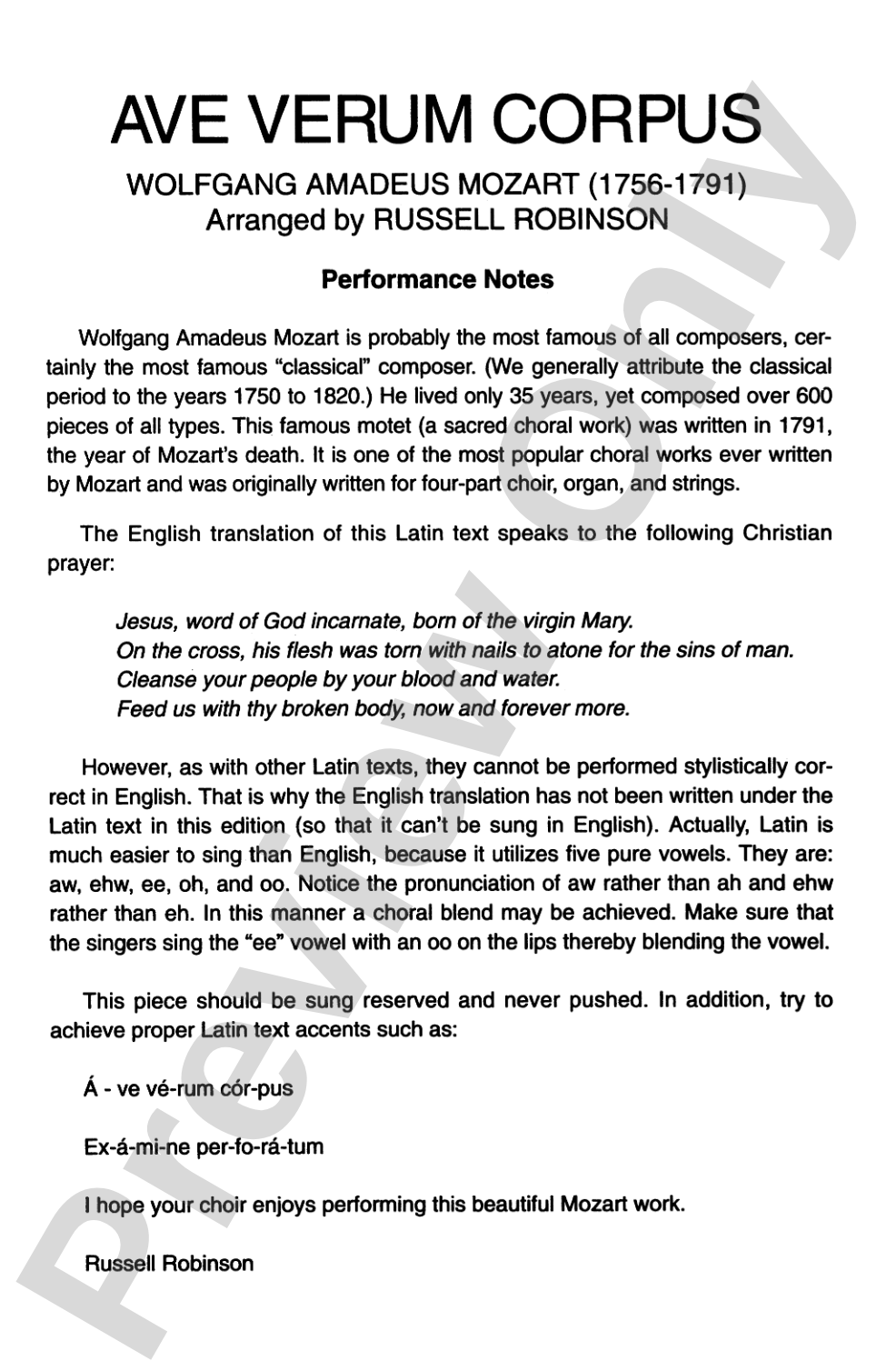
Originally written for four-part chorus, organ and strings, this motet is one of the most frequently performed Mozart choral works. Russell Robinson has adapted this work for our Developing SATB Repertoire series. Now your younger singers can experience the beauty of Mozart.


Don't just read it, hear it, play along with it, and watch your students grow with it. In MakeMusic Cloud, Ave Verum Corpus: 2-Part Choral Octavo comes alive with professional accompaniment, adjustable tempo, and built-in practice tools that turn solo practice into real progress.
Open in the Player
Jump straight in and assign it today.
Start Your Free Trial
Open this title and explore the full library in minutes.
Sample Audio
No sample audio found.
Sample Video
No sample videos found.
Additional Details
Series:
Alfred Archive Edition: Belwin Festival Series
Publisher:
Alfred Music
Page Count:
8
SKU:
00-PO-0002703
More about this title
About the Composer: Wolfgang Amadeus Mozart
Wolfgang Amadeus Mozart (1756-1791) composed sacred music throughout his career, from his earliest masses written as a child prodigy to the profound liturgical works of his maturity. His choral writing balances formal clarity with emotional depth, and his sacred motets remain cornerstones of choral repertoire in churches and concert halls worldwide.
Why we love this
This arrangement opens the door to authentic Classical sacred music for singers still building confidence. Russell Robinson has preserved Mozart's elegant voice leading and harmonic language while creating something genuinely singable for developing ensembles, making this a bridge between pop-style choral work and the real thing.
What to expect
A moment of reverent calm and crystalline beauty. Mozart's setting of this Eucharistic text unfolds with intimate grace, the two-part texture creating warmth without density, allowing the text to land clearly while the harmonic language conveys genuine spiritual presence.
Who it's for
This arrangement serves developing choirs, youth ensembles, and faith communities seeking accessible yet genuinely musical sacred repertoire. It works equally well for singers gaining experience with part-singing and for conductors building a foundation of Classical masterworks.
How to get the most out of it
- Shape the phrases with gentle dynamics rather than dramatic contrast. The beauty lives in sustained vocal tone and careful attention to the text's spiritual weight.
- Balance the two parts equally so neither overwhelms. In Classical writing, independence between voices matters as much as blend.
- Allow the organ or piano accompaniment to breathe during vocal entrances. Clarity of the choral lines depends on adequate space.
How to use it
Program this during Holy Week or Lenten services where contemplative yet musically substantial work enhances worship. It pairs naturally with other spring sacred repertoire and provides a meaningful contrast to contemporary choral settings.
Skills your students will build
- Singing in two-part voicing with maintained independence
- Sustaining legato lines and understanding phrase architecture in Classical style
- Navigating the balance between text clarity and vocal beauty
- Responding to organ or piano accompaniment with ensemble precision