
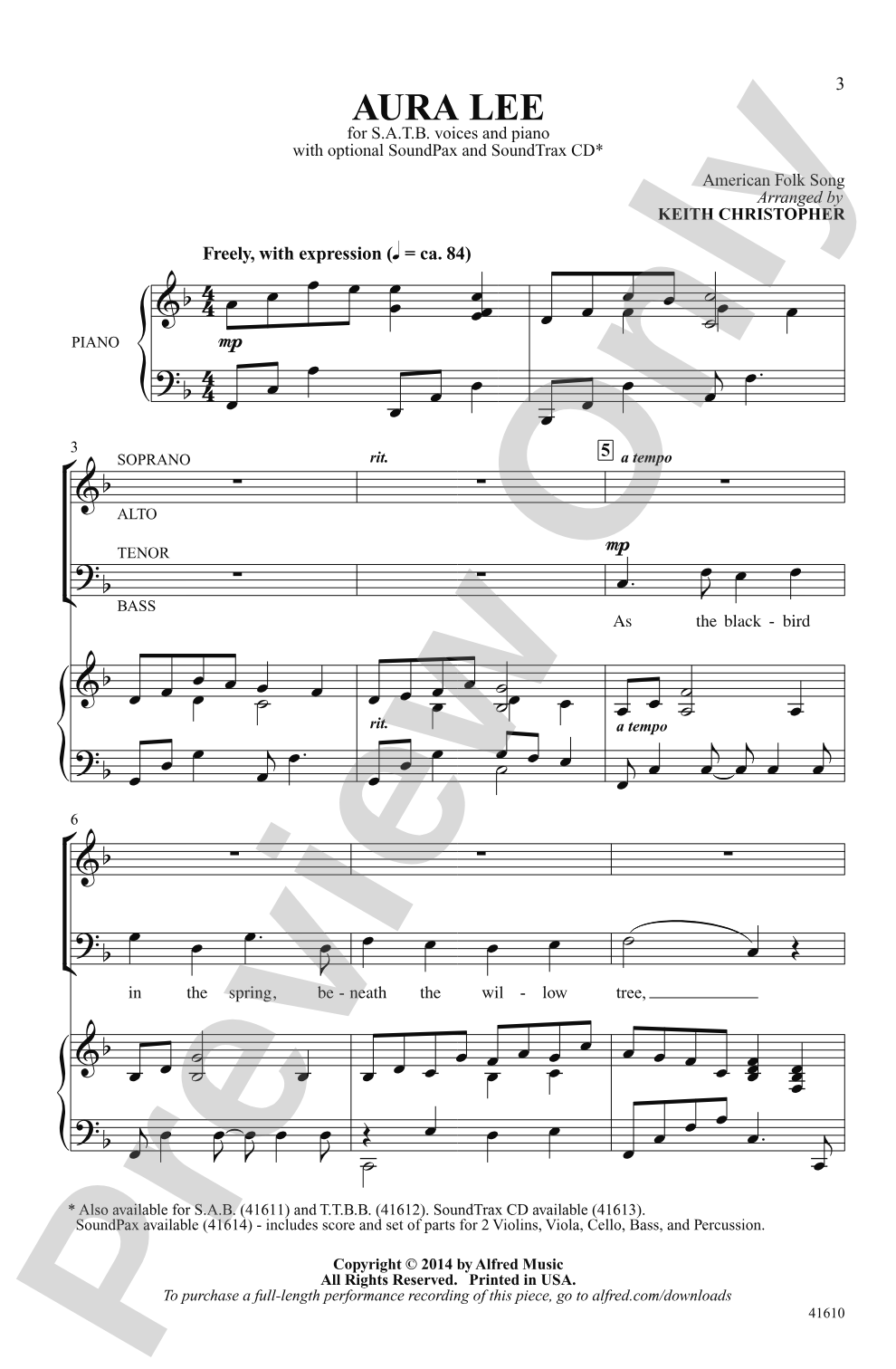
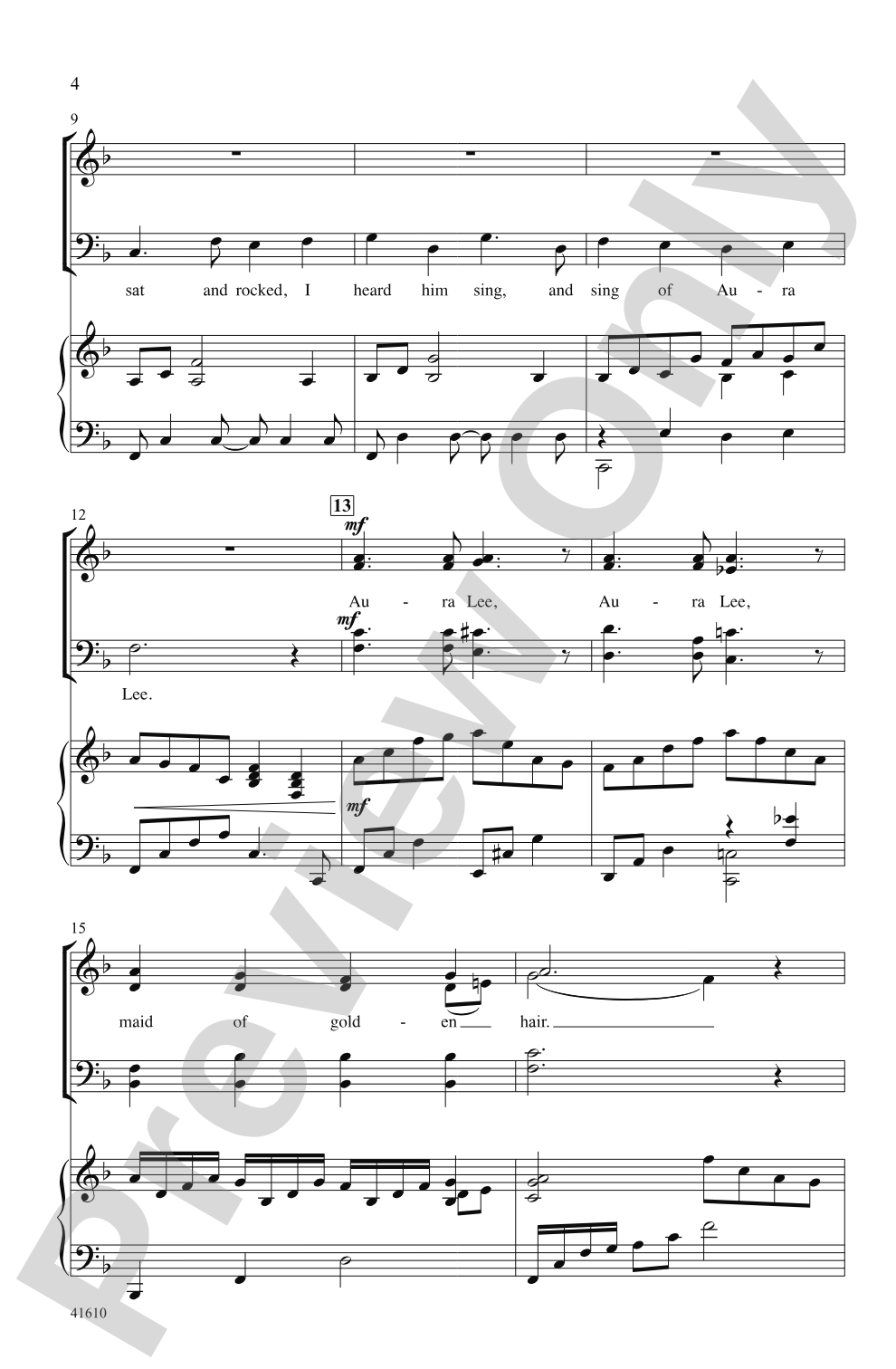

Aura Lee: SATB Choral Octavo
American Folk Song / arr. Keith Christopher
Item: 00-PO-0001828
$1.85
Minimum order quantity: 20 copies
Pickup currently not available
Related Items
Aura Lee: SoundTrax Digital Audio Download |
$27.99
|
View | |
Aura Lee: SAB Choral Octavo |
$1.85
|
View | |
Aura Lee: TTBB Choral Octavo |
$1.85
|
View | |
Aura Lee: SATB Choral Octavo |
$1.85
|
View | |
Aura Lee: SAB Choral Octavo |
$1.85
|
View | |
Aura Lee: TTBB Choral Octavo |
$1.85
|
View | |
Aura Lee: Choral Octavo SoundTrax CD |
$27.99
|
View |
Description
Masterfully crafted with a traditional harmonization, this piece is an eloquent showcase for mixed or men's choirs. The addition of the SoundPax instrumentation (strings, flute, and percussion) will make the arrangement shimmer. A gorgeous treatment of an American classic.


Aura Lee: SATB Choral Octavo isn't in MakeMusic Cloud just yet...but it could be. Let us know you'd like to see it, and you'll help shape what comes next. In the meantime, start a free trial and dive into thousands of interactive titles your students can play along with today.
Request This Title
Tell us you want it.
Start Your Free Trial
Explore everything that's ready to play right now.
Sample Audio
1
Audio File
--:--
0:00
0:00
Sample Video
No sample videos found.
Additional Details
Series:
Alfred Choral Designs
Publisher:
Alfred Music
Page Count:
12
SKU:
00-PO-0001828
More about this title
About the Arranger: Keith Christopher

Keith Christopher brings decades of experience as a composer, arranger, and lyricist to his work across multiple genres and ensembles. His catalog spans hundreds of pieces for choir, band, and orchestra published by major houses worldwide, and his arrangements and compositions have been performed internationally. His contributions to music publishing have earned him consistent recognition from the American Society of Composers, Authors, and Publishers since 1992, as well as a Gold Record Award for "A Merry Christmas with Brass" with The Dallas Brass and a Dove Award for the choral collection More Songs for Praise and Worship.
Beyond composition and arrangement, Christopher has shaped the music publishing industry through production work on over a thousand recordings for publishers. He is also the author of the children's book The First Christmas Night. Based in the Nashville, Tennessee area, he continues to create music that serves performers and audiences across educational and professional settings.
Why we love this
Christopher's arrangement respects the melody's strength while building a harmonic architecture that rewards careful ensemble listening. The flexibility to perform with or without the SoundPax accompaniment makes this work equally at home in a more intimate setting or a fully orchestrated concert moment, giving your choir genuine programming control.
What to expect
Warm and nostalgic without sentimentality, this arrangement wraps a beloved melody in rich harmonic color that feels both familiar and freshly voiced. The traditional treatment invites singers into the emotional landscape of the song while the carefully crafted voicing creates moments of subtle beauty in the background textures.
Who it's for
Mixed choirs and men's ensembles seeking a standard-repertoire piece that combines accessibility with artistic depth. Directors preparing for festival performances or building a concert program around American choral classics will find this octavo immediately singable while offering enough harmonic interest to sustain musicianship growth.
How to get the most out of it
- Balance the harmonic inner voices with the melody; the traditional voicing creates points where altos and tenors carry important harmonic color that shouldn't disappear under soprano dominance.
- If using the recorded accompaniment, begin rehearsals with voices alone to establish the harmonic relationships independently, then layer in the tracks during final preparation.
- Shape the phrase endings with slight ritardandi to honor the folk song's gentle character; avoid rushing through cadences even in uptempo passages.
How to use it
Program this alongside other folk song arrangements or American standards to create a thematic set, or use it as an anchor piece in a concert that moves between styles. The 12-page length and moderate difficulty make it suitable for mid-program placement, where it can provide both familiarity and musical substance without demanding the technical intensity of a concert opener or finale.
Skills your students will build
- Balancing melody against harmonic inner voices in traditional voicing
- Sustaining phrase shapes across longer musical lines
- Blending SATB tone in a folk song context
- Responding to instrumental accompaniment cues (when using recorded tracks)