
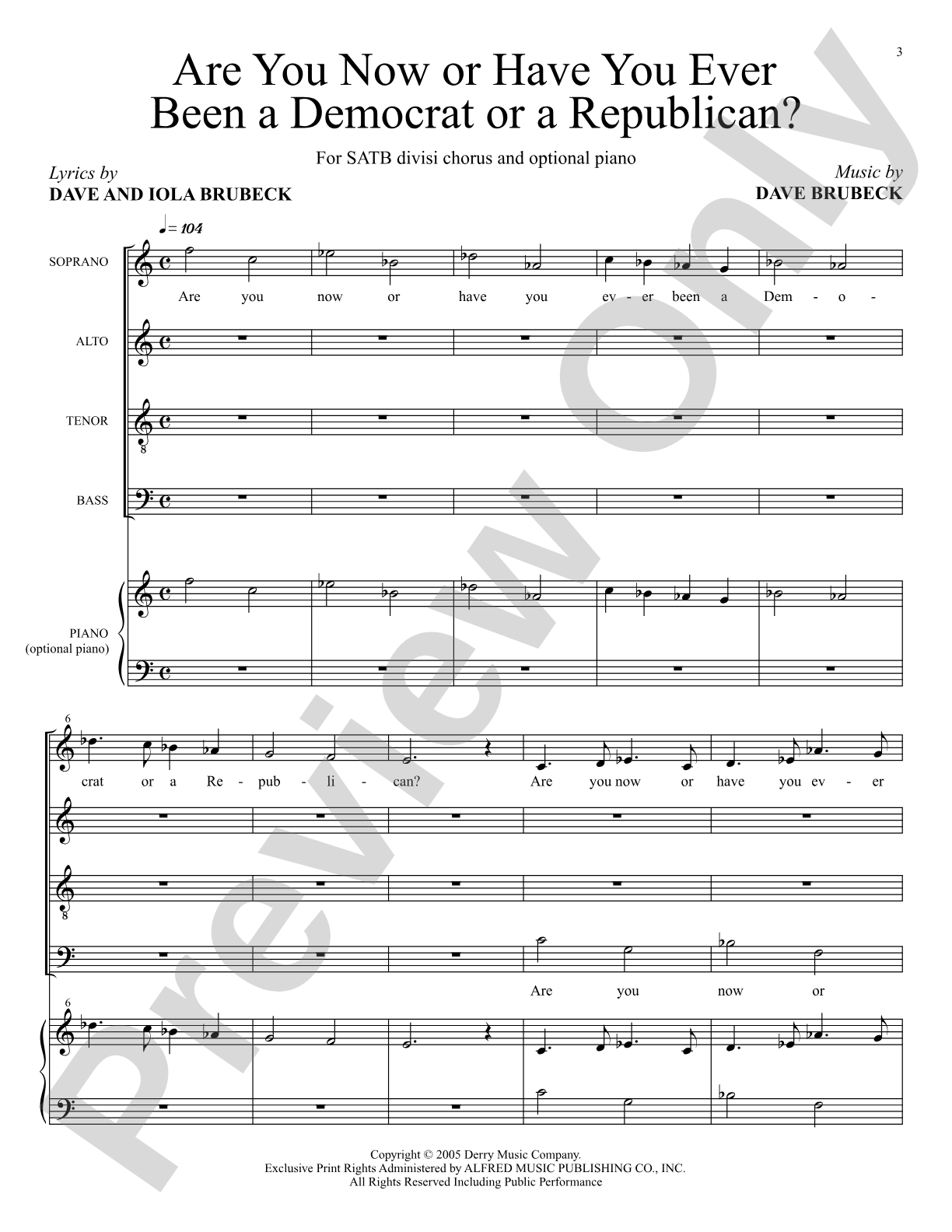
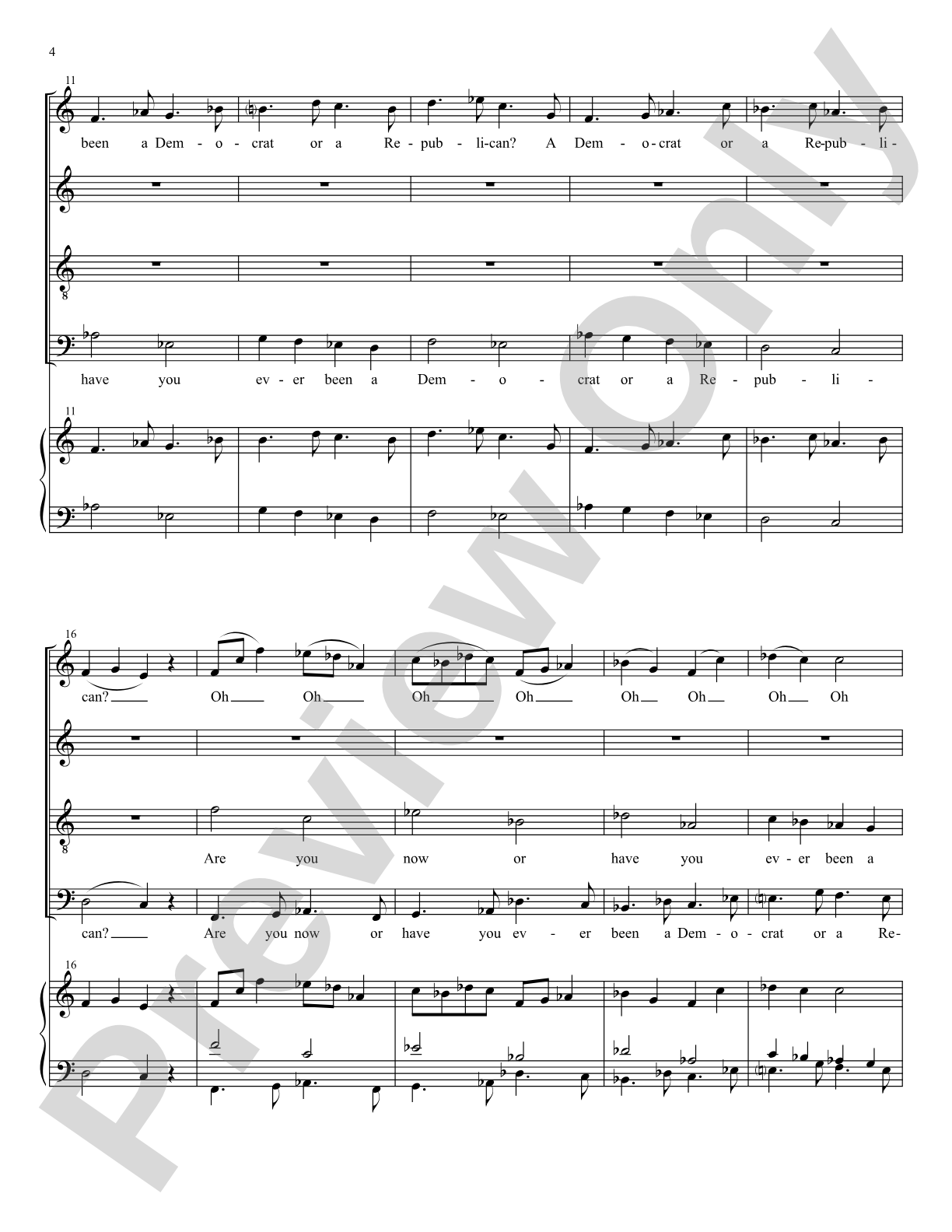

Are You Now or Have You Ever Been a Democrat or a Republican?: SATB Choral Octavo
Lyrics by Dave and Iola Brubeck, music by Dave Brubeck
Item: 00-PO-0004398
$2.95
Minimum order quantity: 20 copies
Pickup currently not available
Related Items
Are You Now or Have You Ever Been a Democrat or a Republican?: SATB Choral Octavo |
$2.95
|
View |
Description


Are You Now or Have You Ever Been a Democrat or a Republican?: SATB Choral Octavo isn't in MakeMusic Cloud just yet...but it could be. Let us know you'd like to see it, and you'll help shape what comes next. In the meantime, start a free trial and dive into thousands of interactive titles your students can play along with today.
Request This Title
Tell us you want it.
Start Your Free Trial
Explore everything that's ready to play right now.
Sample Audio
No sample audio found.
Sample Video
No sample videos found.
Additional Details
Series:
Lawson-Gould: The Dave Brubeck Series
Publisher:
Alfred Music
Page Count:
16
SKU:
00-PO-0004398
More about this title
About the Composer: Dave Brubeck
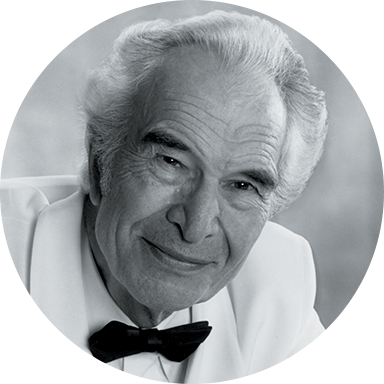
Dave Brubeck stands as one of the twentieth century's most significant jazz pianists, renowned for his improvisational gifts and his ability to synthesize jazz language with classical composition. Beyond "Take Five" and the groundbreaking album "Time Out," he composed extensively across genres: choral works, hymns, orchestral pieces, chamber music, ballets, and large-scale works for chorus and orchestra. His studies with Darius Milhaud at Mills College after World War II shaped his approach to blending jazz idioms with classical forms, a fusion that defines his output as a composer.
Brubeck's influence extended beyond music into civil rights; he was instrumental in dismantling racial barriers in the mid-twentieth century. His sacred works, including the mass "To Hope!" and oratorios like "The Voice of the Holy Spirit" and "Beloved Son," have been recorded by major ensembles and performed internationally. He received the Grammy Lifetime Achievement Award for his jazz contributions, the Presidential Medal of the Arts from President Clinton, and in 2007 was honored with a lifetime achievement award by the London Symphony Orchestra. In 2003, he was inducted into the American Classical Music Hall of Fame.
Why we love this
Brubeck's secular choral writing brings jazz sensibility into the choral rehearsal without resorting to parody or simplification. This octavo demonstrates his gift for creating singable, engaging harmonies that reflect his classical training while preserving the rhythmic sophistication jazz musicians expect. Programming it signals to your singers that their repertoire encompasses more than traditional art song and contemporary classical work.
What to expect
The title itself invites listeners into mid-twentieth-century American political consciousness with a directness that's both humorous and thought-provoking. Musically, the piece combines Brubeck's jazz harmonies with choral accessibility, creating a texture that feels modern, intelligent, and approachable in equal measure.
Who it's for
College and advanced high school choirs looking to expand beyond standard repertoire into works that engage with American cultural dialogue. Ensembles comfortable with rhythmic independence and singers who appreciate text-driven, contemporary secular works will find this piece particularly rewarding.
How to get the most out of it
- Balance the ensemble so that harmonic color emerges; Brubeck's jazz-influenced voicings reward clarity over blend.
- Keep the text delivery conversational and rhythmically precise, letting the spoken-word quality of the title guide phrasing rather than imposing operatic legit.
- Establish a steady, relaxed pulse that serves the harmonic movement rather than driving it forward; jazz-influenced music often benefits from space around the beat.
- Highlight any rhythmic syncopation between parts as a feature, not an obstacle; these moments reflect Brubeck's compositional voice.
How to use it
Position this alongside other twentieth-century secular choral works to frame a concert section on American cultural commentary and identity. It works equally well as a season opener that establishes your choir's range and sensibility or as a closing number that leaves audiences engaged with both musical craft and meaningful text.
Skills your students will build
- Reading jazz-influenced harmonic progressions and seventh chord voicings
- Maintaining independence in syncopated rhythmic figures while singing sustained harmonies
- Text delivery with conversational clarity in a contemporary secular context
- Ensemble balance in extended tertian harmonies without traditional doubling patterns