
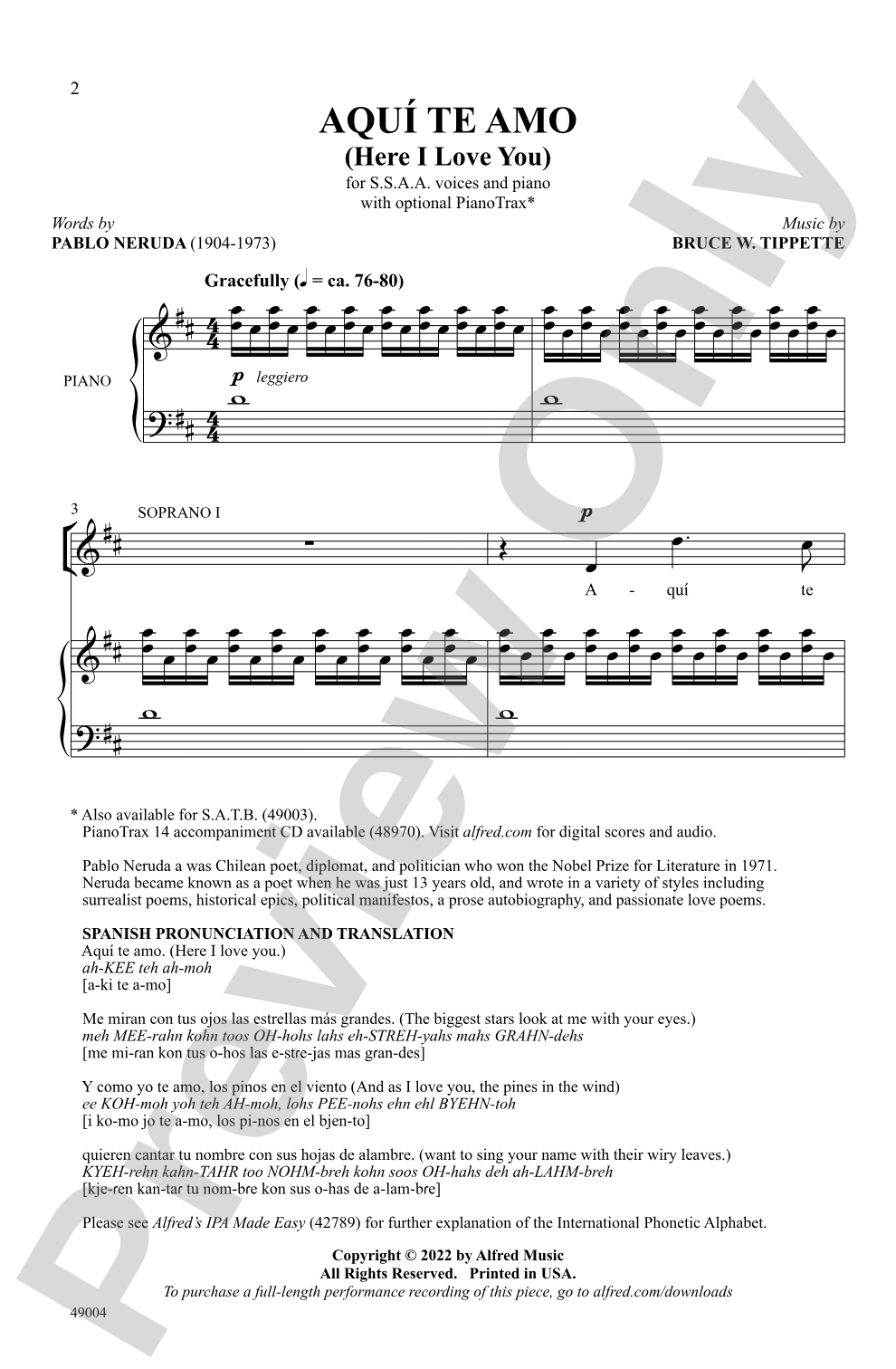

Aquí Te Amo: SSAA Choral Octavo
(Here I Love You)
Words by Pablo Neruda, music by Bruce W. Tippette
Item: 00-PO-0006877

$2.20
Minimum order quantity: 20 copies
Pickup currently not available
Description
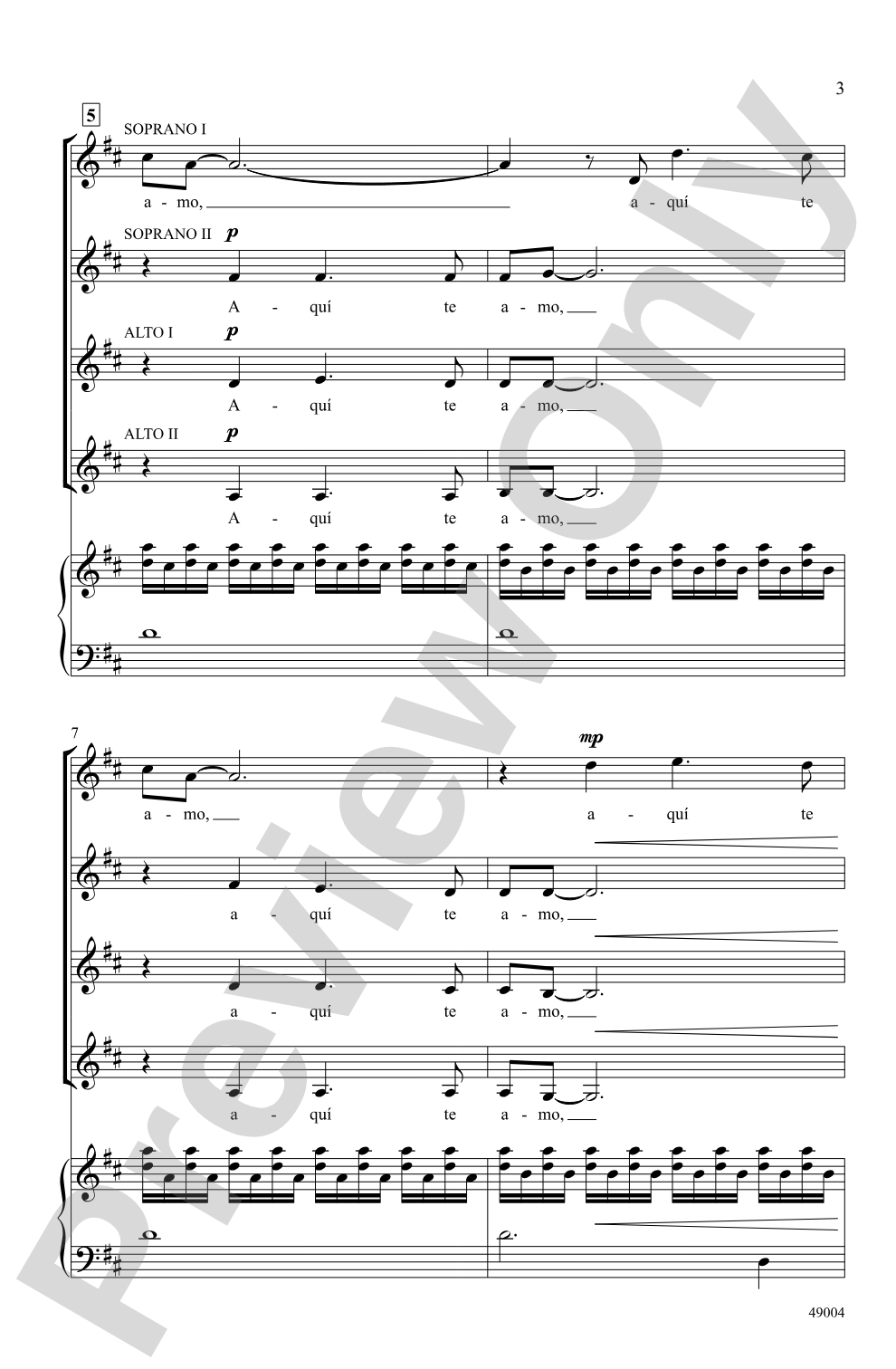
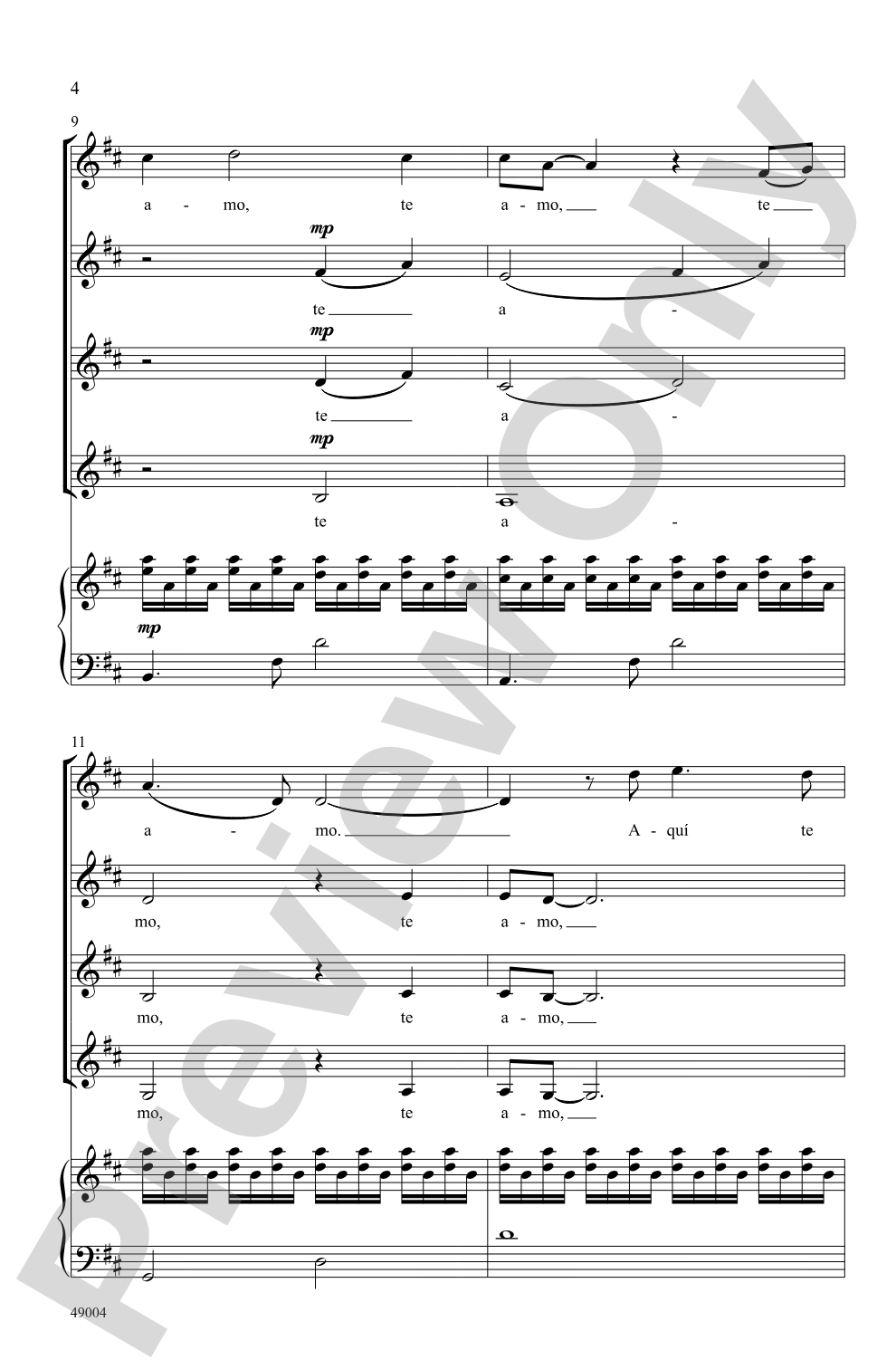
Textured choral writing glides effortlessly over a graceful piano accompaniment in this elegant setting of the romantic text by Chilean poet and Nobel Prize-winner Pablo Neruda. Variations in tempo and contrasts in dynamics guide singers to a nuanced performance of a fully developed form, creating a complete musical story. The purity of Spanish vowels invites beautiful choral singing (phonetic and IPA pronunciation guide included). Exquisite. This title is available in MakeMusic Cloud.


Don't just read it, hear it, play along with it, and watch your students grow with it. In MakeMusic Cloud, Aquí Te Amo: SSAA Choral Octavo comes alive with professional accompaniment, adjustable tempo, and built-in practice tools that turn solo practice into real progress.
Open in the Player
Jump straight in and assign it today.
Start Your Free Trial
Open this title and explore the full library in minutes.
Sample Audio
1
Audio File
--:--
0:00
0:00
Sample Video
Additional Details
Series:
Lawson-Gould
Publisher:
Alfred Music
Page Count:
16
SKU:
00-PO-0006877
More about this title
About the Composer: Bruce W. Tippette

Bruce W. Tippette brings both compositional rigor and pedagogical insight to his work. A graduate of Appalachian State University and the University of North Carolina School of the Arts, where he earned his Master of Music in composition, Tippette has built a portfolio of commissioned works performed internationally across concert, film, and theatrical contexts. His orchestral work Unconquered won the 2012 Mary Starling Composition Competition and received multiple subsequent performances by the Winston-Salem Symphony, while his piano solo Dance of Fire earned the Lynn Freeman Olson Composition Award.
At the Community Music School of the University of North Carolina School of the Arts, Tippette teaches composition, theory, piano, and voice while maintaining an active practice as a collaborative pianist, rehearsal accompanist, and freelance music engraver. His experience spans choral and instrumental composition, choreography, children's musical theater, and experimental multimedia projects. He serves as Youth Music and Handbell Director at Augsburg Lutheran Church in Winston-Salem, where he resides with his family.
Why we love this
Tippette's setting honors Neruda's romantic text while offering singers genuine musical substance. The strategic use of tempo and dynamic contrast prevents this from becoming a simple love song; instead, it unfolds as a complete artistic statement with textural variety that rewards careful rehearsal and reveals new details in each pass.
What to expect
Graceful and introspective, with the kind of harmonic warmth that comes from textured writing rather than simple block chords. The music has an unhurried quality that invites singers to inhabit the poetry, creating intimate moments within a fully developed musical form.
Who it's for
Advanced high school and college choirs with strong intonation and the capacity to sustain legit singing across a romantic text. This piece works equally well for concert performances and festival competitions, offering enough musical substance to justify serious preparation.
How to get the most out of it
- Attend to the phonetic and IPA pronunciation guide provided. Spanish vowel purity shapes the emotional core of this piece, so invest rehearsal time in achieving consistent, open vowel production across all four voices.
- Map the tempo and dynamic variations before sectional rehearsals. These shifts are the primary narrative tool; singers need to understand how each change serves the poetry and contributes to the overall arc.
- Balance the piano accompaniment carefully. The grace of the accompaniment depends on transparency in the upper voices; avoid letting the choral parts cover the harmonic support underneath.
- Use the full 16-page score to explore how Tippette develops material across the form. Identify which musical ideas return and which emerge only once, then shape those moments accordingly in performance.
How to use it
Pair this with other art song settings to create a recital centered on literary texts, or program it as a sophisticated choral selection in a concert that includes both sacred and secular works. The elegance and poetic foundation make it an ideal choice for spring concerts or competitions where thoughtful interpretation matters.
Skills your students will build
- Sustained legit singing across romantically inflected harmonic language
- Spanish vowel production and IPA application in performance
- Navigation of tempo and dynamic variations as expressive tools
- Blending four independent voice parts while maintaining textural balance
- Interpretation of poetry through musical phrasing and dynamic shaping