
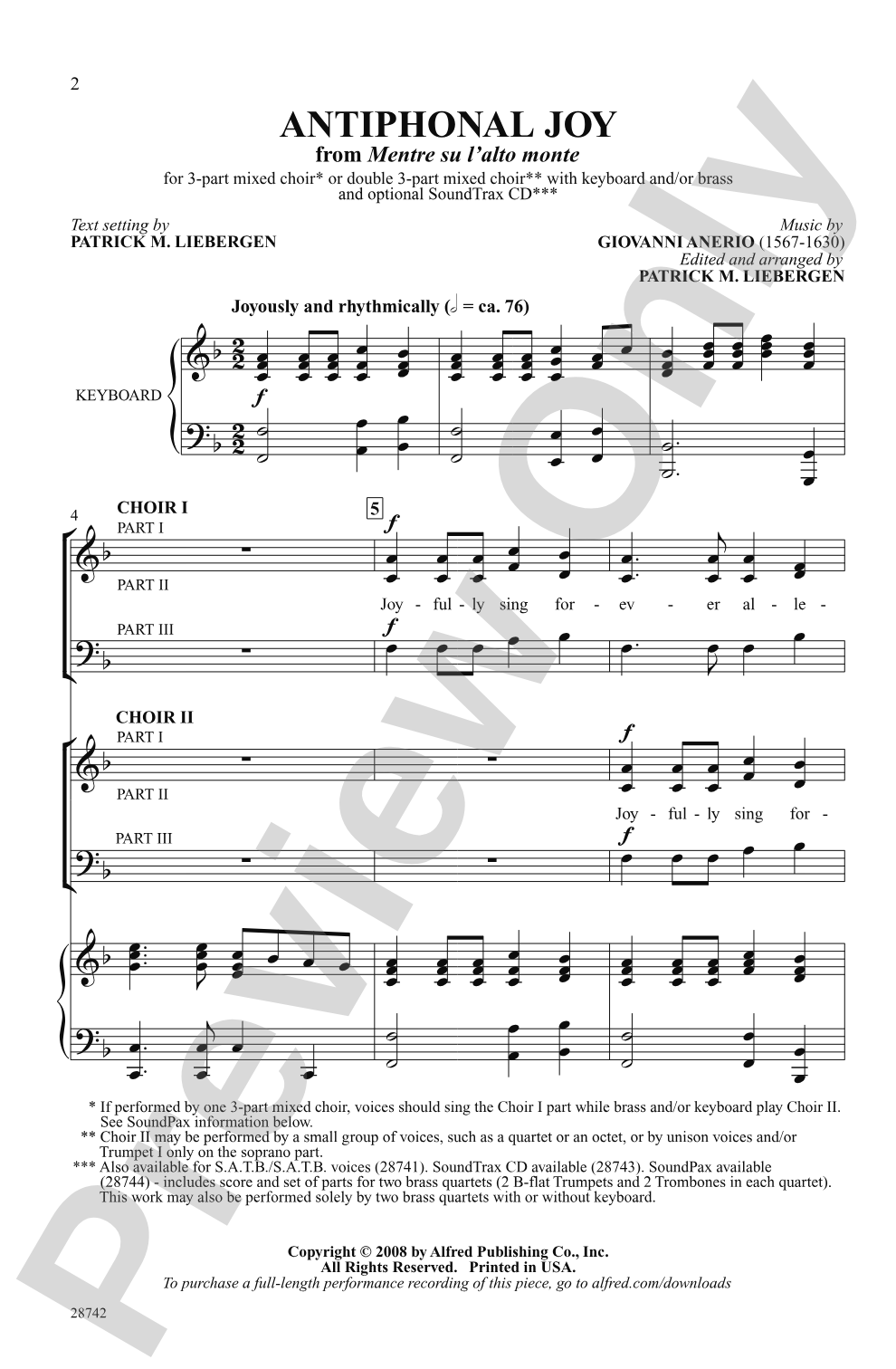
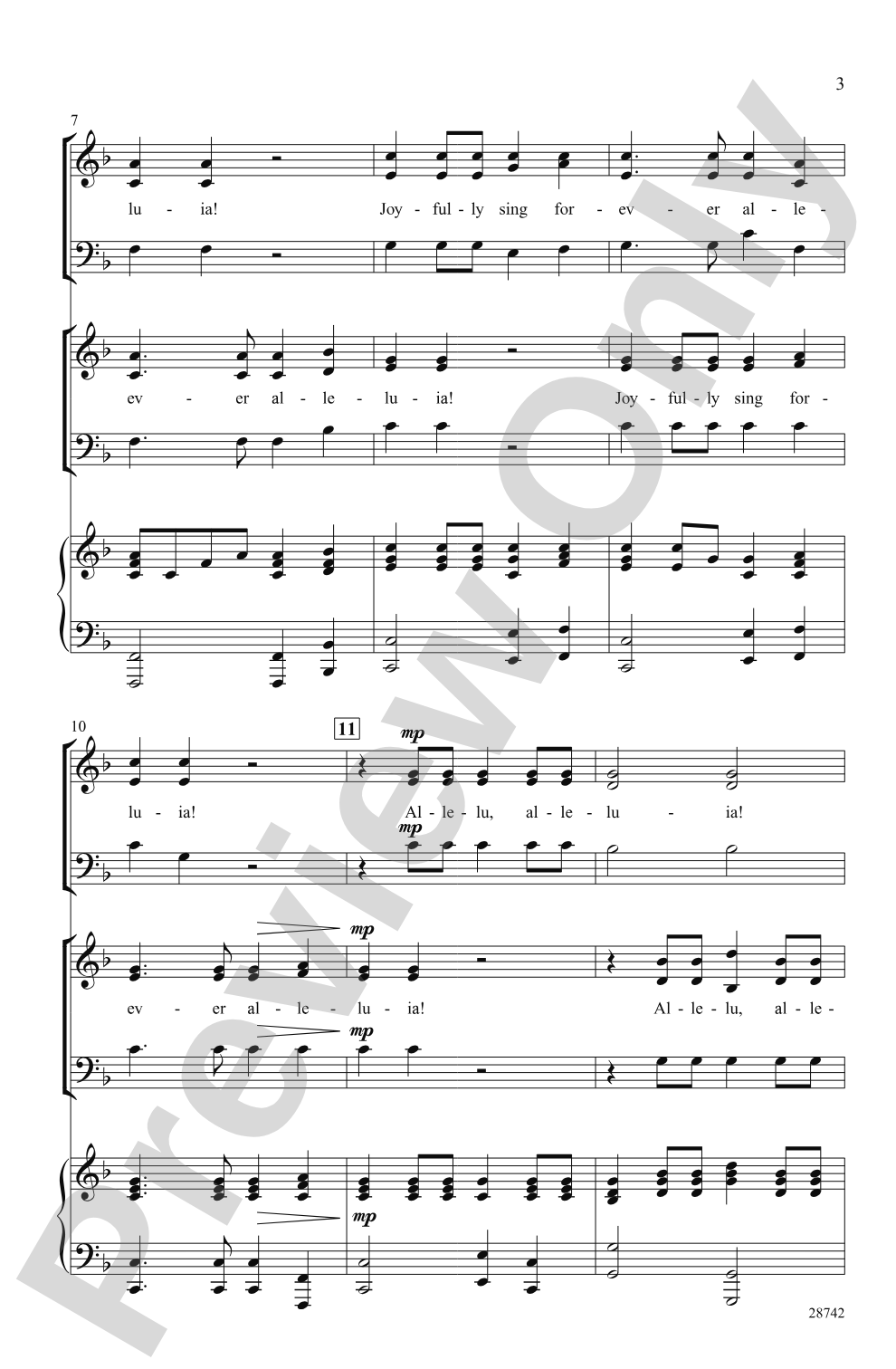

Antiphonal Joy (from Mentre su l'alto monte): 3-Part Mixed Choral Octavo
From Mentre su l'alto monte
Music by Giovanni Anerio / ed. and arr., with English text, by Patrick M. Liebergen
Item: 00-PO-0000558
$1.75
Minimum order quantity: 20 copies
Pickup currently not available
Related Items
Antiphonal Joy: SoundTrax Digital Audio Download |
$24.95
|
View | |
Antiphonal Joy (from Mentre su l'alto monte): SATB Choral Octavo |
$1.75
|
View | |
Antiphonal Joy (from Mentre su l'alto monte): Choral SoundPax |
$25.00
|
View | |
Antiphonal Joy: SATB Choral Octavo |
$1.75
|
View | |
Antiphonal Joy: 3-Part Mixed Choral Octavo |
$1.75
|
View | |
Antiphonal Joy: Choral Octavo SoundTrax CD |
$24.95
|
View | |
Antiphonal Joy: Choral SoundPax |
$25.00
|
View |
Description
A fine antiphonal masterwork for today's mixed choirs. May be performed by one choir with any of the following performing the antiphonal part: a second choir, a small group of voices, a brass quartet, or solo trumpet. A powerful, yet not-too-difficult oratorio chorus.


Antiphonal Joy (from Mentre su l'alto monte): 3-Part Mixed Choral Octavo isn't in MakeMusic Cloud just yet...but it could be. Let us know you'd like to see it, and you'll help shape what comes next. In the meantime, start a free trial and dive into thousands of interactive titles your students can play along with today.
Request This Title
Tell us you want it.
Start Your Free Trial
Explore everything that's ready to play right now.
Sample Audio
1
Audio File
--:--
0:00
0:00
Sample Video
No sample videos found.
Additional Details
Series:
Alfred Choral Designs
Publisher:
Alfred Music
Page Count:
8
SKU:
00-PO-0000558
More about this title
About the Composer: Giovanni Anerio
Giovanni Anerio (1567-1621) was an Italian Renaissance composer who served in the papal chapel and worked across both sacred and secular genres. His fluency in polyphonic writing and gift for lyrical melody made him a respected figure in Rome during the late Renaissance, and his music circulated widely throughout Italy and beyond.
Why we love this
Patrick Liebergen's arrangement preserves the elegant counterpoint and antiphonal drama of Anerio's original while making it genuinely singable for mixed voices without sacrificing musical substance. The flexibility to swap in instrumental answering phrases (trumpet or brass quartet) solves the real logistics problem of programming an antiphonal work when a second choir isn't available, yet the piece never feels like a workaround.
What to expect
Antiphonal Joy radiates Renaissance poise and architectural clarity. The alternating voices create a sense of dialogue and mutual answering, building toward moments of unified grandeur while the lyrical melody and smooth harmonic language give the work an almost courtly elegance.
Who it's for
This octavo serves intermediate to advanced mixed choirs seeking repertoire with real musical substance and performing flexibility. It works equally well for choirs with access to a second ensemble, a strong solo trumpet or brass section, and choirs that want to feature a small group of soloists within the larger choir.
How to get the most out of it
- Establish the character of each antiphonal section before rehearsing them together. The choir and respondent (whether voices, trumpet, or brass) inhabit slightly different sonic worlds, so clarify the mood and tone of each independently first.
- Lock the rhythmic pulse in the main choir part before adding the antiphonal exchange. A wandering tempo between sections will blur the dialogue rather than sharpen it.
- If using a small vocal group for the antiphonal part, position them visually apart from the main choir so singers and audience can hear the spatial conversation the music creates.
- Shape the text within each phrase rather than treating antiphonal exchanges as call-and-response. The music flows across the dialogue, so avoid hard attacks and releases at phrase boundaries.
How to use it
This piece works brilliantly as a choral centerpiece in a concert exploring Renaissance or early Baroque repertoire, or as a powerful standalone number in a mixed choral concert. It also provides a sophisticated way to feature a trumpet soloist or brass quartet alongside the choir without requiring a separate chamber music segment.
Skills your students will build
- Singing in ensemble across antiphonal exchanges with independent rhythmic and harmonic parts
- Balancing between solo/small group and full choir textures
- Renaissance polyphonic singing (linear phrasing, counterpoint awareness)
- Coordinate chamber ensemble (voices with instrumental soloists or small groups)