
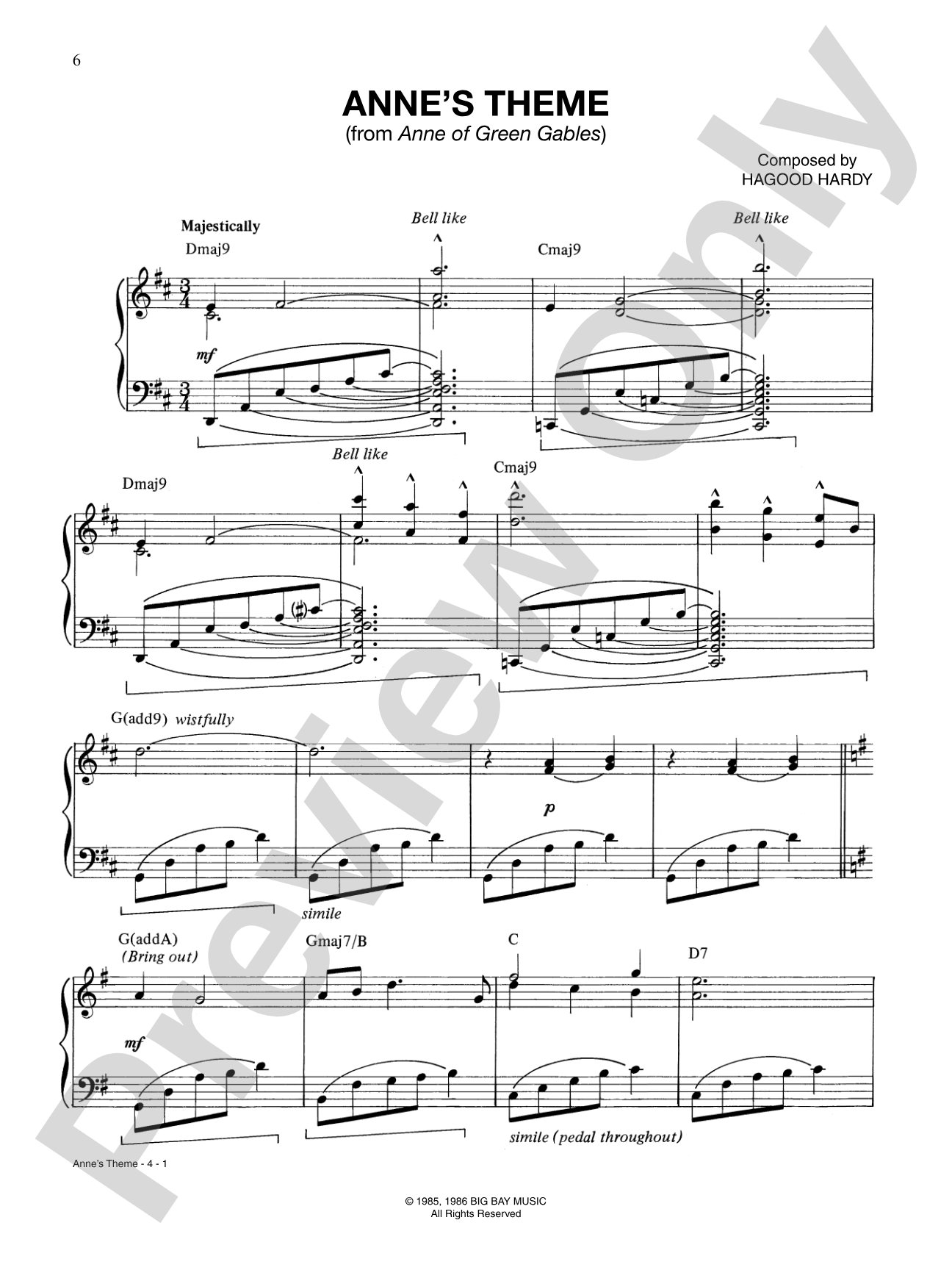

Anne's Theme: Piano
Item: 00-PS-0015711
$4.99
One moment…
Related Items
The Ballad of Gilligan's Isle: Piano/Vocal/Chords |
$4.99
|
View | |
I Have a Dream: Piano/Vocal/Chords |
$4.99
|
View | |
I Don't Want to Miss a Thing: Piano/Vocal/Chords |
$5.99
|
View | |
Munchkinland Musical Sequence: Piano/Vocal/Chords |
$9.99
|
View | |
The Lucky One (Main Theme): Piano |
$4.99
|
View | |
The Giant Book of Movie & TV Sheet Music: Piano/Vocal/Guitar Book |
$24.99
|
View |
Description
This volume contains sheet music for dozens of cherished songs and themes by Hollywood's greatest composers and songwriters! Pianists, singers, and aspiring media composers will find unlimited hours of fun and inspiration among the nearly 250 pages of music in this giant collection, which features musical highlights from 75 years of entertainment history. Titles: Anne of Green Gables: Anne's Theme * Argo: The Mission * Armageddon: I Don't Want to Miss a Thing * August Rush: August Rush Rhapsody (Piano Suite) * Batman (TV series): Batman Theme * Batman Begins: Corynorhinus (Surveying the Ruins) * The Big Bang Theory: Main Title Theme * Corpse Bride: Main Title, Victor's Piano Solo * The Dark Knight: The Dark Knight Overture * Downton Abbey: Downton Abbey - The Suite * Dr. No: James Bond Theme * Extremely Loud & Incredibly Close: Main Theme * Fame: Out Here on My Own * Gilligan's Island: The Ballad of Gilligan's Isle * Harry Potter and the Deathly Hallows - Part 2: Lily's Theme * Harry Potter and the Half-Blood Prince: Harry and Hermione, When Ginny Kissed Harry * Harry Potter and the Sorcerer's Stone: Harry's Wondrous World, Hedwig's Theme, Nimbus 2000 * The Hobbit: An Unexpected Journey: The Adventure Begins, Song of the Lonely Mountain, A Very Respectable Hobbit * Inception: Time * The Lord of the Rings: The Fellowship of the Ring: Concerning Hobbits, In Dreams * The Lord of the Rings: The Return of the King: Into the West * The Lord of the Rings: The Two Towers: Rohan * Love Affair: Theme from Love Affair * The Lucky One: Main Theme * Mamma Mia!: Dancing Queen, I Have a Dream * Man of Steel: Flight, Look to the Stars * Masterpiece Theatre: The Masterpiece * Music and Lyrics: Way Back into Love * The Notebook: Main Title * Once: Falling Slowly, When Your Mind's Made Up * The Pink Panther: The Pink Panther * The Polar Express: Believe * Rock of Ages: Don't Stop Believin' * Rocky: Gonna Fly Now * Sherlock Holmes: Discombobulate * Singin' in the Rain: Singin' in the Rain * The Wizard of Oz: Munchkinland Musical Sequence, Over the Rainbow.


Anne's Theme: Piano isn't in MakeMusic Cloud just yet...but it could be. Let us know you'd like to see it, and you'll help shape what comes next. In the meantime, start a free trial and dive into thousands of interactive titles your students can play along with today.
Request This Title
Tell us you want it.
Start Your Free Trial
Explore everything that's ready to play right now.
Sample Audio
No sample audio found.
Sample Video
No sample videos found.
Additional Details
Series:
The Giant Book of Sheet Music
Publisher:
Alfred Music
Page Count:
240
SKU:
00-PS-0015711
More about this title
Why we love this
This collection bypasses the usual barrier between film and classroom by gathering iconic film and television themes in fully realized piano arrangements. Students immediately recognize these melodies, which transforms what might feel like a textbook exercise into genuine musical engagement. The breadth of styles and compositional approaches across 75 years of entertainment history gives pianists a rare survey of how melody and harmony serve storytelling.
What to expect
You are stepping into a cinema. These arrangements distill the emotional core of each moment they represent, whether a swooping action theme, a tender character moment, or an unforgettable TV opening. The piano becomes both an instrument and a time machine, bridging decades of storytelling through melody.
Who it's for
Pianists seeking repertoire with immediate emotional resonance, from high school students building confidence through recognizable material to adult recreational players looking for engaging arrangements. Music educators can use individual selections to motivate reluctant students or as springboards into discussions about film scoring and orchestration.
How to get the most out of it
- Study the recorded versions alongside the sheet music to hear how orchestral textures translate into solo piano voicings, then find your own balance between fidelity and what your hands can manage.
- Treat theme recognition as a performance asset. The audience's familiarity with these melodies is part of the appeal, so lean into clarity of line rather than overcomplicating the arrangement.
- Group several shorter themes together in a single recital slot to create a cinematic flow, moving between contrasting moods and tempos rather than performing them in isolation.
- Mark up your score with dynamics and tempo variations before the first full run-through; these arrangements often call for interpretive choices that aren't always notated.
How to use it
Program selections thematically around a concert concept (fantasy adventure themes, dramatic overtures, romantic interludes) rather than scattering them throughout. A mixed recital gains coherence and accessibility when grouped this way, and audiences naturally anticipate the familiar strains. Individual pieces also work beautifully as encore material, where recognition and charm carry the day.
Skills your students will build
- Voicing chords across the keyboard range to suggest orchestral texture on a solo instrument
- Phrasing lyrical melodies over accompaniment patterns drawn from different genres
- Sight-reading diverse harmonic styles and notation conventions across decades of film scoring
- Interpreting arrangements that balance fidelity to familiar orchestrations with pianistic idiom