
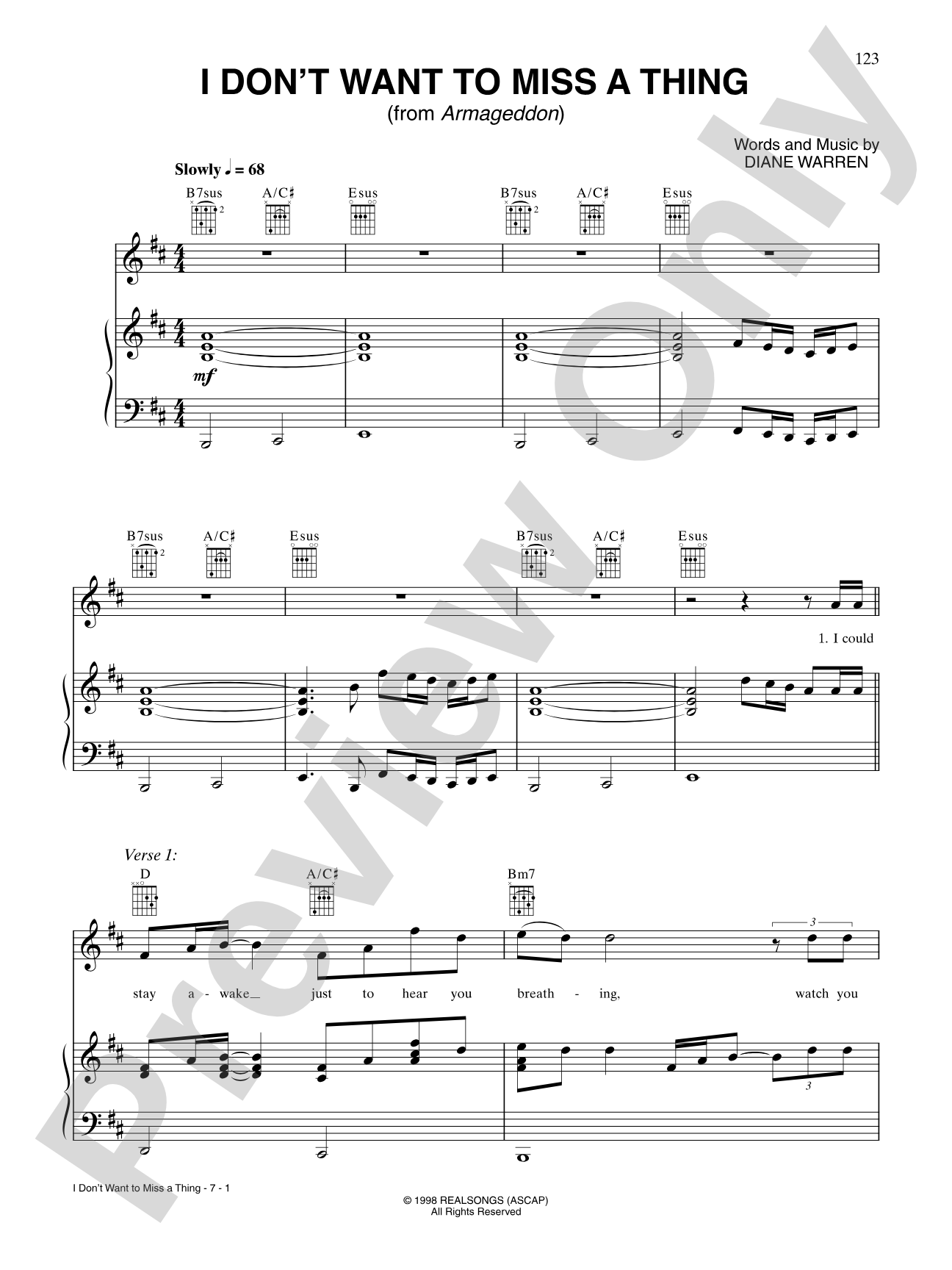
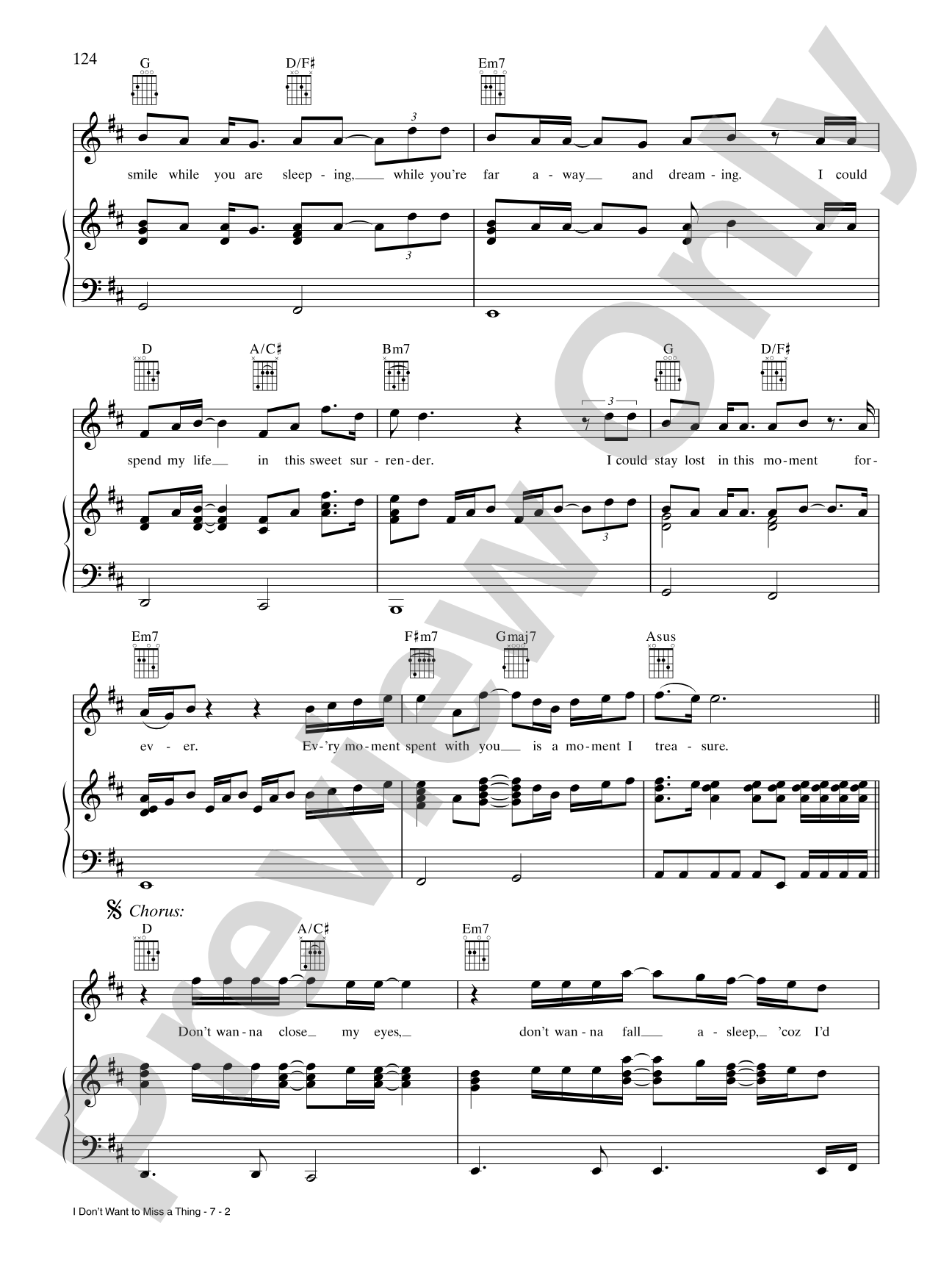

I Don't Want to Miss a Thing: Piano/Vocal/Chords
Item: 00-PS-0015710
$5.99
Pickup currently not available
Related Items
The Ballad of Gilligan's Isle: Piano/Vocal/Chords |
$4.99
|
View | |
I Have a Dream: Piano/Vocal/Chords |
$4.99
|
View | |
Anne's Theme: Piano |
$4.99
|
View | |
Munchkinland Musical Sequence: Piano/Vocal/Chords |
$9.99
|
View | |
The Lucky One (Main Theme): Piano |
$4.99
|
View | |
The Giant Book of Movie & TV Sheet Music: Piano/Vocal/Guitar Book |
$24.99
|
View |
Description
This volume contains sheet music for dozens of cherished songs and themes by Hollywood's greatest composers and songwriters! Pianists, singers, and aspiring media composers will find unlimited hours of fun and inspiration among the nearly 250 pages of music in this giant collection, which features musical highlights from 75 years of entertainment history. Titles: Anne of Green Gables: Anne's Theme * Argo: The Mission * Armageddon: I Don't Want to Miss a Thing * August Rush: August Rush Rhapsody (Piano Suite) * Batman (TV series): Batman Theme * Batman Begins: Corynorhinus (Surveying the Ruins) * The Big Bang Theory: Main Title Theme * Corpse Bride: Main Title, Victor's Piano Solo * The Dark Knight: The Dark Knight Overture * Downton Abbey: Downton Abbey - The Suite * Dr. No: James Bond Theme * Extremely Loud & Incredibly Close: Main Theme * Fame: Out Here on My Own * Gilligan's Island: The Ballad of Gilligan's Isle * Harry Potter and the Deathly Hallows - Part 2: Lily's Theme * Harry Potter and the Half-Blood Prince: Harry and Hermione, When Ginny Kissed Harry * Harry Potter and the Sorcerer's Stone: Harry's Wondrous World, Hedwig's Theme, Nimbus 2000 * The Hobbit: An Unexpected Journey: The Adventure Begins, Song of the Lonely Mountain, A Very Respectable Hobbit * Inception: Time * The Lord of the Rings: The Fellowship of the Ring: Concerning Hobbits, In Dreams * The Lord of the Rings: The Return of the King: Into the West * The Lord of the Rings: The Two Towers: Rohan * Love Affair: Theme from Love Affair * The Lucky One: Main Theme * Mamma Mia!: Dancing Queen, I Have a Dream * Man of Steel: Flight, Look to the Stars * Masterpiece Theatre: The Masterpiece * Music and Lyrics: Way Back into Love * The Notebook: Main Title * Once: Falling Slowly, When Your Mind's Made Up * The Pink Panther: The Pink Panther * The Polar Express: Believe * Rock of Ages: Don't Stop Believin' * Rocky: Gonna Fly Now * Sherlock Holmes: Discombobulate * Singin' in the Rain: Singin' in the Rain * The Wizard of Oz: Munchkinland Musical Sequence, Over the Rainbow.


I Don't Want to Miss a Thing: Piano/Vocal/Chords isn't in MakeMusic Cloud just yet...but it could be. Let us know you'd like to see it, and you'll help shape what comes next. In the meantime, start a free trial and dive into thousands of interactive titles your students can play along with today.
Request This Title
Tell us you want it.
Start Your Free Trial
Explore everything that's ready to play right now.
Sample Audio
No sample audio found.
Sample Video
No sample videos found.
Additional Details
Series:
The Giant Book of Sheet Music
Publisher:
Alfred Music
Page Count:
240
SKU:
00-PS-0015710
More about this title
About the Composer: Diane Warren
Diane Warren is one of Hollywood's most prolific and accomplished songwriters, with a career spanning four decades of film and television scoring. She has earned multiple Academy Award nominations and Golden Globe awards for her work on major motion pictures, establishing herself as a master of emotionally resonant themes that elevate cinematic moments. Her compositions are known for their accessibility to performers across skill levels while maintaining sophisticated harmonic and melodic structures that reward careful interpretation.
Why we love this
This collection captures the breadth of what makes film and television music so powerful: themes that audiences recognize instantly, melodies that stick with you long after the credits roll, and arrangements that work equally well in a recital hall or living room. The piano/vocal/guitar format gives pianists real interpretive choices, singers a treasure trove of contemporary repertoire beyond the traditional art song, and guitarists access to sophisticated chord progressions. Assembling nearly 250 pages from 75 years of screen music in one volume creates endless programming possibilities and genuine inspiration for students exploring how great songwriting translates across media.
What to expect
Opening this collection is like walking through a curated museum of modern songwriting: each page carries the warmth of a film moment you've experienced, whether you're revisiting Hedwig's soaring wonder or discovering a theme for the first time. The pieces balance cinematic grandeur with the intimacy of the piano and voice, creating a sense of both accessibility and substance. These are songs designed to touch the heart, and the best of them do so without artifice or calculation.
Who it's for
This folio serves pianists seeking contemporary repertoire that audiences actually know and love, singers building recital programs that bridge classical traditions and modern songwriting, and media composition students mining real-world examples of how to write memorable, emotionally direct themes. Community musicians and private studio teachers will find material that engages students across ages and experience levels.
How to get the most out of it
- Study the original film or television recordings before you begin. Hearing Warren's orchestrations in context reveals the emotional architecture beneath each theme, helping you make choices about rubato, dynamic shaping, and phrasing that serve the song rather than overplay it.
- Pay attention to where the melody sits within the piano's range and the vocal tessitura. Many of these themes were written for specific orchestral colors and vocal ranges; adjusting keys or octaves can shift the entire character of the piece.
- Balance the interplay between voice and piano rather than treating them as soloist and accompaniment. Even when the voice carries the primary line, countermelodies and harmonic movement in the piano part deserve clarity and forward motion.
How to use it
Weave selections into student recitals to demonstrate how contemporary composition approaches melody, harmony, and form without abandoning emotional clarity. Teachers can use these pieces as bridges between classical training and popular songwriting, showing students that serious compositional craft and audience connection are not opposing forces. A themed concert pairing film themes with classical precursors (leitmotif traditions, operatic songwriting, Romantic era character pieces) offers programming that intrigues both traditional and casual listeners.
Skills your students will build
- Reading chord symbols and chord charts for piano voicing
- Interpreting and performing pop/contemporary song conventions in a concert setting
- Balancing melodic lines between voice and piano accompaniment
- Understanding theme structure and emotional pacing in cinematic composition
- Transposing and adapting pieces to match vocal range and instrumental capability
- Sight-reading across multiple clefs and standard notation formats