
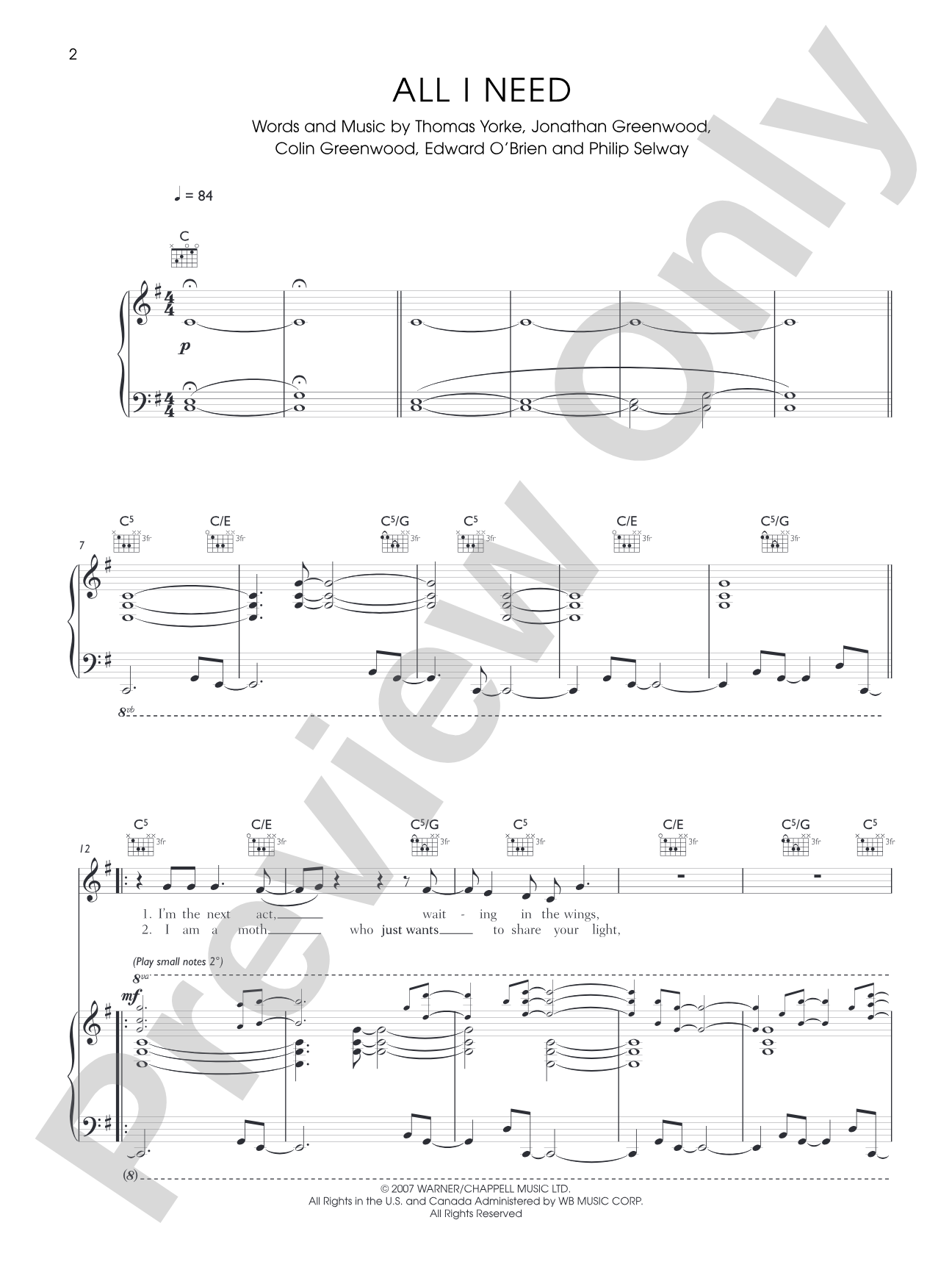

All I Need: Piano/Vocal/Chords
Radiohead
Item: 00-PS-0013155
$4.99
One moment…
Related Items
My Iron Lung: Piano/Vocal/Chords |
$5.99
|
View | |
Street Spirit (Fade Out): Piano/Vocal/Chords |
$5.99
|
View | |
Fake Plastic Trees: Piano/Vocal/Chords |
$4.99
|
View | |
High and Dry: Piano/Vocal/Chords |
$5.99
|
View | |
Lucky: Piano/Vocal/Chords |
$4.99
|
View | |
Paranoid Android: Piano/Vocal/Chords |
$5.99
|
View | |
Subterranean Homesick Alien: Piano/Vocal/Chords |
$5.99
|
View | |
Karma Police: Piano/Vocal/Chords |
$4.99
|
View | |
No Surprises: Piano/Vocal/Chords |
$4.99
|
View | |
How I Made My Millions: Piano/Vocal/Chords |
$4.99
|
View | |
Exit Music (For a Film): Piano/Vocal/Chords |
$4.99
|
View | |
Life In a Glasshouse: Piano/Vocal/Chords |
$4.99
|
View | |
Creep: Piano/Vocal/Chords |
$4.99
|
View | |
Everything In Its Right Place: Piano/Vocal/Chords |
$4.99
|
View | |
Motion Picture Soundtrack: Piano/Vocal/Chords |
$4.99
|
View | |
Pyramid Song: Piano/Vocal/Chords |
$4.99
|
View | |
Knives Out: Piano/Vocal/Chords |
$4.99
|
View | |
Like Spinning Plates: Piano/Vocal/Chords |
$5.99
|
View | |
Fog (Again): Piano/Vocal/Chords |
$4.99
|
View | |
Sit Down. Stand Up.: Piano/Vocal/Chords |
$5.99
|
View | |
Sail to the Moon: Piano/Vocal/Chords |
$4.99
|
View | |
A Wolf at the Door: Piano/Vocal/Chords |
$5.99
|
View | |
We Suck Young Blood: Piano/Vocal/Chords |
$5.99
|
View | |
A Punch Up at a Wedding: Piano/Vocal/Chords |
$4.99
|
View | |
Videotape: Piano/Vocal/Chords |
$4.99
|
View | |
Last Flowers to the Hospital: Piano/Vocal/Chords |
$4.99
|
View |
Description
After more than a decade of numerous guitar-oriented Radiohead songbook releases, pianists are at last treated to a Radiohead sheet music collection that they can enjoy. Twenty-eight favorite songs drawn from a wide variety of Radiohead albums are compiled in this expansive collection, specially transcribed and arranged to be played on the piano. Titles: All I Need * Creep * Everything in Its Right Place * Exit Music (For a Film) * Fake Plastic Trees * Fog Again * High and Dry * How I Made My Millions * I Want None of This * Karma Police * Knives Out * Last Flowers to the Hospital * Life in a Glasshouse * Like Spinning Plates * Lucky * Motion Picture Soundtrack * My Iron Lung * No Surprises * Paranoid Android * A Punch Up at a Wedding * Pyramid Song * Sail to the Moon * Sit Down. Stand Up. * Street Spirit (Fade Out) * Subterranean Homesick Alien * Videotape * We Suck Young Blood * A Wolf at the Door.


Discover MakeMusic Cloud: thousands of interactive titles your students can play along with today.
Sample Audio
No sample audio found.
Sample Video
No sample videos found.
Additional Details
Publisher:
Alfred Music
Page Count:
144
SKU:
00-PS-0013155
More about this title
About the Composer: Thomas Yorke
Thomas Yorke is the lead vocalist and primary songwriter for Radiohead, the Oxford-based band that emerged from the 1990s alternative rock scene to become one of the most influential groups in contemporary music. Across three decades of recording, Yorke has developed a distinctive compositional voice marked by intricate melodies, unconventional song structures, and sophisticated harmonic language that extends well beyond typical rock conventions.
Why we love this
Pianists rarely have access to Radiohead's catalog in accessible arrangements, and this collection fills that absence with genuine respect for the compositions. The 28 songs span the band's evolution from early alternative rock through experimental electronic work, giving pianists exposure to writing that challenges conventional harmony and form while remaining deeply expressive.
What to expect
These songs inhabit a landscape of introspection and architectural precision, where angular melodies meet shifting harmonic ground. You'll find moments of stark beauty alongside unsettling dissonance, passages that breathe space and restraint alongside dense, layered textures that demand attention to every voice.
Who it's for
This collection serves pianists and keyboardists who want to explore Radiohead's songwriting beyond guitar-based interpretations, as well as singers working with piano accompaniment who need accessible, well-transcribed lead sheets. It's equally valuable for serious students investigating contemporary composition and harmonic practice outside classical traditions.
How to get the most out of it
- Study the vocal melody line first, even if you're playing without singing; understanding the contour and phrasing will shape your approach to the accompaniment and harmonic voicings.
- Pay attention to the chord symbols and explore different voicing options that suit your hand size and musical preferences; these arrangements offer flexibility rather than rigid prescription.
- Listen to the original Radiohead recordings to internalize the rhythmic feel and emotional intent, especially for tracks where groove and texture matter as much as melody.
- Work through passages where piano and vocal lines interact independently; several of these songs layer countermelodies that require careful balancing between hands.
How to use it
Use this collection to program a contemporary music recital or showcase, pairing Radiohead selections with other 21st-century composers to create a coherent thematic arc. These arrangements also work well as repertoire options in collaborative piano courses or as part of a student recital featuring music beyond the standard classical canon.
Skills your students will build
- Reading and interpreting chord symbols in contemporary notational contexts
- Voicing extended harmonies (ninths, elevenths, altered chords) at the keyboard
- Balancing melody and accompaniment textures when they operate independently
- Adapting vocal phrasing conventions to instrumental playing
- Understanding non-functional harmony and chromatic voice leading in modern songwriting