
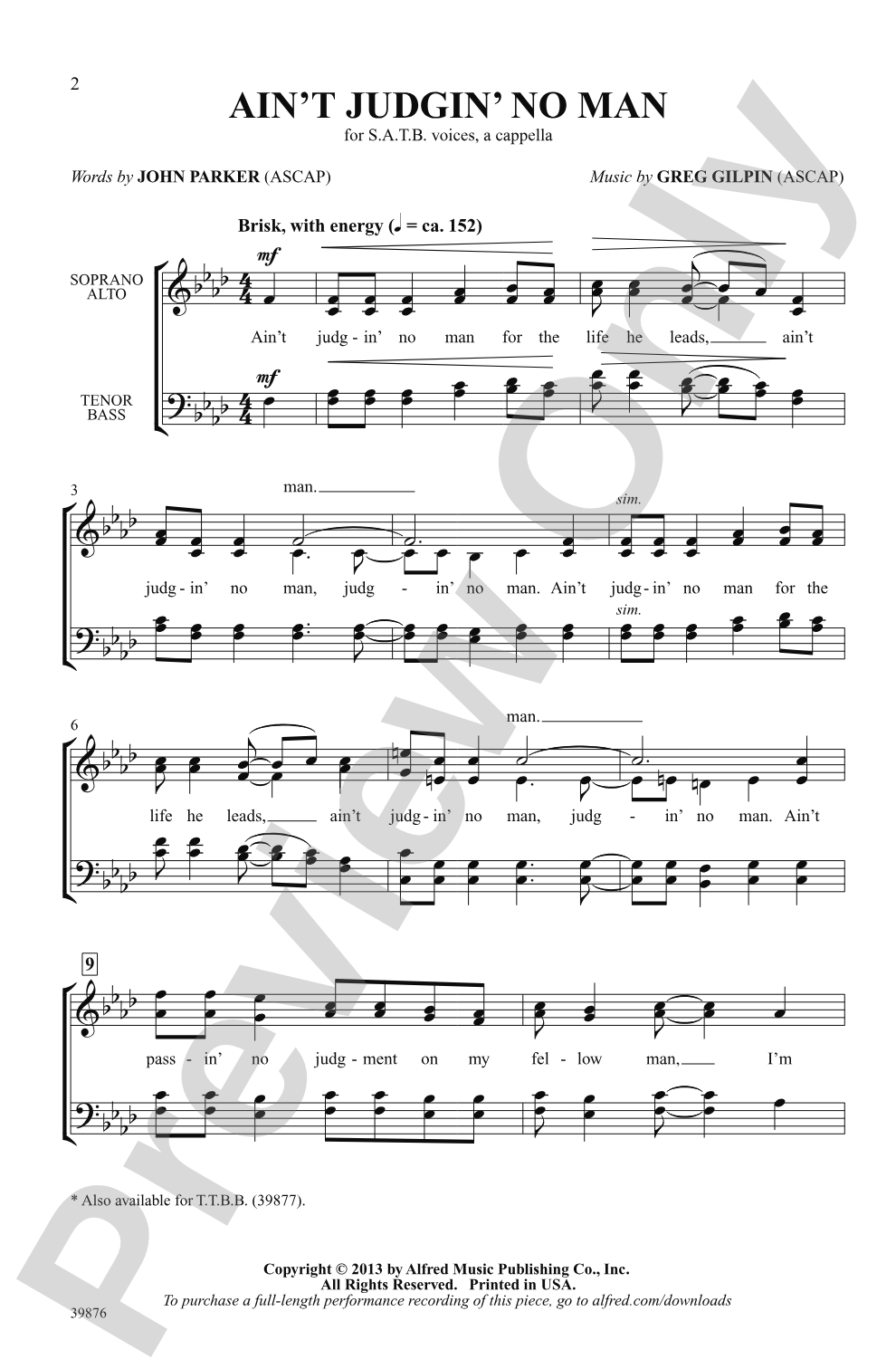

Ain't Judgin' No Man: SATB, a cappella Choral Octavo
Words by John Parker, music by Greg Gilpin
Item: 00-PO-0001675
$2.05
Minimum order quantity: 20 copies
Pickup currently not available
Description
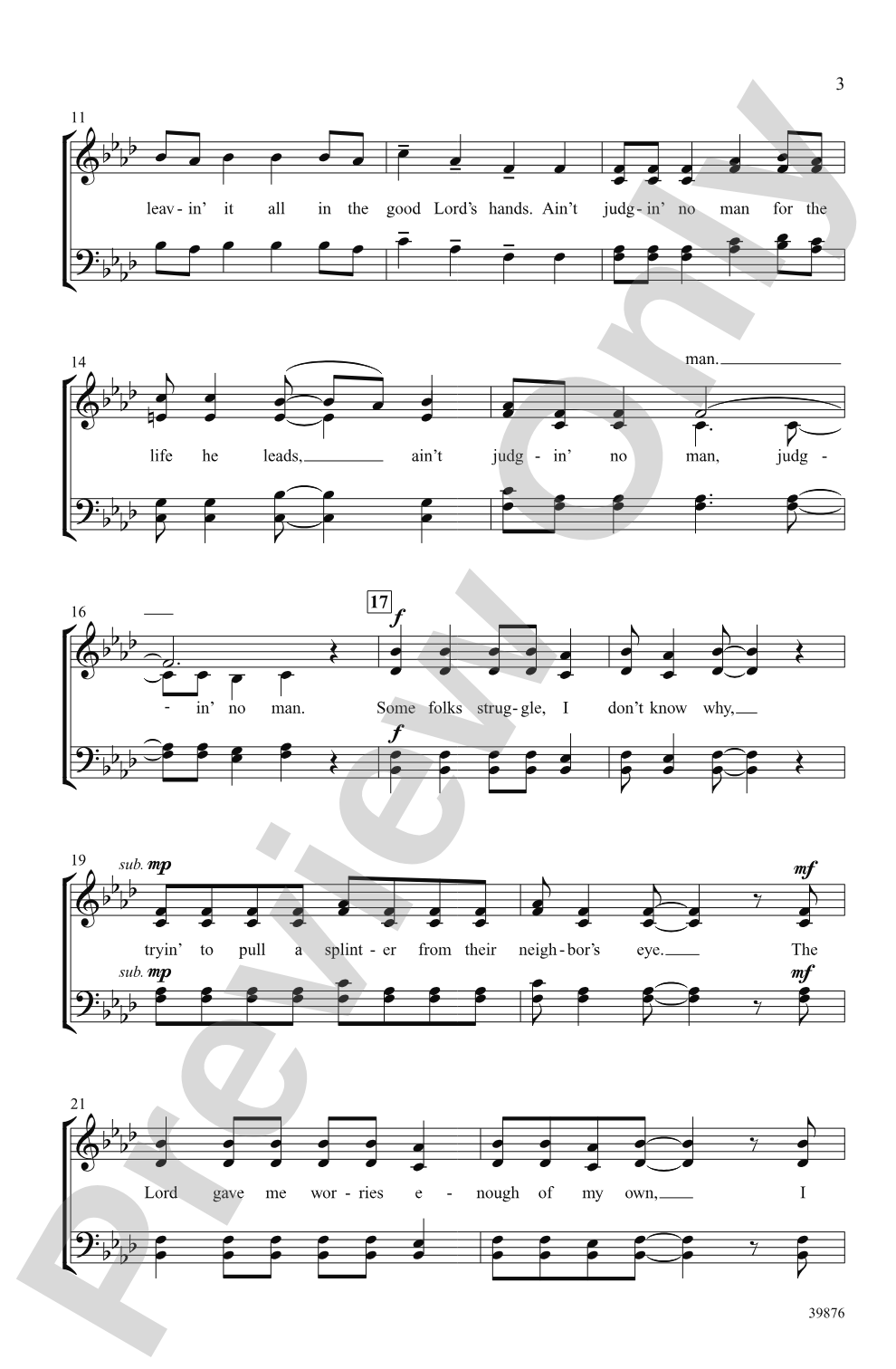
Cut from the same cloth as the great traditional spirituals, this riveting original boasts unwavering rhythmic intensity, gripping minor key sonorities, and a tenacious, meaningful text. Presented in a musical form that builds and builds to the big finish! This title is available in Music Prodigy. This title is available in MakeMusic Cloud.


Ain't Judgin' No Man: SATB, a cappella Choral Octavo isn't in MakeMusic Cloud just yet...but it could be. Let us know you'd like to see it, and you'll help shape what comes next. In the meantime, start a free trial and dive into thousands of interactive titles your students can play along with today.
Request This Title
Tell us you want it.
Start Your Free Trial
Explore everything that's ready to play right now.
Sample Audio
1
Audio File
--:--
0:00
0:00
Sample Video
Additional Details
Series:
Alfred Choral Designs
Publisher:
Alfred Music
Page Count:
12
SKU:
00-PO-0001675
More about this title
About the Composer: Greg Gilpin

Greg Gilpin stands among the most performed choral composers in America. His work has been heard at Carnegie Hall, Lincoln Center, and Ryman Auditorium, with international performances spanning the Sydney Opera House, Royal Festival Hall in London, and Harpa Concert Hall in Reykjavik. As an ASCAP award-winning composer and arranger, Gilpin also serves as Director of Educational Choral Publications for Shawnee Press, where he shapes the repertoire available to choirs across the country.
Beyond the concert hall, Gilpin's creative reach extends to film scoring, recording production, and most recently, professional organizing and financial coaching. In 2021, he composed the score for the award-winning short film "Rosie's Rescue," earning Best Score recognition. He is active in ACDA, NAfME, SAG-AFTRA, and holds Life Loyal membership in Phi Mu Alpha Sinfonia.
Why we love this
Gilpin captures the spiritual's DNA while forging something entirely his own. The relentless rhythmic drive and minor key intensity create an irresistible forward momentum, while the text lands with genuine weight and purpose. This is the kind of piece that builds genuine excitement in a room and sticks with audiences long after the final note.
What to expect
From the opening moments, the piece exerts a gravitational pull. Minor key sonorities create an atmosphere of conviction and urgency, while the unwavering rhythmic intensity propels the music forward with an almost liturgical gravity. As the form builds toward its climax, the momentum becomes irresistible, transforming the repetition into a powerful meditation on meaning and resilience.
Who it's for
This octavo belongs in the hands of strong SATB choirs with solid intonation and rhythmic discipline. It works equally well for competitive festival settings and concert programs, and the 12-page length makes it accessible for groups ranging from high school choirs to college and community ensembles.
How to get the most out of it
- Establish the rhythmic pulse in rehearsal before worrying about blend; this piece demands precision and forward motion from every voice part.
- Shape the building intensity across the form by gradually increasing vocal presence and conviction. The repetition is intentional, so let it work by finding fresh energy in each iteration.
- Balance the minor sonorities carefully so the harmonic color reads clearly without muddying. Vowel unification becomes especially important in the tighter passages.
- Commit fully to the text. The meaning of these words should inform your approach to dynamics, articulation, and phrase direction throughout.
How to use it
Pair this with lighter or more lyrical pieces to showcase your choir's range and power. Its spiritual roots make it a natural fit for concerts that explore themes of faith, social justice, or the choral tradition itself. The building architecture also makes it a compelling closing number that leaves a lasting impression on audiences.
Skills your students will build
- Maintaining rhythmic precision in a capella settings across all four voice parts
- Singing in minor tonalities with clear intonation and expressive control
- Building emotional intensity through repetition and form
- Balancing individual line clarity with ensemble cohesion in complex harmonies
- Connecting text meaning to musical interpretation and phrasing