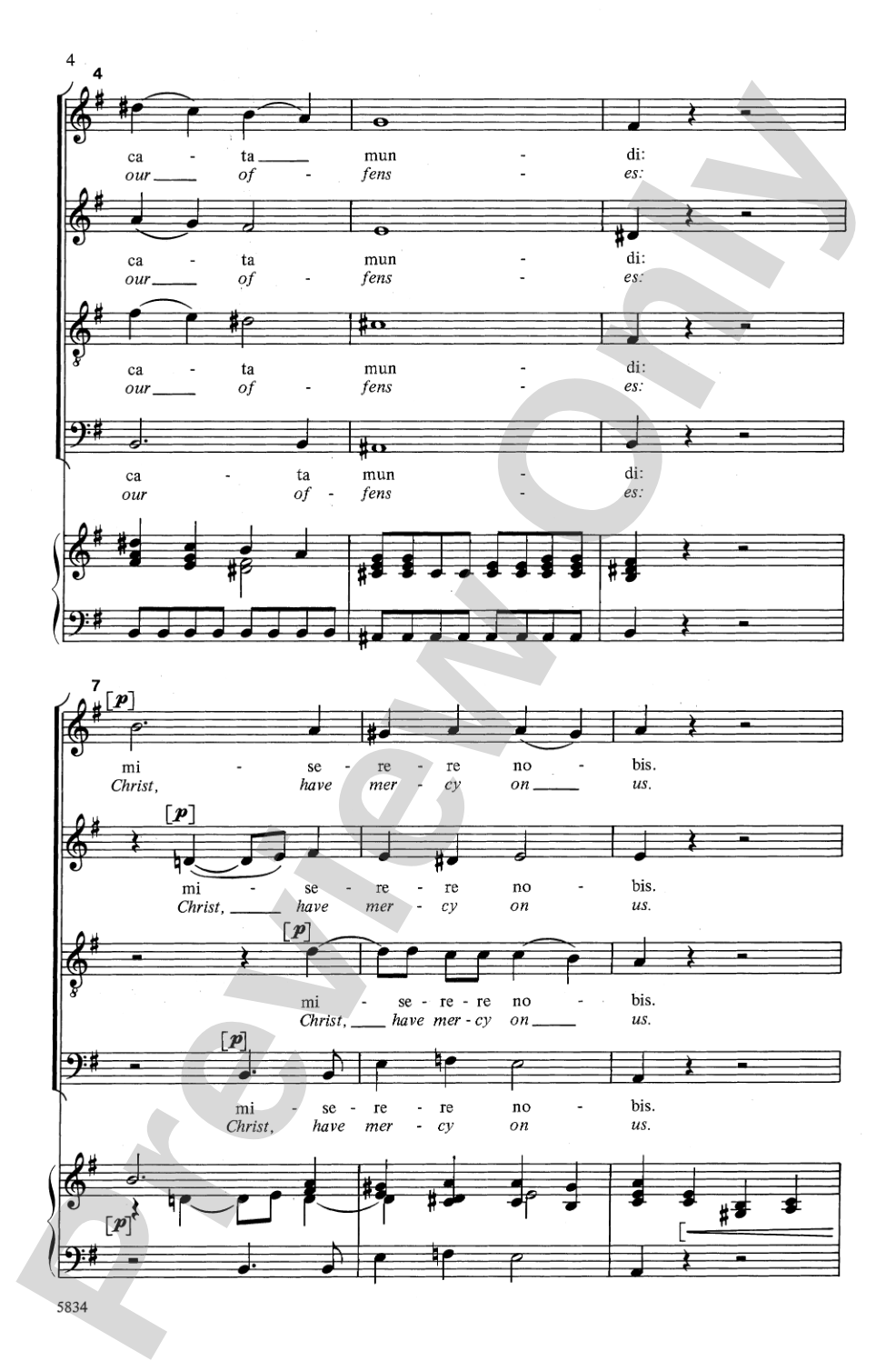
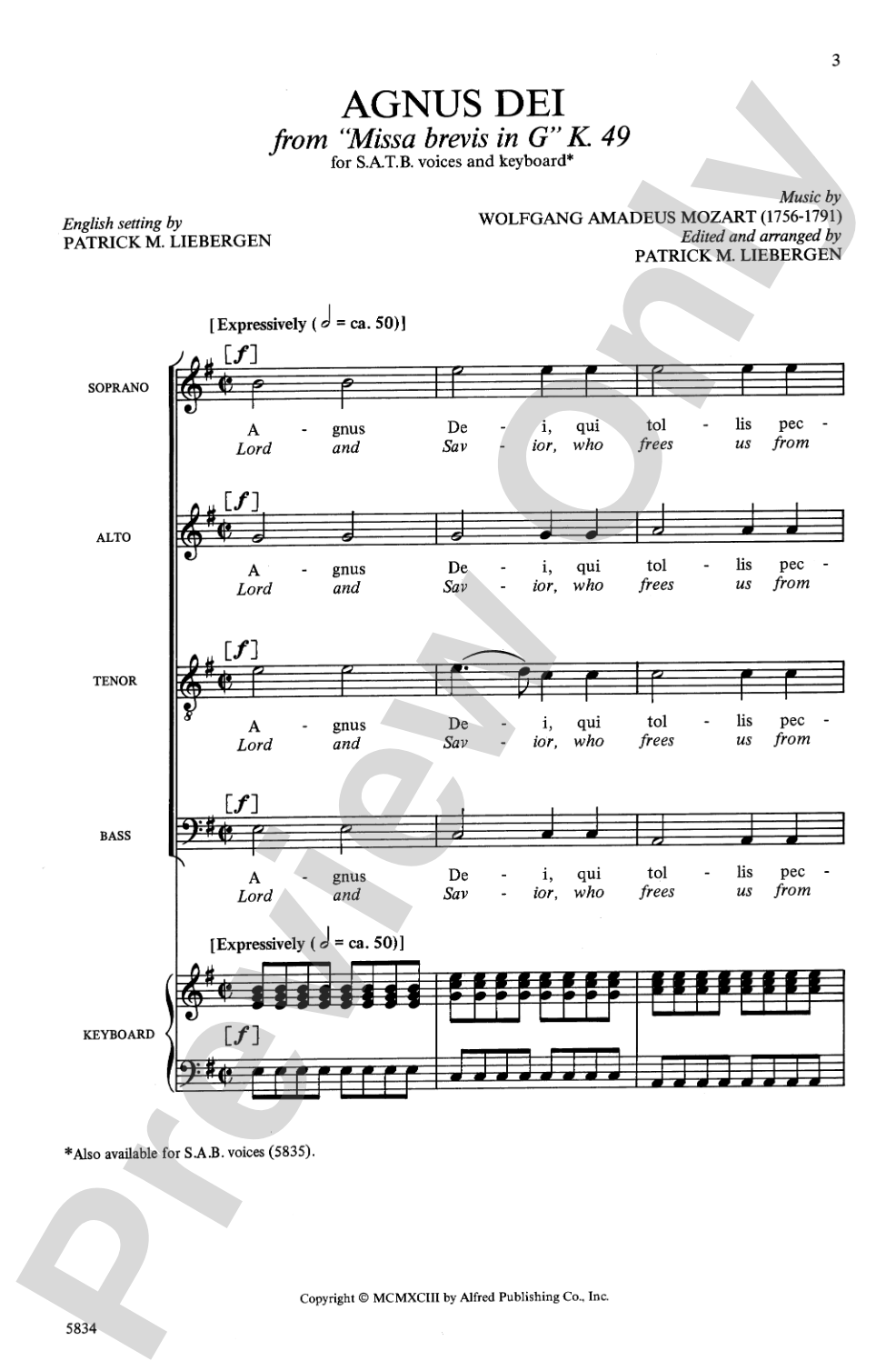
Agnus Dei (from <i>Missa Brevis in G</i>) Sheet Music Preview

Agnus Dei (from Missa Brevis in G): SATB Choral Octavo

From Missa Brevis in G

Music by Wolfgang Amadeus Mozart / arr. Patrick M. Liebergen

Item: 00-PO-0004502

Digital Download
$2.25

Minimum order quantity: 20 copies

Description
This publication provides the Agnus Dei movement found in Mozart's "Missa brevis in G," K.49. In Mozart's time, a Missa brevis (brief Mass) was quite concise and few instruments were employed, since it was composed for use in the main worship service of the Catholic Church. Mozart originally scored the Agnus Dei of this Mass for S.A.T.B. voices with an accompaniment of strings and continuo.

Agnus Dei (from Missa Brevis in G): SATB Choral Octavo isn't in MakeMusic Cloud just yet...but it could be. Let us know you'd like to see it, and you'll help shape what comes next. In the meantime, start a free trial and dive into thousands of interactive titles your students can play along with today.

Sample Audio
No sample audio found.
Sample Video
Additional Details
Series: Alfred Archive Edition: Alfred Choral Designs
Publisher: Alfred Music
Page Count: 12
SKU: 00-PO-0004502

More about this title

About the Composer: Wolfgang Amadeus Mozart

Wolfgang Amadeus Mozart (1756-1791) was an Austrian composer whose prolific output spanned virtually every musical genre of the Classical era. His sacred music, including over 18 complete masses, demonstrates his ability to write idiomatically for voices while maintaining the formal clarity and melodic brilliance that define his style. Mozart composed the Missa brevis in G, K.49, early in his career when he was establishing himself as a master of both instrumental and vocal forms.

Why we love this

This octavo gives singers direct access to a cornerstone of the Classical choral repertoire without requiring orchestral forces or elaborate preparation. The Agnus Dei showcases Mozart's gift for word-painting and harmonic clarity, moving from supplication to peace with elegant simplicity that rewards both careful rehearsal and genuine emotional engagement from your singers.

What to expect

The opening unfolds with quiet dignity, voices entering in a gentle cascade that expresses humble petition. By the final measures, the piece settles into an almost austere stillness, the repeated text setting creating a meditative quality that leaves space for individual singers to connect personally with the prayer for peace.

Who it's for

This octavo suits intermediate to advanced SATB choirs with secure sight-reading skills and experience balancing Classical counterpoint. It works equally well for high school select choirs, college choral ensembles, and adult church choirs preparing liturgical or concert programming.

How to get the most out of it

  • Shape the opening phrase with gentle motion toward the word "Dei" rather than letting each measure sit statically; the supplicatory character depends on forward momentum within a restrained dynamic.
  • Balance the texture carefully in passages where all four voices move together; Mozart's spacing can blur if sopranos and altos sit too heavily on their upper staff lines.
  • Attend to the text setting in "dona nobis pacem"; the repeated plea gains power through rhythmic precision across voices, not through added weight.

How to use it

Program this as part of a Mass or sacred music concert where it can anchor a liturgical context, or pair it with other Mozart sacred works for a focused exploration of his choral idiom. It also serves effectively as the closing movement in a concert program, offering a moment of genuine repose rather than bravura.

Skills your students will build

  • Singing in Classical style with appropriate phrase shape and restraint
  • Balancing four-part homophonic texture with clear voice leading
  • Interpreting text with emotional authenticity while maintaining formal clarity
  • Intonation in sustained, unaccompanied passages

You May Also Like