
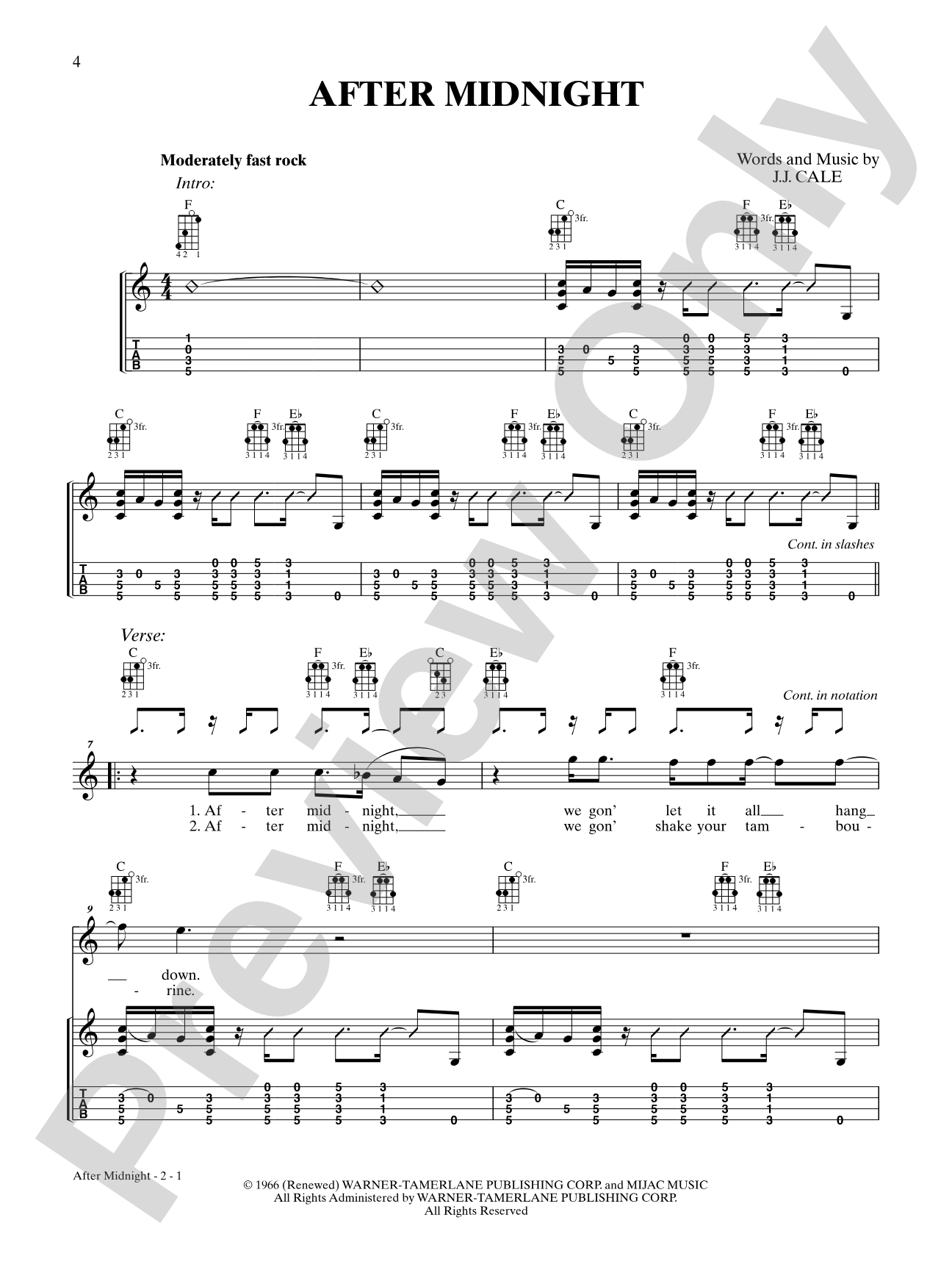

After Midnight: Mandolin TAB
12 Great Songs of the '60s, '70s & '80s
Item: 00-PS-0011915
$4.99
One moment…
Related Items
Paint It, Black: Mandolin TAB |
$4.99
|
View | |
It's All Over Now: Mandolin TAB |
$4.99
|
View | |
Long Train Runnin': Mandolin TAB |
$4.99
|
View | |
The Night They Drove Old Dixie Down: Mandolin TAB |
$4.99
|
View | |
Stairway to Heaven: Mandolin TAB |
$5.99
|
View | |
Maggie May: Mandolin TAB |
$4.99
|
View | |
Sunshine of Your Love: Mandolin TAB |
$4.99
|
View | |
Just for Fun: Classic Rock Mandolin: Easy Mandolin TAB Book |
$14.99
|
View |
Description
Classic Rock Mandolin is designed for your total enjoyment. Each song uses the original guitar parts arranged for the mandolin. Titles: After Midnight (Eric Clapton) * Go Your Own Way (Fleetwood Mac) * Hotel California (Eagles) * It's All Over Now (The Rolling Stones) * Jump (Van Halen) * Long Train Runnin' (The Doobie Brothers) * Maggie May (Rod Stewart) * The Night They Drove Old Dixie Down (The Band) * Paint It, Black (The Rolling Stones) * Stairway to Heaven (Led Zeppelin) * Sunshine of Your Love (Cream) * Truckin' (Grateful Dead).


After Midnight: Mandolin TAB isn't in MakeMusic Cloud just yet...but it could be. Let us know you'd like to see it, and you'll help shape what comes next. In the meantime, start a free trial and dive into thousands of interactive titles your students can play along with today.
Request This Title
Tell us you want it.
Start Your Free Trial
Explore everything that's ready to play right now.
Sample Audio
No sample audio found.
Sample Video
No sample videos found.
Additional Details
Series:
Just for Fun
Publisher:
Alfred Music
Page Count:
60
SKU:
00-PS-0011915
More about this title
About the Composer: J. J. Cale
J.J. Cale wrote "After Midnight," one of rock music's most enduring classics, though Eric Clapton's 1977 recording became the definitive version. Cale's compositional approach emphasized economy and groove over technical display, crafting songs built on hypnotic riffs and minimal chord changes that have become foundational to rock pedagogy.
Cale's influence extends far beyond his own recording career. His songs have been recorded by major artists across genres, and his stripped-down, riff-driven style has shaped how musicians teach and learn rock composition. His work remains central to understanding how great songs survive reinterpretation across instruments and styles.
Why we love this
This collection transforms twelve iconic rock songs into idiomatically playable mandolin arrangements without losing a moment of their original swagger. The TAB format removes transcription guesswork, letting mandolin students dive straight into music they actually want to hear. You'll find your repertoire suddenly includes stadium anthems your students recognize instantly, which changes engagement entirely.
What to expect
Electric guitar energy translated to an acoustic fretted instrument creates an unexpectedly compelling sonic world. These arrangements capture the swagger of the originals while revealing new textural possibilities unique to the mandolin's brightness and rhythmic snap.
Who it's for
Mandolin students who want to move beyond folk and classical contexts into the music they hear on the radio. This book works equally well for musicians new to mandolin who already play other fretted instruments and want to leverage that foundation. Players should be comfortable reading TAB and have basic familiarity with common rock rhythms and song structures.
How to get the most out of it
- Anchor the rhythm section with steady pick articulation on the signature riffs; mandolin's natural brightness can either enhance or muddy these parts depending on your attack clarity.
- Reference the original recordings alongside the tabs to internalize the groove and phrasing before worrying about perfect accuracy with every note.
- Keep your strap tension consistent across songs; the constant position shifts required by these arrangements demand muscle memory that changes with strap height.
- Adjust your tempo expectations downward at first. Many of these pieces feel deceptively simple until you're playing them at tempo with others.
How to use it
Assign individual songs as solo recital pieces or small ensemble selections that audiences recognize immediately. These tracks also function as informal ensemble repertoire for mixed student groups seeking contemporary repertoire beyond the standard classical and folk catalogs. Consider pairing them with guitar or other fretted instruments to create a cohesive rock ensemble unit within your studio or school.
Skills your students will build
- Reading mandolin TAB notation
- Translating guitar-voiced riffs to mandolin register and fingering patterns
- Maintaining steady rhythmic feel in rock grooves
- Idiomatic rock pick technique and articulation
- Balancing single-note soloing with rhythmic accompaniment patterns
- Listening for and internalizing original arrangements as pedagogical models