
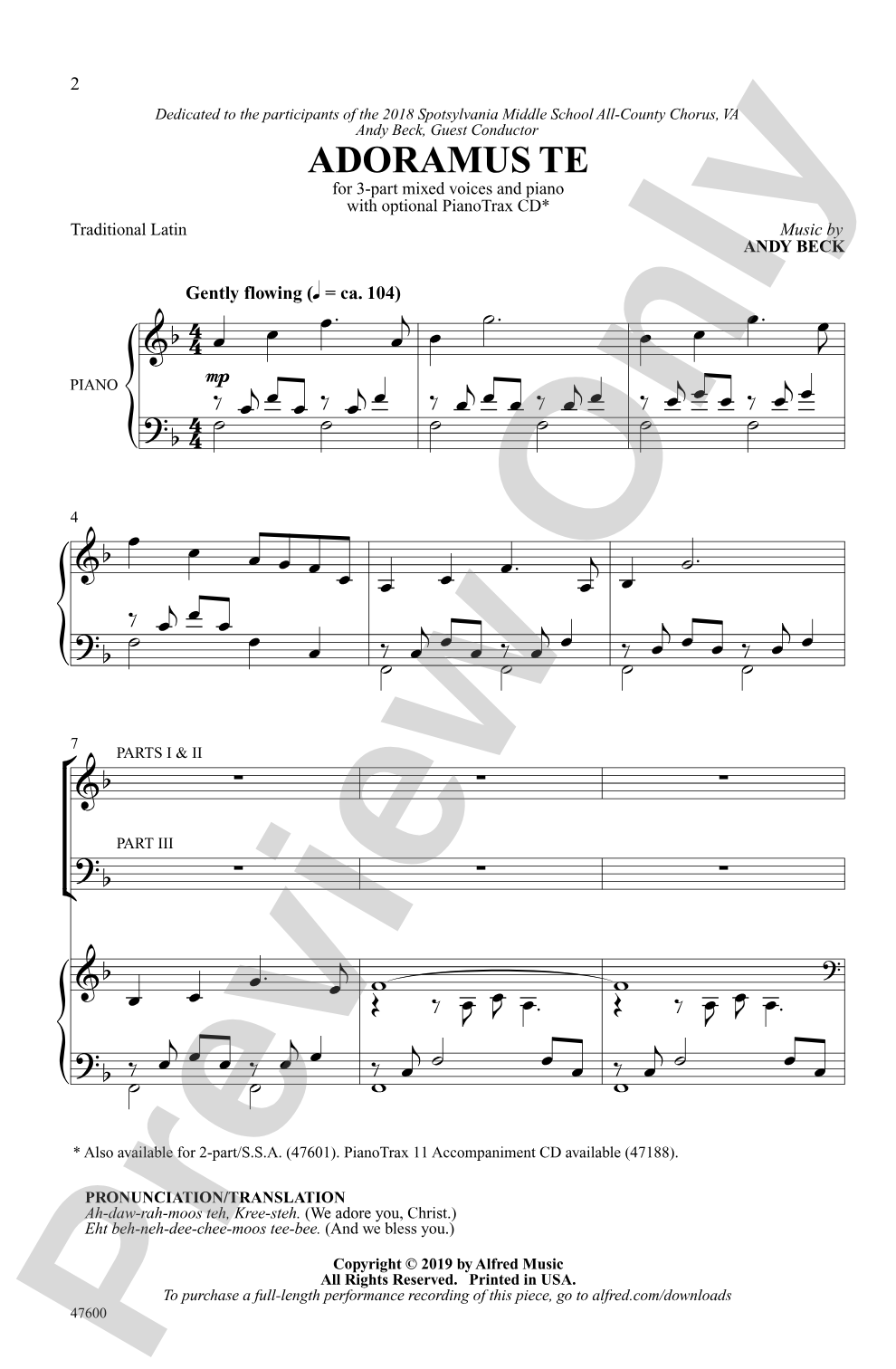
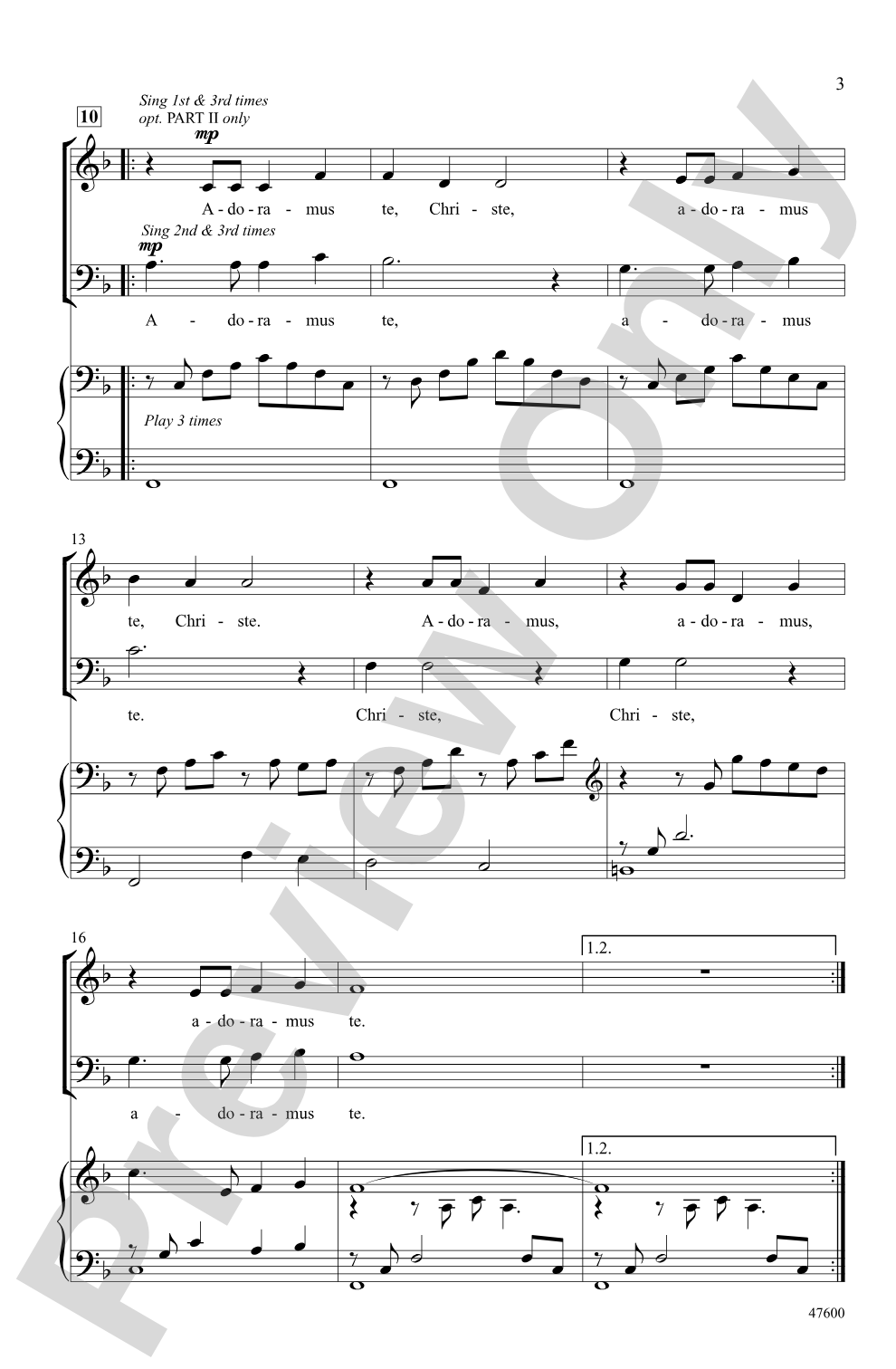

Adoramus Te: 3-Part Mixed Choral Octavo
By Andy Beck
Item: 00-PO-0005954
$2.05
Minimum order quantity: 20 copies
Pickup currently not available
Description
This simple yet elegant setting is sung on just two short Latin phrases. A partner song approach gives each voice part independence, while a brief B section includes some homophonic choral harmonies. Halfway through the piece, a delicate descant-like third part is introduced, which floats gently above when the lyrical theme and counter theme return. Excellent concert or contest repertoire for developing groups.


Adoramus Te: 3-Part Mixed Choral Octavo isn't in MakeMusic Cloud just yet...but it could be. Let us know you'd like to see it, and you'll help shape what comes next. In the meantime, start a free trial and dive into thousands of interactive titles your students can play along with today.
Request This Title
Tell us you want it.
Start Your Free Trial
Explore everything that's ready to play right now.
Sample Audio
1
Audio File
--:--
0:00
0:00
Sample Video
Additional Details
Series:
Alfred Choral Designs
Publisher:
Alfred Music
Page Count:
8
SKU:
00-PO-0005954
More about this title
About the Composer: Andy Beck

Andy Beck oversees choral publications at Alfred Music and has established himself as a prolific voice in contemporary choral writing, with more than 450 works across sacred and secular genres currently in active use. Beyond composition, he has shaped music education through widely adopted vocal resources including Sing at First Sight, Foundations in Choral Sight Singing, and Vocalize! 45 Vocal Warm-Ups That Teach Technique, all designed to build both literacy and vocal technique.
His work as a guest conductor, adjudicator, and clinician has taken him across the United States and internationally, where he regularly leads honor choirs and all-state ensembles. A trained tenor with degrees in Music Education from Ithaca College and Northwest Missouri State University, Beck brings classroom experience to every piece he writes. He continues to perform with the North Carolina Master Chorale Chamber Choir and has contributed as a studio singer for Alfred Music since 1992, keeping him grounded in the practical demands of both singers and educators.
Why we love this
Beck's understanding of what developing choirs need shows clearly here: the partner song texture gives singers real independence without overwhelming them, while the late entrance of the descant adds a moment of genuine sophistication that feels earned rather than imposed. The simplicity of working with just two Latin phrases means your singers can focus entirely on blend, balance, and the emotional arc of the piece rather than wrestling with text.
What to expect
Contemplative and luminous. The text revolves around adoration, and Beck's setting honors that reverence through clean counterpoint and transparent sonorities. When the descant enters midway through, the music takes on an almost ethereal quality, as if a veil has been lifted.
Who it's for
Developing youth, college, and adult choirs preparing for concert or festival performance. The mixed voicing and moderate length make it accessible for groups still building ensemble cohesion, while the layered musical ideas offer enough substance to engage more experienced singers.
How to get the most out of it
- Balance the two independent melodic lines during the partner song section by thinking of them as equal soloists rather than melody and harmony. Have each voice part sing through the other line in rehearsal to build mutual awareness.
- Introduce the descant entrance as a special moment. It should feel like a gentle revelation rather than a sudden textural shift. Rehearse the combination with full choir singing beneath at a softer dynamic so the third part floats naturally into place.
- Let the homophonic B section breathe and land cleanly. The shift from independence to unified harmony is more effective when each chord change feels intentional and precise.
How to use it
Slot this into a sacred or interfaith program where you need a shorter piece with real musical weight. Its eight pages and moderate difficulty make it an ideal pairing with larger choral works, allowing you to anchor a program section without overshadowing neighboring selections. Works equally well in competitive festival contexts where judges value clarity and musicianship.
Skills your students will build
- Singing independent melodic lines within a partner song texture
- Balancing two simultaneous themes
- Entering a descant securely over harmonic movement
- Maintaining blend during homophonic passages
- Sight-reading Latin text with proper pronunciation
- Understanding form through the relationship between partner sections and unified harmonic moments