

A Pleasant Life: SAB Choral Octavo
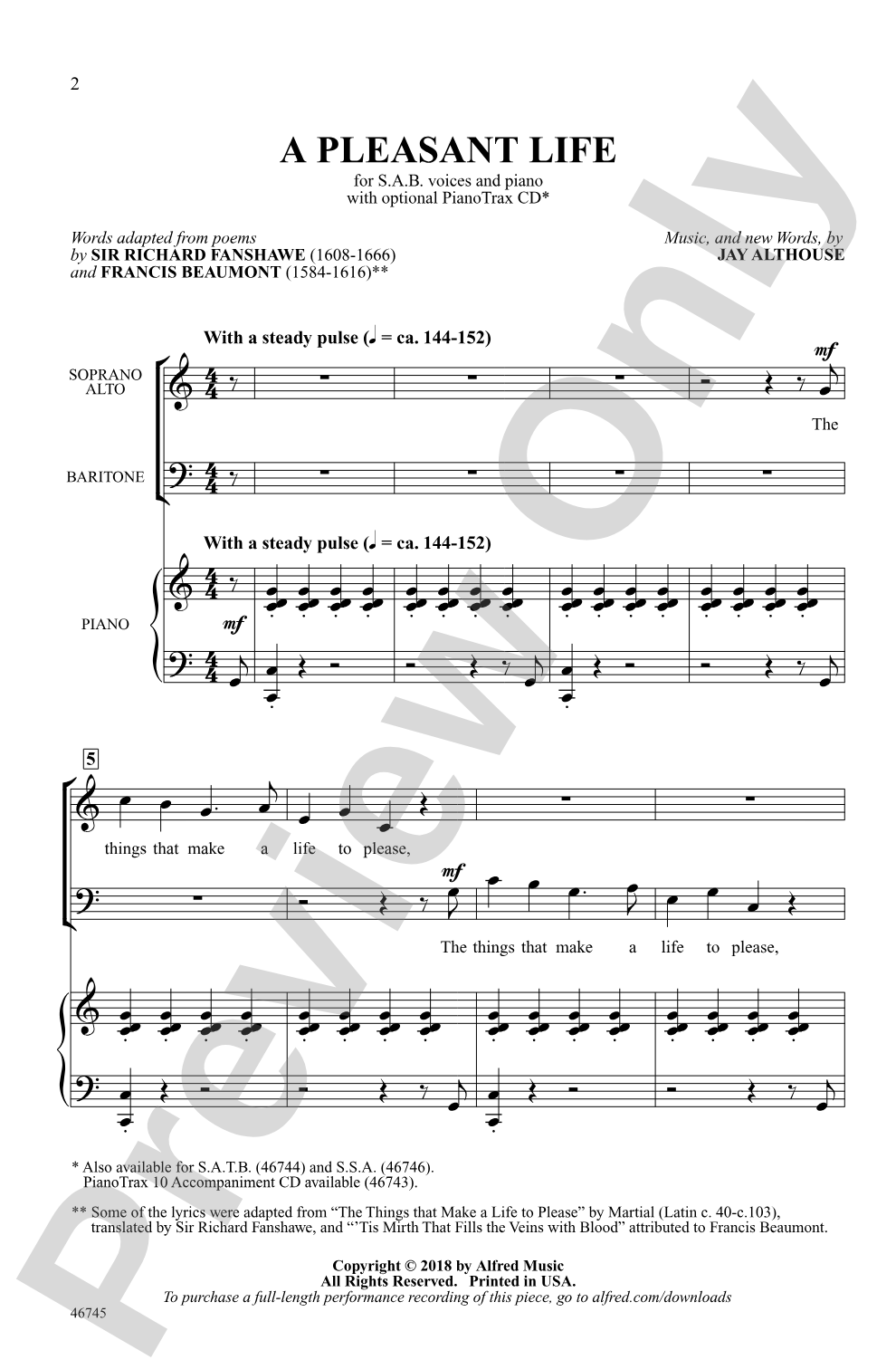
Words adapted from poems by Sir Richard Fanshawe and Francis Beaumont, music and new words, by Jay Althouse
Item: 00-PO-0005781
$2.05
Minimum order quantity: 20 copies
Pickup currently not available
Related Items
A Pleasant Life: PianoTrax Digital Download |
$9.99
|
View | |
A Pleasant Life: SATB Choral Octavo |
$2.05
|
View | |
A Pleasant Life: SSA Choral Octavo |
$2.05
|
View | |
A Pleasant Life: SATB Choral Octavo |
$2.05
|
View | |
A Pleasant Life: SAB Choral Octavo |
$2.05
|
View | |
A Pleasant Life: SSA Choral Octavo |
$2.05
|
View |
Description
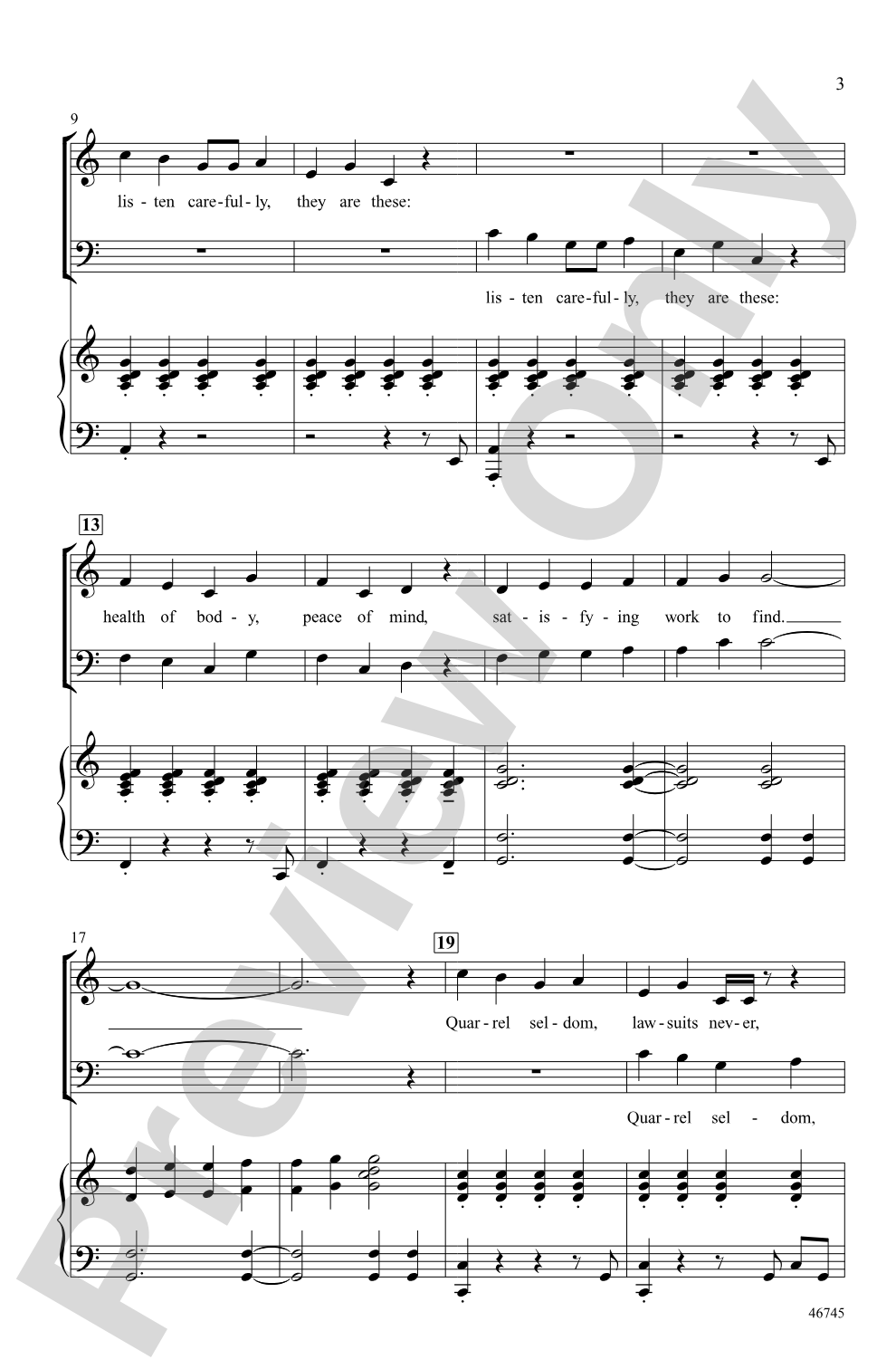
Practical, timeless advice abounds in this jaunty contemporary choral with texts lifted from Renaissance-era poetry and a translation of ancient verse. The opening melody winds around the tonic triad before the B section breaks into colorful contemporary harmony in a chorale setting. Light, yet legit.


A Pleasant Life: SAB Choral Octavo isn't in MakeMusic Cloud just yet...but it could be. Let us know you'd like to see it, and you'll help shape what comes next. In the meantime, start a free trial and dive into thousands of interactive titles your students can play along with today.
Request This Title
Tell us you want it.
Start Your Free Trial
Explore everything that's ready to play right now.
Sample Audio
1
Audio File
--:--
0:00
0:00
Sample Video
No sample videos found.
Additional Details
Series:
Alfred Choral Designs
Publisher:
Alfred Music
Page Count:
12
SKU:
00-PO-0005781
More about this title
About the Composer: Jay Althouse

Jay Althouse studied music education and music at Indiana University of Pennsylvania, where he later received the Distinguished Alumni award. His career spans both publishing and composition; he spent eight years managing rights and licenses for a major educational music publisher and served on the Executive Board of the Music Publishers Association of America.
As a composer, Althouse has published more than 800 choral works performed widely across English-speaking countries. He is a writer member of ASCAP and a regular recipient of the ASCAP Special Award. Beyond composition, he has co-written musicals with his wife Sally K. Albrecht, compiled vocal solo collections, and authored several classroom resources including The Complete Choral Warm-up Book and Accent on Composers. His collaborative choral work I Hear America Singing was performed by the San Francisco Girls and Boys Choirs at President Barack Obama's inauguration in 2009. He serves on the National Advisory Board of the Folk Art Society of America and resides in North Carolina.
Why we love this
Althouse balances accessibility with real compositional substance here. The opening melody's exploration of the tonic triad makes the piece approachable for developing choirs, while the B section's contemporary harmonic shift signals that you're working with genuine music, not a simplification. It's the kind of piece that sounds fresh in concert without demanding years of rehearsal to land well.
What to expect
There's intellectual lightness to this piece. The melody feels conversational and almost folksy at first, then the harmony unfolds into something more contemporary without ever becoming dissonant or austere. It carries the tone of someone offering wise advice with a smile rather than a lecture.
Who it's for
This works well for developing mixed choirs (high school or community ensembles) that are ready to move beyond purely functional harmony but aren't yet equipped for complex divisi. The three-part texture keeps rehearsal demands manageable while the contemporary harmonic language keeps singers musically engaged.
How to get the most out of it
- Shape the opening melody with subtle dynamic contour to let its triangular motion around the tonic feel intentional rather than static; the wandering line rewards careful phrasing.
- Balance the transition into the B section's chorale setting by allowing the harmony to breathe. This shift in texture is the piece's central moment and deserves space to register with the audience.
- Keep the text delivery clear and conversational, especially since the Renaissance and ancient verse references carry meaning. Diction precision will elevate the piece's 'legit' quality despite its jaunty character.
How to use it
Program this as a standalone concert or festival selection that demonstrates harmonic sophistication without intimidating audiences. It pairs well alongside Renaissance madrigals or other text-driven contemporary pieces, where the literary grounding becomes a shared programming theme. The modest length and straightforward voicing also make it suitable for festival sight-reading rounds where your ensemble can represent itself confidently.
Skills your students will build
- Reading and executing contemporary harmonic language in chorale texture
- Shaping melodic contour through subtle dynamic and agogic emphasis
- Balancing textural contrast between a tonal opening and a more advanced harmonic section
- Clear diction and text projection in secular choral literature