

A Pleasant Life: SATB Choral Octavo
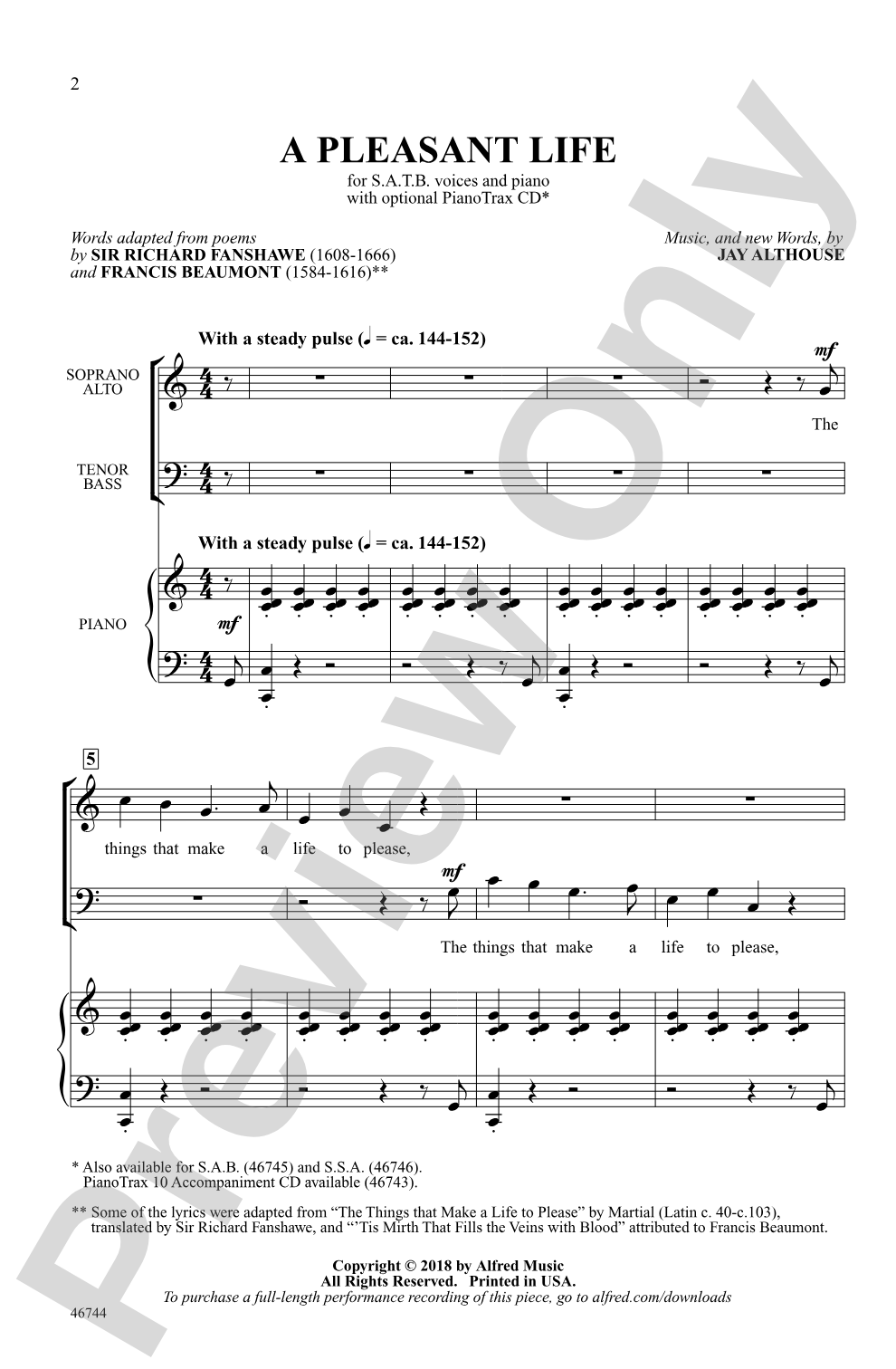
Words adapted from poems by Sir Richard Fanshawe and Francis Beaumont, music and new words, by Jay Althouse
Item: 00-PO-0005780
$2.05
Minimum order quantity: 20 copies
Pickup currently not available
Description
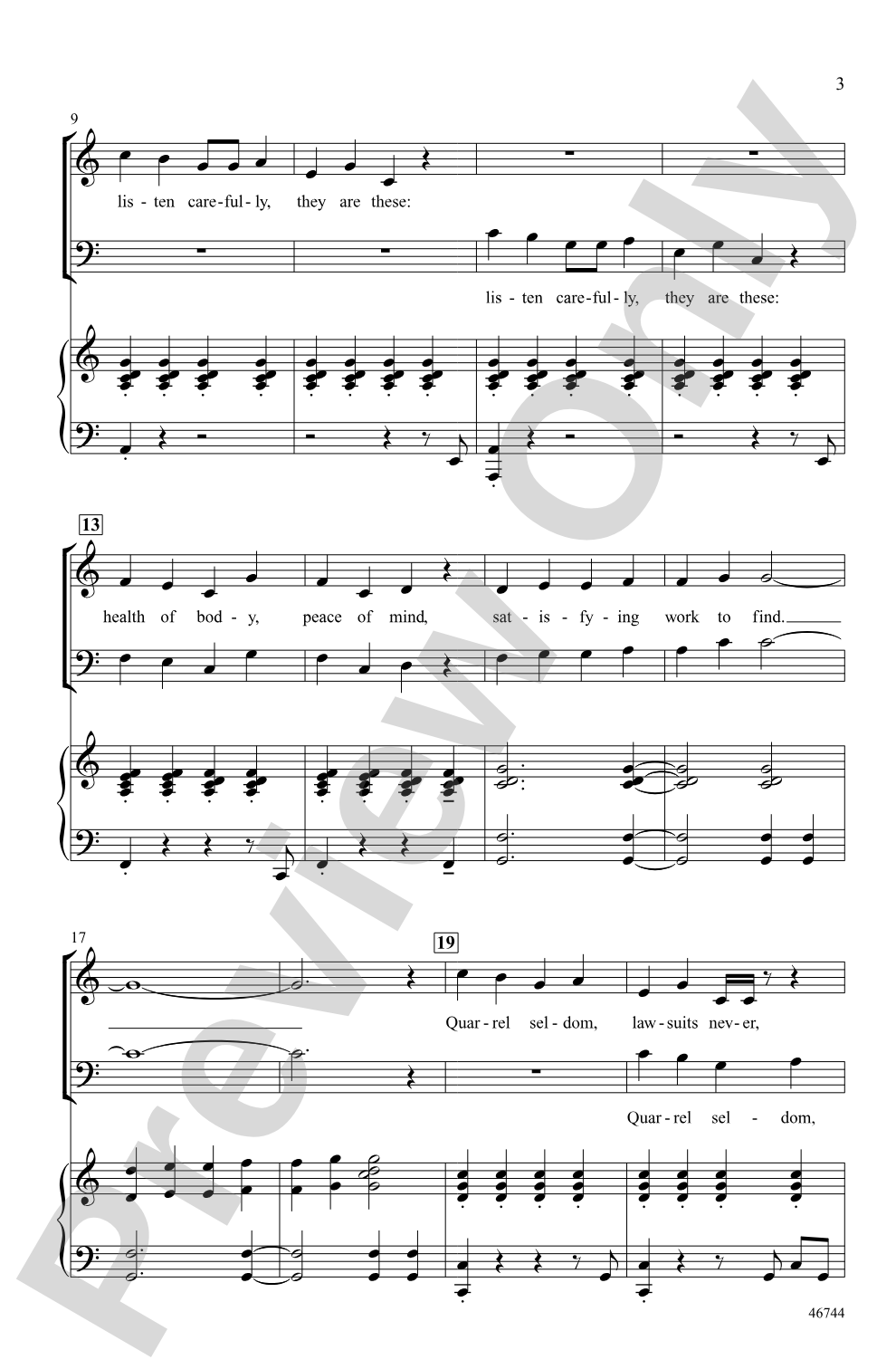
Practical, timeless advice abounds in this jaunty contemporary choral with texts lifted from Renaissance-era poetry and a translation of ancient verse. The opening melody winds around the tonic triad before the B section breaks into colorful contemporary harmony in a chorale setting. Light, yet legit.


A Pleasant Life: SATB Choral Octavo isn't in MakeMusic Cloud just yet...but it could be. Let us know you'd like to see it, and you'll help shape what comes next. In the meantime, start a free trial and dive into thousands of interactive titles your students can play along with today.
Request This Title
Tell us you want it.
Start Your Free Trial
Explore everything that's ready to play right now.
Sample Audio
1
Audio File
--:--
0:00
0:00
Sample Video
Additional Details
Series:
Alfred Choral Designs
Publisher:
Alfred Music
Page Count:
12
SKU:
00-PO-0005780
More about this title
About the Composer: Jay Althouse

Jay Althouse holds degrees in Music Education and Music from Indiana University of Pennsylvania, where he was honored as a Distinguished Alumnus. His career spans both the publishing world, where he spent eight years managing rights and licenses for a major educational music publisher and served on the Executive Board of the Music Publishers Association of America, and prolific composition, with more than 800 choral works currently in print across all choir levels.
Althouse's output ranges from concert works to pedagogical resources. He has co-written children's musicals with his wife Sally K. Albrecht, edited respected vocal solo collections including Folk Songs for Solo Singers, and authored or co-authored classroom books such as Ready to Read Music, Sixty Music Quizzes, and One-Page Composer Bios. He is a writer member of ASCAP and a recurring recipient of the ASCAP Special Award. His choral composition "I Hear America Singing," co-written with Albrecht, was performed by the San Francisco Girls and Boys Choirs at President Barack Obama's inauguration in 2009. Althouse has served on the boards of the North Carolina Master Chorale and currently sits on the National Advisory Board of the Folk Art Society of America.
Why we love this
Althouse crafts this piece with genuine wit and substance. The text selection spans Renaissance poetry and classical translation, lending intellectual weight without pretense, while the musical setting balances an approachable opening melody with genuinely interesting harmonic choices in the B section. It's the kind of piece that satisfies both audience and singers: charming enough to hold a concert program without apology, sophisticated enough to make your choir feel like they're singing something that matters.
What to expect
The piece opens with a sense of discovery, as if the melody is gently tracing the outline of a familiar harmonic shape. When the B section arrives, the harmonies shift into richer, more unexpected territory, creating a moment of pleasant surprise that mirrors the wisdom the text conveys. Throughout, there's an underlying buoyancy that feels earned rather than forced.
Who it's for
This works for intermediate to advanced SATB choirs seeking a concert piece with literary substance and contemporary harmonic interest. It suits singers ready to handle balanced four-part writing and audiences who appreciate wit paired with genuine musicality.
How to get the most out of it
- Shape the opening melody with careful attention to the tonic triad progression. Let the logic of the harmonic movement guide your phrasing rather than impose arbitrary breathing points.
- The B section's contemporary harmonies demand precise blend and intonation. Spend rehearsal time on vertical sonority work, listening for moments where the harmony shifts color.
- Balance the jaunty character of the opening against the reflective quality of the text. This isn't frivolous music; the cheerfulness supports rather than undermines the wisdom in the lyrics.
- Keep ensemble clarity crisp without sacrificing warmth. These 12 pages reward attention to diction that lets the text breathe naturally.
How to use it
Slot this into a mixed choral concert as a palate-cleanser between heavier works, or pair it with other secular pieces that value literary text. Its 12-page length makes it an ideal festival piece that doesn't demand disproportionate rehearsal time while still demonstrating thoughtful arranging and text selection.
Skills your students will build
- Reading four-part SATB writing with rhythmic independence across voices
- Listening for and tuning contemporary harmonic sonorities outside common triadic progressions
- Interpreting poetic text with musical sensitivity and articulation choices
- Maintaining ensemble cohesion across shifts in harmonic color and texture