

A Piece of Pi: SAB Choral Octavo
Words and music by Pepper Choplin
Item: 00-PO-0007592
$2.30
Minimum order quantity: 20 copies
Pickup currently not available
Description
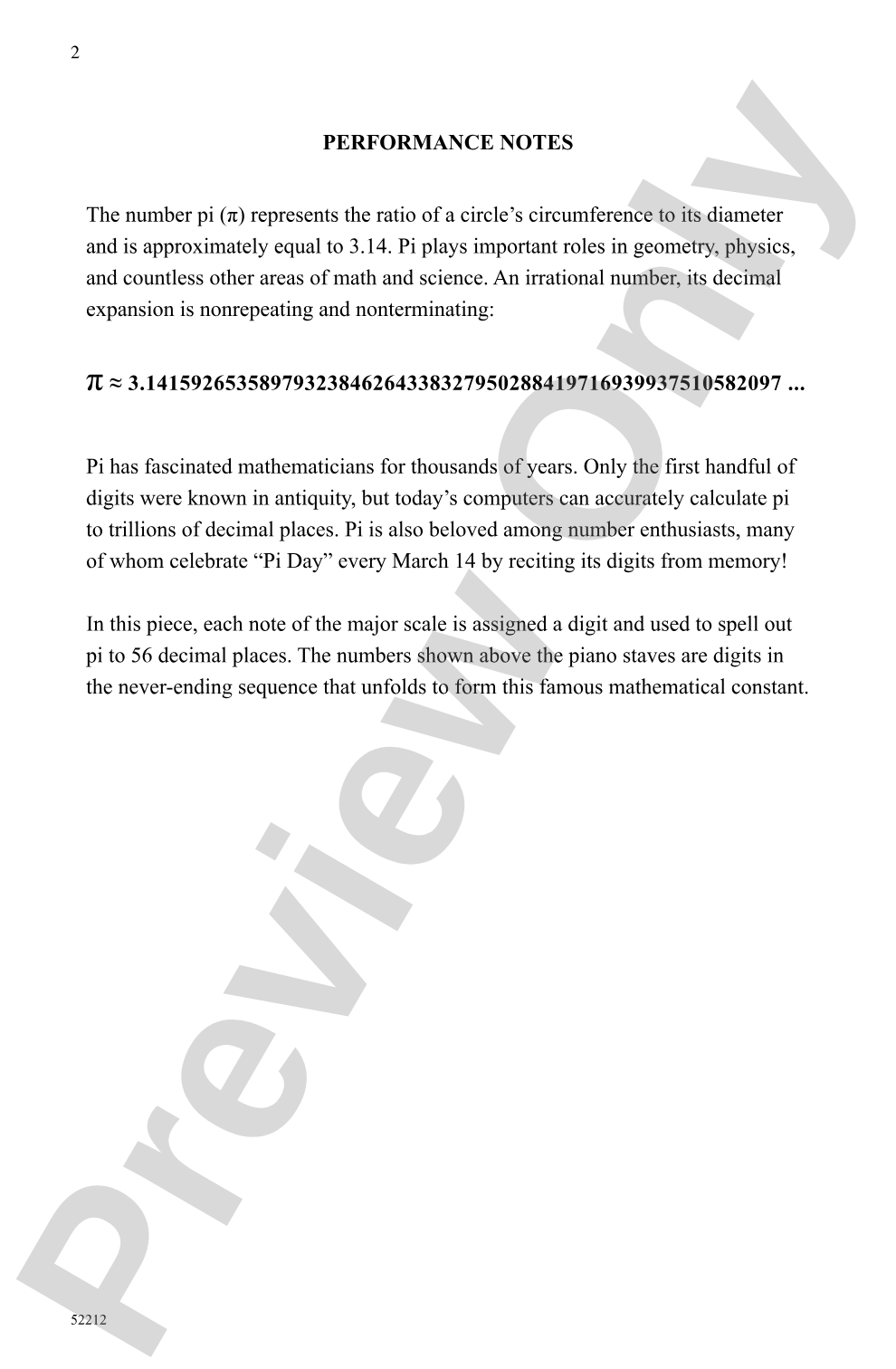
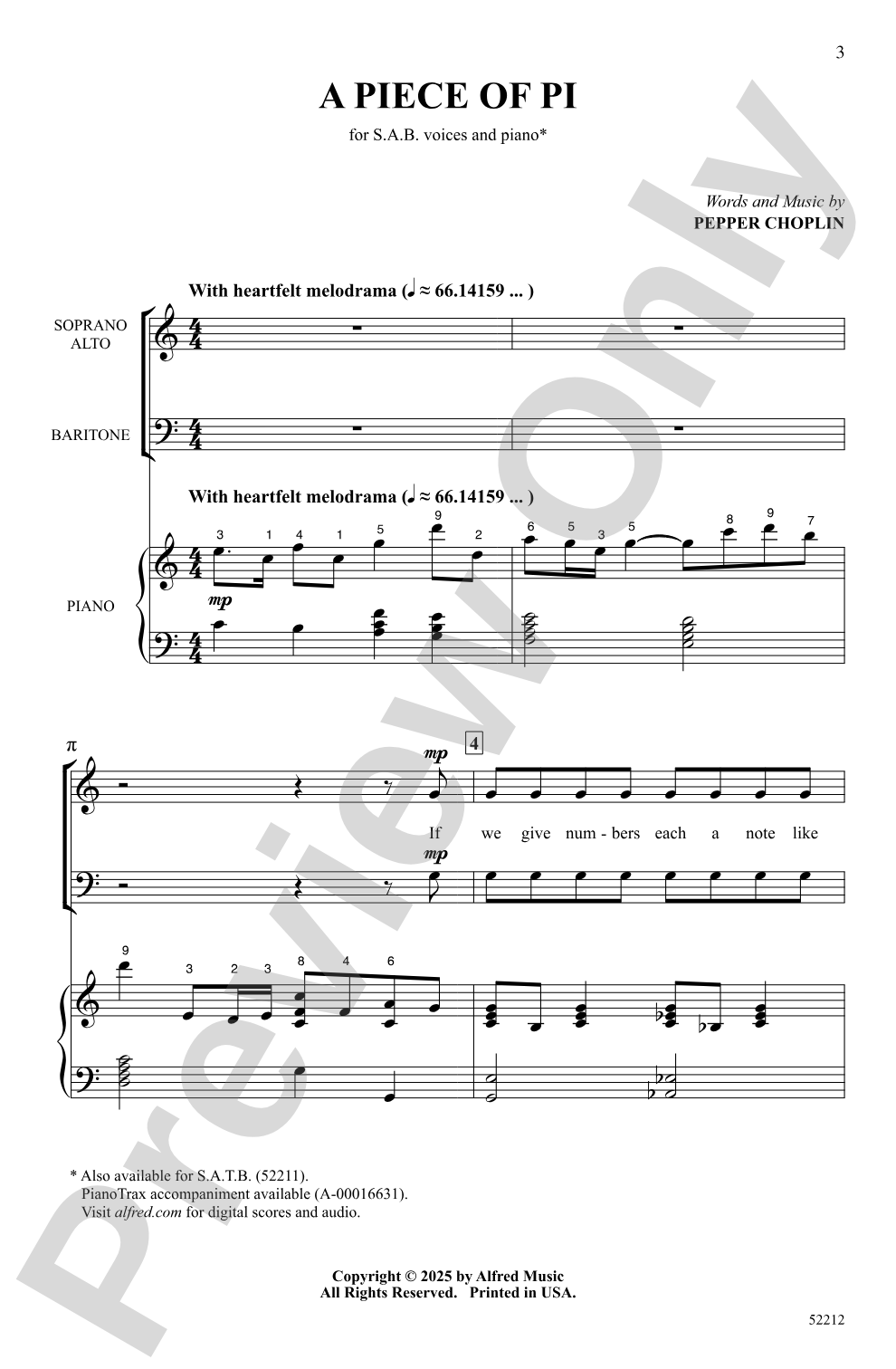
Here's an ode to the beloved mathematical constant that will delight singers and number enthusiasts alike. Each digit of the never-ending number is assigned a note of the major scale, revealing a surprisingly musical melody. In an unexpected twist, the circle-inspired pattern stacks into a remarkable round. Well worth the learning curve, this spectacular song doubles as a sight-singing exercise with the power to fortify skills!


Discover MakeMusic Cloud: thousands of interactive titles your students can play along with today.
Sample Audio
1
Audio File
--:--
0:00
0:00
Sample Video
Additional Details
Series:
Alfred Choral Designs
Publisher:
Alfred Music
Page Count:
12
SKU:
00-PO-0007592
More about this title
About the Composer: Pepper Choplin

Pepper Choplin holds degrees from the University of North Carolina at Greensboro (Bachelor of Music) and Southwestern Baptist Theological Seminary in Fort Worth, Texas (Master of Music in composition). Over the course of his career, he has composed more than two hundred anthems and seven choral musicals, drawing on performance experience that spans rock, classical, bluegrass, and theme park entertainment.
Choplin serves as Minister of Music at Greystone Baptist Church in Raleigh, North Carolina, where many of his compositions originate from the church's worship needs. He regularly conducts, clinics, and performs across the country, blending inspirational and humorous material that moves audiences to both laughter and reflection. His recordings include the self-produced album Pepper Is My Real Name, featuring his comedic songs, and Hold On, a collection of his most beloved inspirational works.
Why we love this
Choplin crafts a genuinely clever concept here that transcends its mathematical hook. The assignment of pi digits to scale degrees creates an authentic melody that demands nothing of singers beyond accurate reading, while the round form adds structural sophistication that surprises on repeated hearings. Few pieces this playful also function as rigorous sight-singing reinforcement.
What to expect
Playful ingenuity meets focused musicianship. The melody unfolds with genuine lyricism despite its algorithmic origins, creating the delightful surprise that pi actually sings. The round amplifies this effect, layering the same pattern into polyphonic harmony that feels both logical and musically satisfying.
Who it's for
Directors seeking novelty material with genuine musical substance will find this ideal for middle school through adult choirs. The SAB voicing makes it accessible to mixed ensembles without requiring divisi work, and the math-to-music concept appeals equally to singers and audiences curious about the intersection of pattern and melody.
How to get the most out of it
- Learn each voice part individually before stacking the round, since the relationship between parts remains abstract until singers grasp their own line's contour and rhythm.
- Emphasize the major scale patterns during rehearsal so the pi-to-note mapping becomes intuitive rather than mechanical.
- Maintain ensemble precision in the round entries, paying close attention to balance so the texture builds logically rather than collapsing into muddy simultaneous singing.
- Take advantage of the recorded accompaniment to solidify intonation and provide a stable harmonic foundation while voices align.
How to use it
A natural choice for a Pi Day concert or a program theme celebrating mathematics and music. Its accessibility and novelty appeal make it an excellent opener or closer that engages audiences immediately while demonstrating your choir's interpretive range. The seven-minute learning curve rewards rehearsal time with a memorable, conversation-starting performance.
Skills your students will build
- Reading and singing scale degree relationships
- Sight-singing accuracy in stepwise motion
- Entering and maintaining precision in round form
- Balancing independent voice parts in polyphonic texture
- Sustaining pitch and intonation without relying on harmonic support