
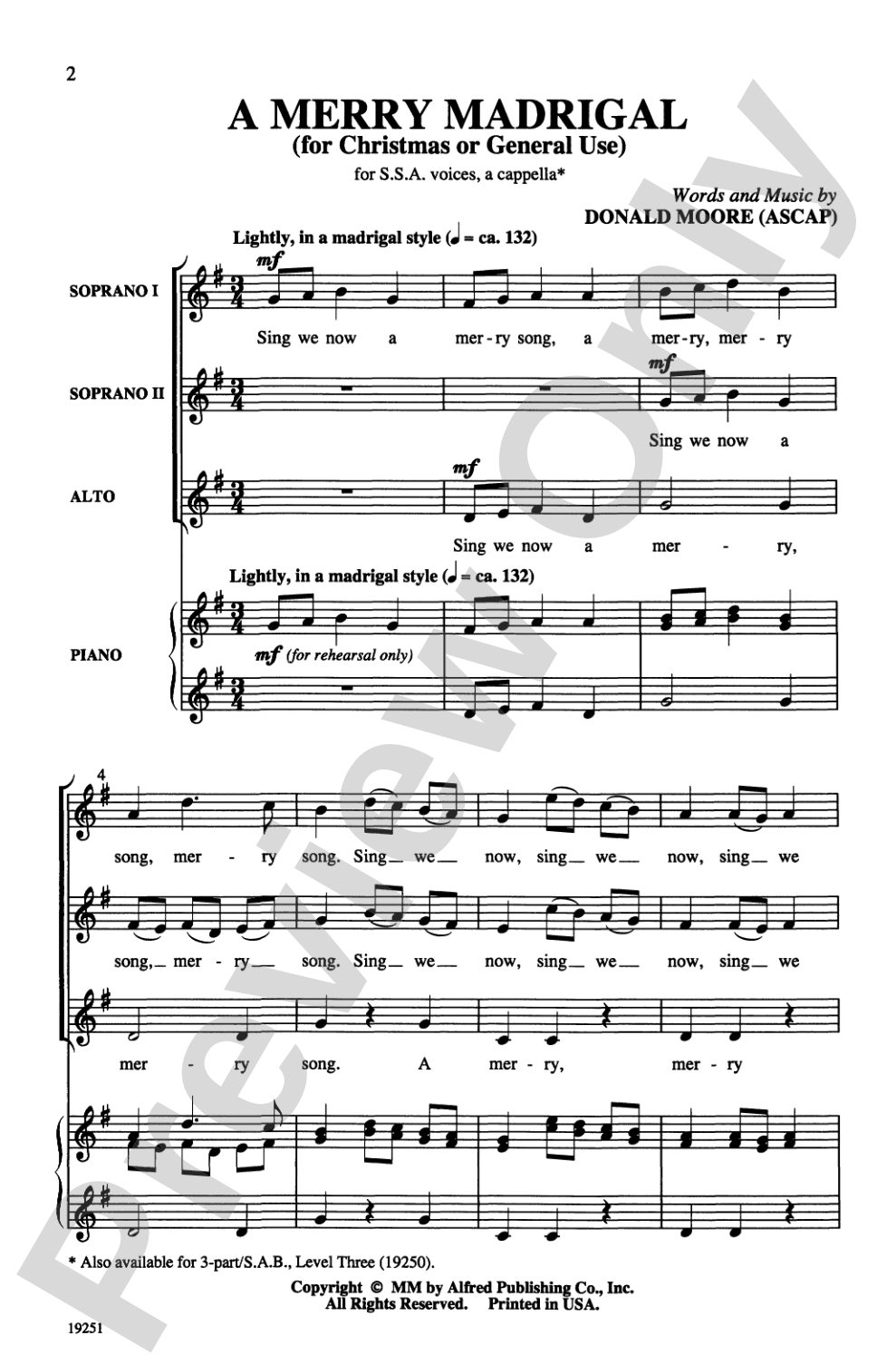

A Merry Madrigal (for Christmas or General Use): SSA, a cappella Choral Octavo
For Christmas or General Use
Music by Donald Moore
Item: 00-PO-0004150
$2.25
Minimum order quantity: 20 copies
Pickup currently not available
Description
A "fa la la" section in this joyful number makes it appropriate for both Christmas and general use. It's a fine learning piece in the madrigal style, yet the singable melodies make the independent vocal lines easy to learn. Don Moore is a master at creating works that develop choral singing, teach a classic choral style and, most importantly, sound great. Use it in concerts and at festivals and adjudications.


A Merry Madrigal (for Christmas or General Use): SSA, a cappella Choral Octavo isn't in MakeMusic Cloud just yet...but it could be. Let us know you'd like to see it, and you'll help shape what comes next. In the meantime, start a free trial and dive into thousands of interactive titles your students can play along with today.
Request This Title
Tell us you want it.
Start Your Free Trial
Explore everything that's ready to play right now.
Sample Audio
1
Audio File
--:--
0:00
0:00
Sample Video
No sample videos found.
Additional Details
Series:
Alfred Archive Edition: Alfred Choral Designs
Publisher:
Alfred Music
Page Count:
8
SKU:
00-PO-0004150
More about this title
About the Composer: Donald Moore

Donald Moore earned his Bachelor of Music in organ performance and Master of Arts in Teaching from Kent State University. He serves as Organist-Choirmaster at Pilgrim United Church of Christ in Cuyahoga Falls, Ohio, and has established himself as one of America's most prolific choral composers, with over 500 works published across multiple houses including Alfred Music, Hal Leonard, Heritage Music Press, and others.
Moore's output spans sacred, secular, educational, and pop choral idioms alongside organ and piano works and eight instructional books. His compositions appear regularly on state and national contest programs, and the American Choral Directors Association recognized him in the Choral Journal as one of 400 historically significant American choral composers. He is a seventeen-time recipient of the ASCAP Composers Standard Award. Moore also pursues competitive midget car racing, fielding championship drivers throughout the racing season.
Why we love this
Moore has a gift for writing treble voices that feel natural to sing while remaining musically substantial. The madrigal form gives your singers immediate exposure to an essential choral tradition, and the "fa la la" refrain anchors the piece in genuine festive warmth rather than saccharine sentiment. This works equally well as a contest piece or a concert moment that audiences genuinely enjoy.
What to expect
A Merry Madrigal radiates genuine good humor and festive lightness. The interlocking vocal lines create a sense of playfulness without becoming overly clever, and the "fa la la" sections feel like an invitation to celebrate rather than a forced garnish. Even when harmonies shift, the piece maintains a buoyant, warmly human character.
Who it's for
This piece suits treble choirs at the middle school through adult level who have basic secure intonation and are ready to explore Renaissance and early choral style. It works equally well for singers with one or two years of ensemble experience seeking an accessible entry into madrigal writing, and for more advanced groups who want a polished contest or festival offering.
How to get the most out of it
- Establish the homophonic opening sections cleanly before allowing the overlapping lines of the madrigal sections to build complexity. Your singers will absorb the independent voice writing more readily when the harmonic foundation is secure.
- Let the "fa la la" refrain breathe slightly. A measured, almost dance-like lilt here lifts the mood without rushing the text.
- Balance the three voice parts by rehearsing the soprano and alto lines separately from the beginning. SSA writing can burden the soprano with melodic responsibility; ensure the alto and second soprano parts have their musical character heard.
How to use it
Pair this with other madrigals or Renaissance repertoire to create a thematic concert section on choral history, or place it late in a winter concert as a moment of pure joy after heavier work. It travels well to festivals and adjudications and performs equally effectively in worship settings during Advent or Christmas seasons.
Skills your students will build
- Reading independent voice lines in madrigal texture
- Singing a cappella with secure intonation in three parts
- Recognizing and performing period-appropriate articulation and phrasing in secular Renaissance style
- Balancing treble voice parts to achieve clarity in polyphonic writing
- Understanding historical context of the madrigal form