
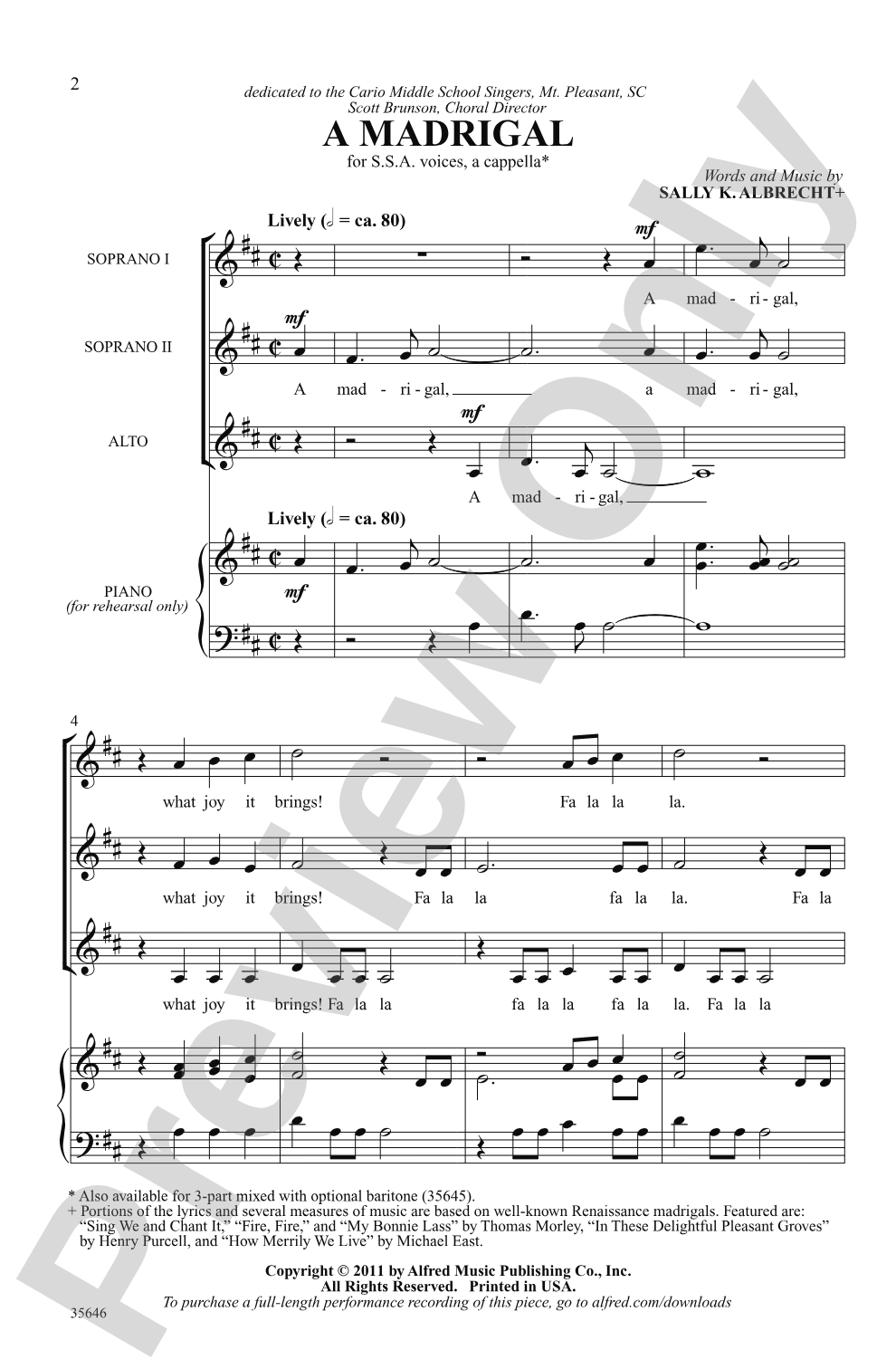


A Madrigal: SSA, a cappella Choral Octavo
Words and music by Sally K. Albrecht
Item: 00-PO-0000933
$1.80
Minimum order quantity: 20 copies
Pickup currently not available
Description
Here's a marvelous music history lesson! This clever a cappella choral features snippets of well-known madrigal texts and music, mixed in with an original contrapuntal theme.


A Madrigal: SSA, a cappella Choral Octavo isn't in MakeMusic Cloud just yet...but it could be. Let us know you'd like to see it, and you'll help shape what comes next. In the meantime, start a free trial and dive into thousands of interactive titles your students can play along with today.
Request This Title
Tell us you want it.
Start Your Free Trial
Explore everything that's ready to play right now.
Sample Audio
1
Audio File
--:--
0:00
0:00
Sample Video
No sample videos found.
Additional Details
Series:
Alfred Choral Designs
Publisher:
Alfred Music
Page Count:
12
SKU:
00-PO-0000933
More about this title
About the Composer: Sally K. Albrecht

Sally K. Albrecht has shaped American choral music for decades as a composer, conductor, and clinician with a distinctive focus on movement and accessible writing for singers of all levels. Since 1987, she has received the ASCAP Special Music Award annually and maintains over 600 published choral works alongside 75 larger musicals and songbooks. Her conducting has graced honor choir festivals at Lincoln Center, Carnegie Hall, and The Kennedy Center, while her three decades directing school choral and vocal publications at major educational publishers established her as a trusted voice in music pedagogy.
Albrecht holds degrees from Rollins College (B.A. in Music and Theater, 1976), the University of Miami (M.A. in Drama, 1977; M.M. in Accompanying, 1979), and has taught at Oakland University, Jersey City State College, and Meredith College. A 2021 recipient of the Distinguished Alumna Award from both the University of Miami Frost School of Music and Rollins College, she continues to influence music education alongside her husband, composer and arranger Jay Althouse, from North Carolina.
Why we love this
Albrecht threads together authentic madrigal fragments with her own contrapuntal writing, creating a piece that teaches music history through direct musical experience rather than lecture. The a cappella setting demands genuine ensemble listening and balance, rewarding singers with the satisfying sound of voices blending in Renaissance-inspired counterpoint. This is the kind of piece that sparks joy in rehearsal because singers immediately recognize the historical references while enjoying the clever integration of Albrecht's original material.
What to expect
Elegant and playful, with a sense of musical discovery woven throughout. The piece feels like stepping into a conversation between past and present, where centuries-old madrigal voices suddenly recognize themselves in new harmonic contexts. There's an intellectual delight to hearing the familiar recontextualized, paired with the pure vocal joy of well-crafted three-part writing.
Who it's for
Treble choirs at the secondary or collegiate level seeking an engaging repertoire piece that combines musical substance with educational value. This works particularly well for ensembles comfortable with a cappella singing and interested in exploring Renaissance music through a contemporary compositional lens.
How to get the most out of it
- Isolate each madrigal excerpt in sectional rehearsals so singers understand the text and style before blending all three voice parts; this contextual knowledge strengthens intonation and phrasing throughout.
- Shape phrases with the textual meaning rather than by bar line; madrigal style rewards subtle rubato and breathwork that honors the poetry.
- Balance the original contrapuntal theme against the recognizable madrigal snippets by adjusting dynamic support; let familiar material emerge slightly while maintaining harmonic integrity in your composed sections.
How to use it
Pair this with a Renaissance madrigal by a historical composer (Marenzio, Monteverdi, Byrd) to create a mini-unit exploring how contemporary composers dialogue with the past. It also shines in a concert celebrating music history or as the centerpiece of a chamber concert featuring smaller ensemble works. Consider programming it in a spring concert where lighter, more sophisticated repertoire feels seasonally appropriate.
Skills your students will build
- Listening to balance and blend in a cappella counterpoint
- Recognizing and interpreting Renaissance musical and textual conventions
- Sustaining intonation without instrumental support across shifting harmonic contexts
- Understanding how contemporary composers reference and reimagine historical styles
- Phrasing text with musical integrity in polyphonic textures