
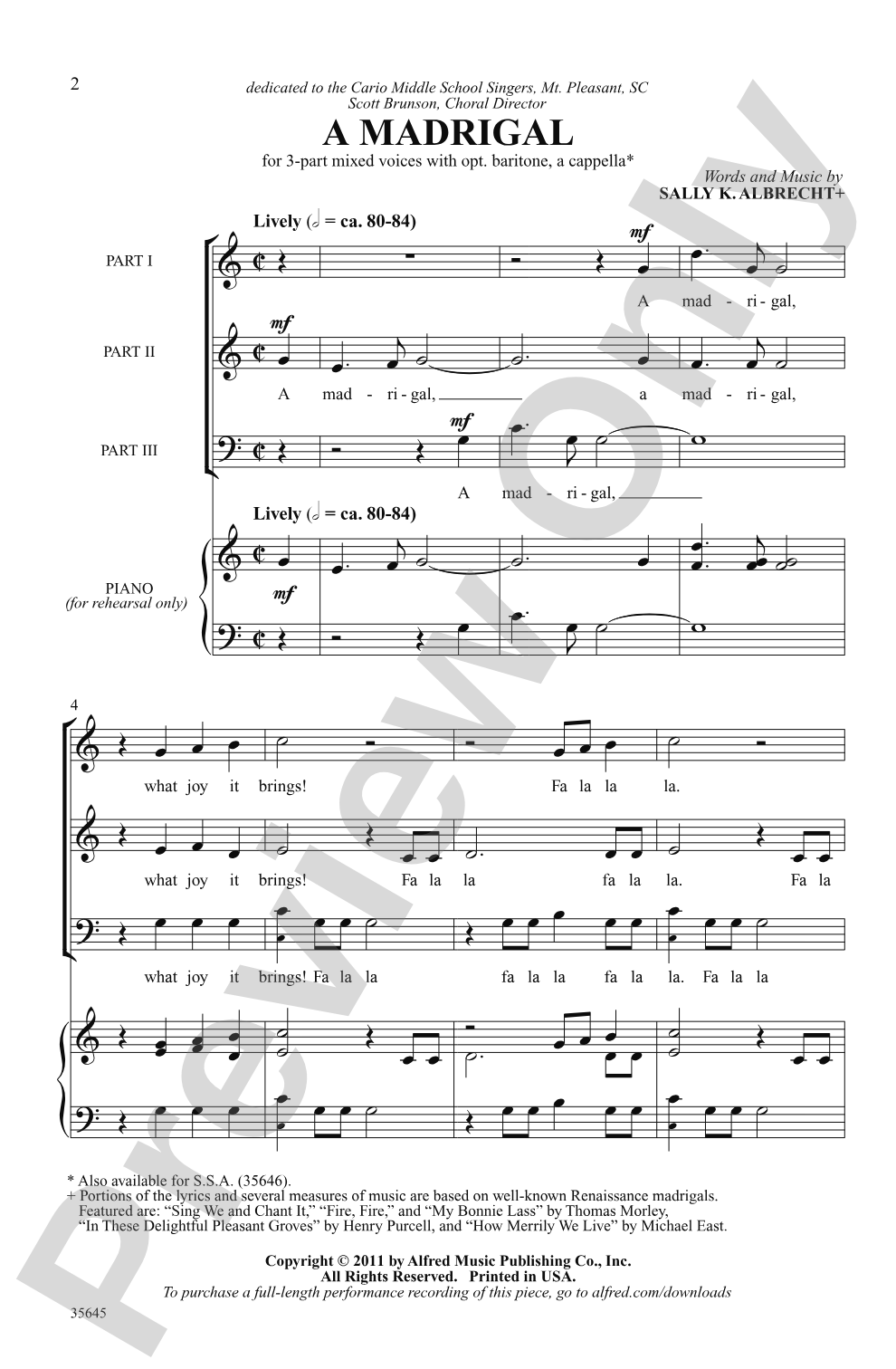
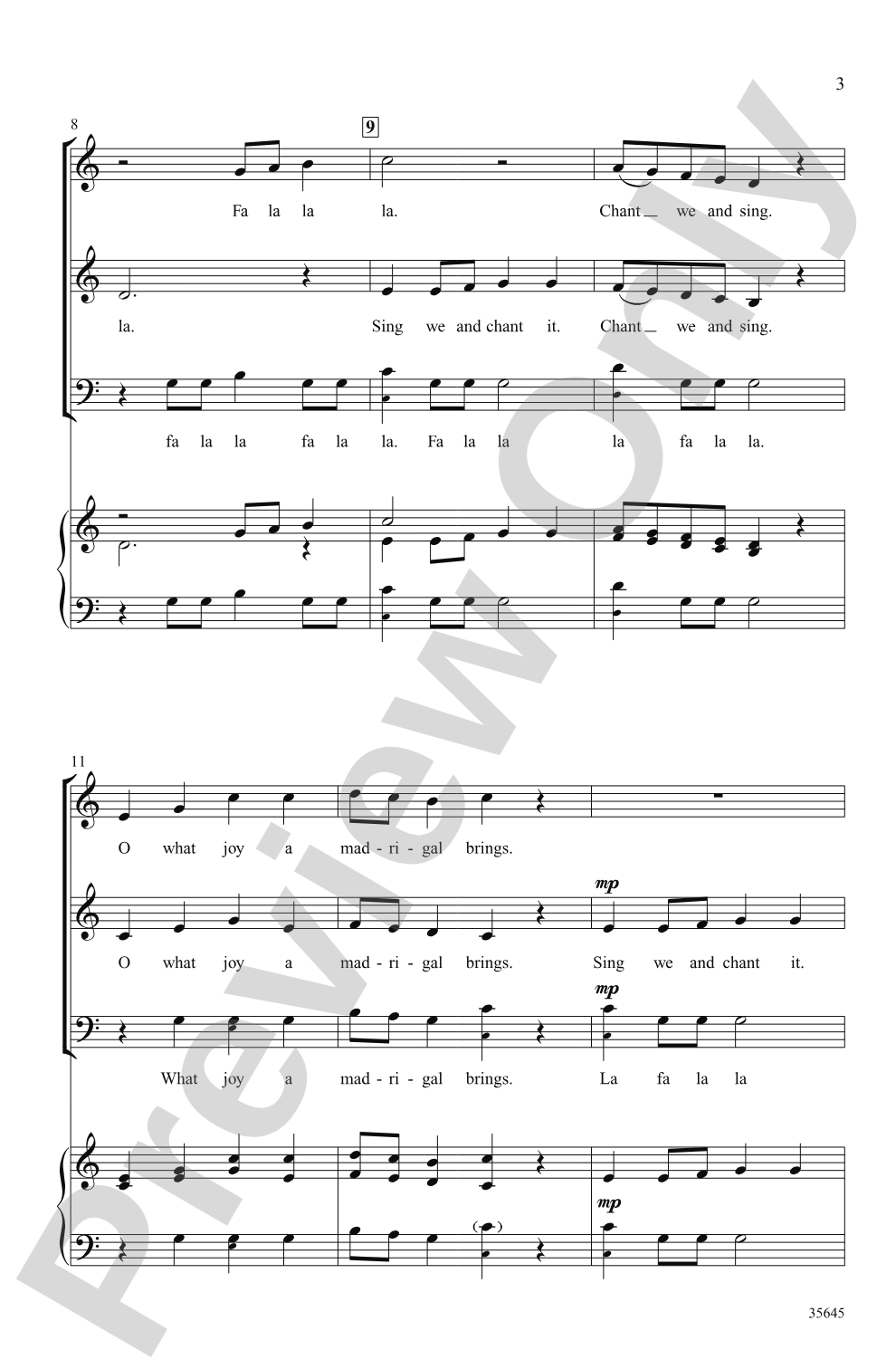
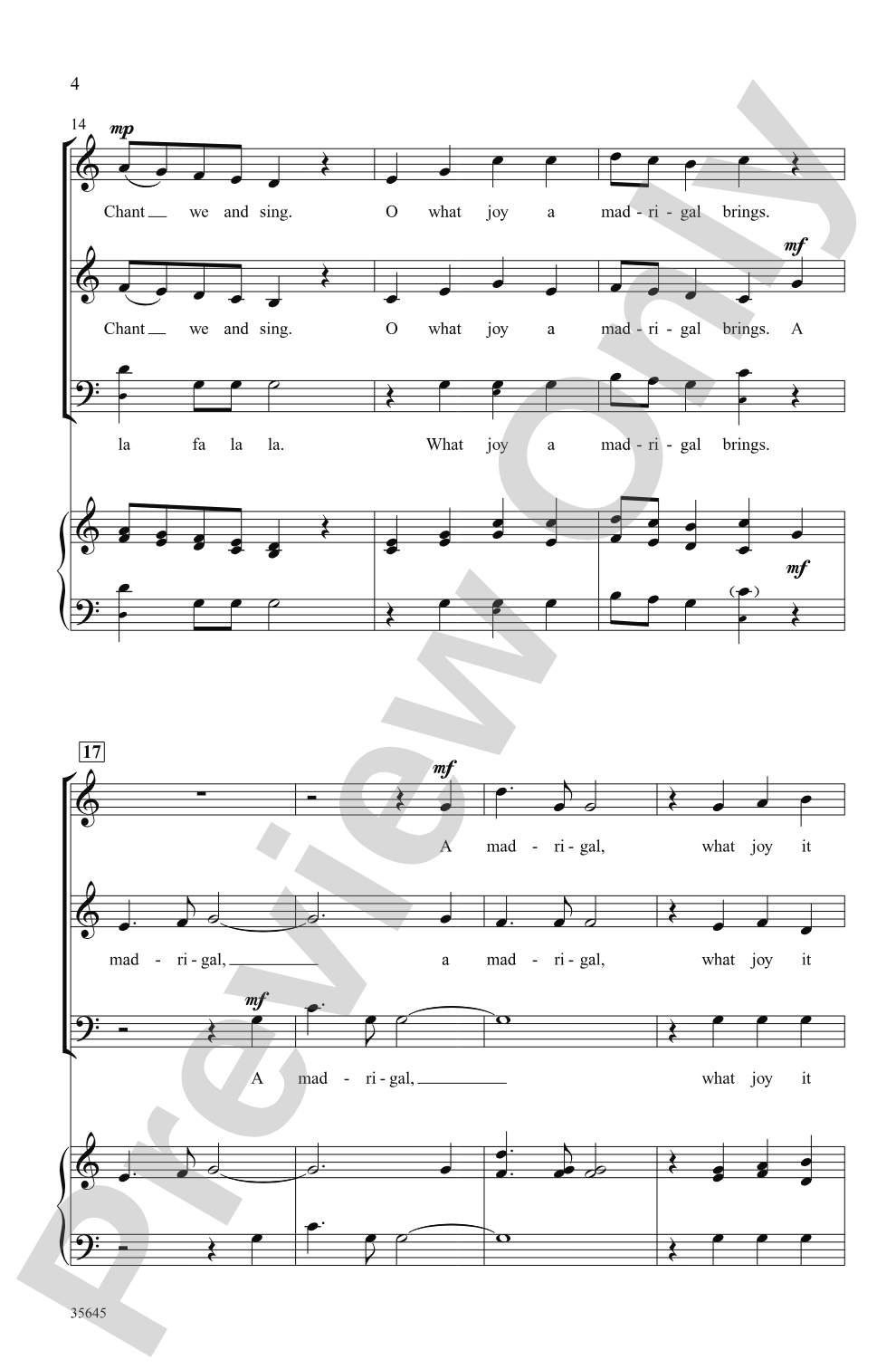

A Madrigal: 3-Part Mixed, a cappella Choral Octavo
Words and music by Sally K. Albrecht
Item: 00-PO-0000932
$1.80
Minimum order quantity: 20 copies
Pickup currently not available
Description
Here's a marvelous music history lesson! This clever a cappella choral features snippets of well-known madrigal texts and music, mixed in with an original contrapuntal theme.


A Madrigal: 3-Part Mixed, a cappella Choral Octavo isn't in MakeMusic Cloud just yet...but it could be. Let us know you'd like to see it, and you'll help shape what comes next. In the meantime, start a free trial and dive into thousands of interactive titles your students can play along with today.
Request This Title
Tell us you want it.
Start Your Free Trial
Explore everything that's ready to play right now.
Sample Audio
1
Audio File
--:--
0:00
0:00
Sample Video
No sample videos found.
Additional Details
Series:
Alfred Choral Designs
Publisher:
Alfred Music
Page Count:
12
SKU:
00-PO-0000932
More about this title
About the Composer: Sally K. Albrecht

Sally K. Albrecht has shaped choral music education as both a prolific composer and a visionary publisher. Since 1987, she has received the annual ASCAP Special Music Award and maintains over 600 published choral works alongside 75 larger musicals and songbooks. For more than thirty years, she directed school choral and vocal publications for major educational music houses, including Alfred Music, while also conducting honor choirs at Lincoln Center, Carnegie Hall, and The Kennedy Center.
Albrecht holds degrees from Rollins College (B.A. in Music and Theater, 1976), the University of Miami (M.A. in Drama, 1977; M.M. in Accompanying, 1979), and has taught at Oakland University, Jersey City State College, and Meredith College. She was recognized with the Distinguished Alumna Award from both the University of Miami Frost School of Music and Rollins College in 2021, and served as Chair of the Board of Trustees for the Omicron Delta Kappa National Leadership Honor Society. She lives in Wake Forest, North Carolina, with her husband, composer and arranger Jay Althouse.
Why we love this
Albrecht braids music history into a singable performance that works equally well as a concert piece and a teaching tool. The layering of recognizable madrigal fragments with original counterpoint gives singers something intellectually engaging to discover while maintaining the elegance and charm that define the genre. Your ensemble will enjoy the detective work of identifying borrowed material while learning authentic Renaissance vocal writing.
What to expect
The piece captures the conversational warmth and textural complexity of Renaissance madrigals while maintaining enough modern clarity to feel accessible. Listeners experience a playful encounter with the past, where familiar melodic fragments weave together like a musical conversation across centuries.
Who it's for
This piece suits mixed choirs of intermediate ability and above who have solid ensemble intonation and are ready for three-part a cappella writing. It appeals to groups interested in exploring music history through performance, or choirs preparing concert programs that blend historical substance with engaging musical storytelling.
How to get the most out of it
- Shape each phrase with forward momentum; the a cappella texture demands careful breath placement and line continuity to prevent the piece from sounding fragmented.
- Balance the three parts so that no single voice dominates when text overlaps, especially where Albrecht introduces the borrowed madrigal snippets.
- Approach diction with clarity and intention, since the secular text and historical references come alive when words are articulate.
- Experiment with subtle dynamic shaping to highlight the moments where the original contrapuntal theme emerges against the woven madrigal quotations.
How to use it
Program this as an engaging centerpiece for a concert segment on music history or choral literature, where it can stand alongside either period-authentic madrigals or contemporary choral works. It also serves as a meaningful classroom performance piece when studying the madrigal genre, giving students the dual experience of learning and performing in the same lesson.
Skills your students will build
- Reading and singing in three-part mixed voicing with accurate part independence
- Maintaining intonation in a cappella ensemble singing without instrumental support
- Recognizing and interpreting borrowed musical material and historical allusions within a composition
- Shaping vocal lines with legit phrasing while managing breath and sustain in counterpoint
- Understanding Renaissance madrigal conventions through performance and listening