

A Christmas Roundelay: TBB, a cappella Choral Octavo
Words and music by Sally K. Albrecht
Item: 00-PO-0003663
$1.90
Minimum order quantity: 20 copies
Pickup currently not available
Related Items
A Christmas Roundelay: 3-Part Mixed, a cappella Choral Octavo |
$2.05
|
View | |
A Christmas Roundelay: SSA, a cappella Choral Octavo |
$1.90
|
View | |
A Christmas Roundelay: 3-Part Mixed, a cappella Choral Octavo |
$2.05
|
View | |
A Christmas Roundelay: SSA, a cappella Choral Octavo |
$1.90
|
View | |
A Christmas Roundelay: TBB, a cappella Choral Octavo |
$1.90
|
View |
Description
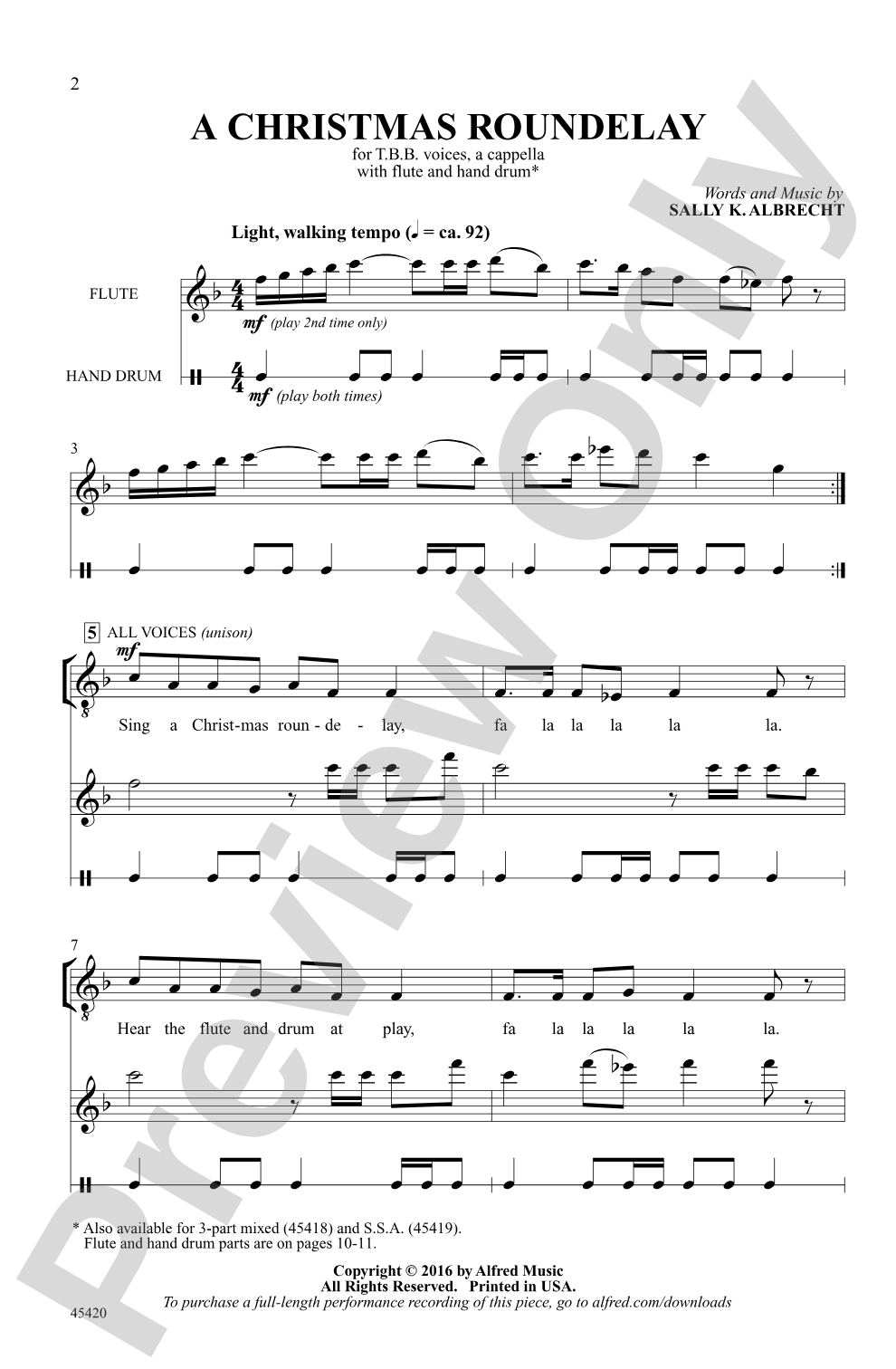
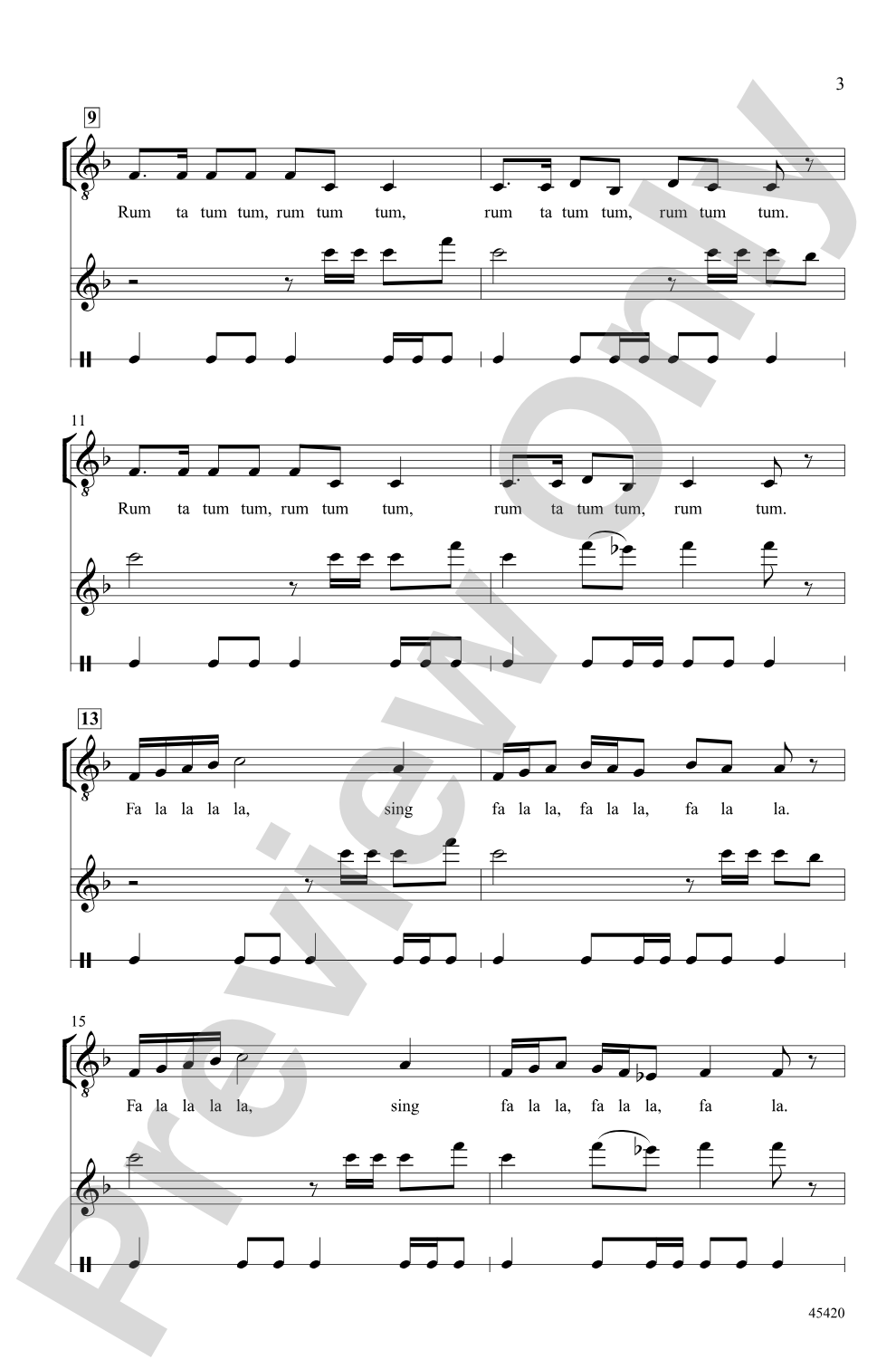
A mixolydian melody becomes the foundation for this stately three-part canon with madrigal style counterpoint. Festive flute and hand drum parts add a Renaissance music touch to a piece with only 12 bars of singing to teach. Ideal for processionals, madrigal feasts, or as a concert opener.


A Christmas Roundelay: TBB, a cappella Choral Octavo isn't in MakeMusic Cloud just yet...but it could be. Let us know you'd like to see it, and you'll help shape what comes next. In the meantime, start a free trial and dive into thousands of interactive titles your students can play along with today.
Request This Title
Tell us you want it.
Start Your Free Trial
Explore everything that's ready to play right now.
Sample Audio
1
Audio File
--:--
0:00
0:00
Sample Video
No sample videos found.
Additional Details
Series:
Alfred Choral Designs
Publisher:
Alfred Music
Page Count:
12
SKU:
00-PO-0003663
Instrumentation:
Flute & Hand Drum
More about this title
About the Composer: Sally K. Albrecht

Sally K. Albrecht has shaped choral music education for over three decades, first as Director of School Choral, Vocal, and Elementary Publications at major educational publishers including Alfred Music, and throughout her career as a prolific composer with more than 600 choral works and 75 larger musicals and songbooks in print. Her contributions have been recognized annually through the ASCAP Special Music Award since 1987, and she has conducted honor choirs at prestigious venues including Lincoln Center, Carnegie Hall, and The Kennedy Center.
Albrecht holds degrees from Rollins College (B.A. in Music and Theater, 1976) and the University of Miami (M.A. in Drama, 1977; M.M. in Accompanying, 1979). She has taught at Oakland University in Michigan, Jersey City State College in New Jersey, and Meredith College in North Carolina. Among her honors are the Distinguished Alumna Award from both the University of Miami Frost School of Music and Rollins College, where she serves on the Board of Trustees. A native of Cleveland, Ohio, she lives in Wake Forest, North Carolina with her husband, composer and arranger Jay Althouse.
Why we love this
This piece solves the perennial challenge of finding short, elegant Christmas repertoire that doesn't require extensive rehearsal time. The three-part canon structure with Renaissance instrumentation creates a sophisticated sound that works beautifully in formal concert settings, while the brevity (only 12 bars of singing) makes it accessible for groups with limited rehearsal schedules or mixed skill levels.
What to expect
A Renaissance fair brought into the concert hall: stately and festive at once, with the mixolydian melody creating an ancient, almost medieval atmosphere. The flute and hand drum add genuine texture rather than sentimentality, giving the piece an understated elegance that feels both ceremonial and joyful.
Who it's for
Directors seeking a brief, concert-ready Christmas selection for treble or mixed voice choirs who want something beyond the typical holiday fare. The piece works well for groups already comfortable with part singing and modal harmony, making it ideal for intermediate to advanced ensembles.
How to get the most out of it
- Emphasize the modal quality of the mixolydian melody; resist the urge to sharpen the seventh scale degree, which would shift the piece toward major tonality and compromise its Renaissance character.
- Balance the flute and hand drum parts with the vocal lines rather than treating them as mere accompaniment. The instrumentation should feel integral to the sound, not added decoration.
- Shape each entrance of the canon carefully to allow listeners to hear both the melodic line and the counterpoint clearly. Slight staggering of dynamics between parts can help achieve this without disrupting ensemble cohesion.
- Take advantage of the processional context: rehearse the piece with movement in mind, allowing singers to internalize the steady pulse while walking.
How to use it
Open a concert with this piece to establish an unhurried, sophisticated tone before moving into longer works. Its brief length and processional character make it ideal for intermediate positions in a program where you want a stylistic shift. The piece also shines in madrigal feast settings or as the processional entrance for a holiday concert, where its Renaissance instrumentation and stately canon work naturally with the venue and context.
Skills your students will build
- Reading and singing in modal tonality, specifically mixolydian mode
- Entering and maintaining lines in canon while listening to other parts
- Balancing vocal and instrumental parts in a cappella context
- Interpreting Renaissance performance practice and style
- Coordinating ensemble singing with processional movement