
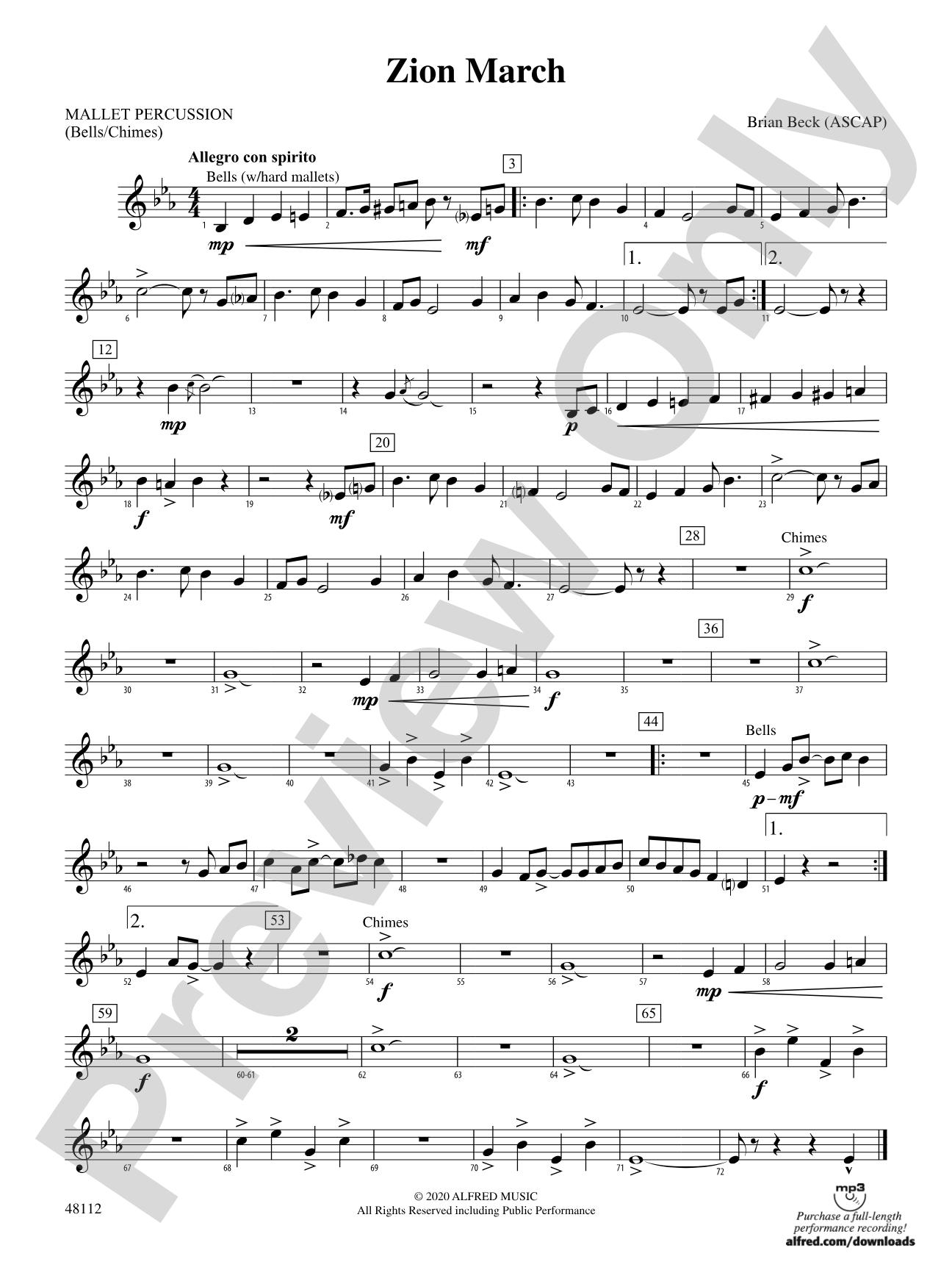

Zion March: Mallets
By Brian Beck
Grade: 1.5 (Easy)
Item: 00-PC-0018562_M1
$3.00
Pickup currently not available
Description
Zion March is written in classic march style, using many permutations of quarter/eighth-note rhythms. Though range is limited, the use of many chromatic notes creates interesting harmonies. Groups performing piece will soon become "rhythm masters"! Correlated to Sound Innovations, Book 2, Level 3. (2:30) This title is available in MakeMusic Cloud.


Don't just read it, hear it, play along with it, and watch your students grow with it. In MakeMusic Cloud, Zion March: Mallets comes alive with professional accompaniment, adjustable tempo, and built-in practice tools that turn solo practice into real progress.
Open in the Player
Jump straight in and assign it today.
Start Your Free Trial
Open this title and explore the full library in minutes.
Sample Audio
1
Audio File
--:--
0:00
0:00
Sample Video
Additional Details
Series:
Sound Innovations for Concert Band
Publisher:
Alfred Music
Page Count:
152
SKU:
00-PC-0018562_M1
More about this title
About the Composer: Brian Beck

Brian Beck is a composer and arranger whose works span instrumental and vocal ensembles. His pieces have been selected for TMEA Honor Band concerts, state marching competitions, UIL prescribed music lists, and clinics across the Midwest and Western regions. Publications including The Instrumentalist, J.W. Pepper, and Tom Lee Music have recognized his compositions, and his writing appears in the GIA Publications series Teaching Music Through Performance In Band.
Beck has directed bands at both middle school and high school levels in Texas, earning consistent Superior ratings at UIL contests and developing groups selected for regional and state honors. He holds a Bachelor's degree in Music Education from Texas A&M University-Commerce and a Master's degree from the University of Houston. As a student, he was a member of the TMEA All-State Band and participated in the Duncanville Band Program.
Why we love this
Beck writes marches that engage young ensembles without overcomplicating the fundamentals. The chromatic harmony keeps ears interested while limited range keeps the focus on rhythm precision, making this an ideal teaching tool for groups building confidence in march style and early sight-reading. At Grade 1.5, it sits in that sweet spot where students feel challenged but not overwhelmed.
What to expect
Zion March carries the classical march stride that audiences recognize immediately, but with unexpected harmonic turns from its chromatic writing. The piece feels energetic and purposeful without relying on extreme registers, making it accessible for younger players while remaining musically satisfying for both ensemble and listener.
Who it's for
Early intermediate bands working through Level 3 of Sound Innovations who need a concert piece that reinforces march fundamentals without excessive range demands. Directors preparing groups for contest and festival settings will find this especially useful for building sight-reading confidence and rhythmic cohesion.
How to get the most out of it
- Lock the articulation style before adding dynamics. The quarter and eighth-note figures demand consistent tonguing across all sections, which becomes easier once rhythmic accuracy is established.
- Balance the chromatic voices that create harmonic color. These aren't just passing tones; they're deliberate harmonic choices that need to sit beneath the primary melody line.
- Work the march tempo gradually. Zion March sounds best when the ensemble can maintain steady subdivision; rushing the pace muddies the rhythmic permutations Beck uses throughout.
- Emphasize uniform eighth-note subdivision across the full band. The limited range means the ear catches every rhythmic unevenness, so precision here directly elevates the sound.
How to use it
Program this early in rehearsal season when your focus is establishing rhythm fundamentals and march style conventions. It works equally well as a festival or contest selection, or as a closing piece on a concert where you want clean, confident execution rather than technical display.
Skills your students will build
- Mastering the rhythm permutations of quarter and eighth-note patterns characteristic of march style
- Reading and performing chromatic passages within a limited overall range
- Maintaining steady subdivision and articulation consistency across full ensemble
- Developing rhythmic precision through repetitive figures that reward accurate counting
- Sight-reading and performance skills aligned with Sound Innovations Book 2 Level 3