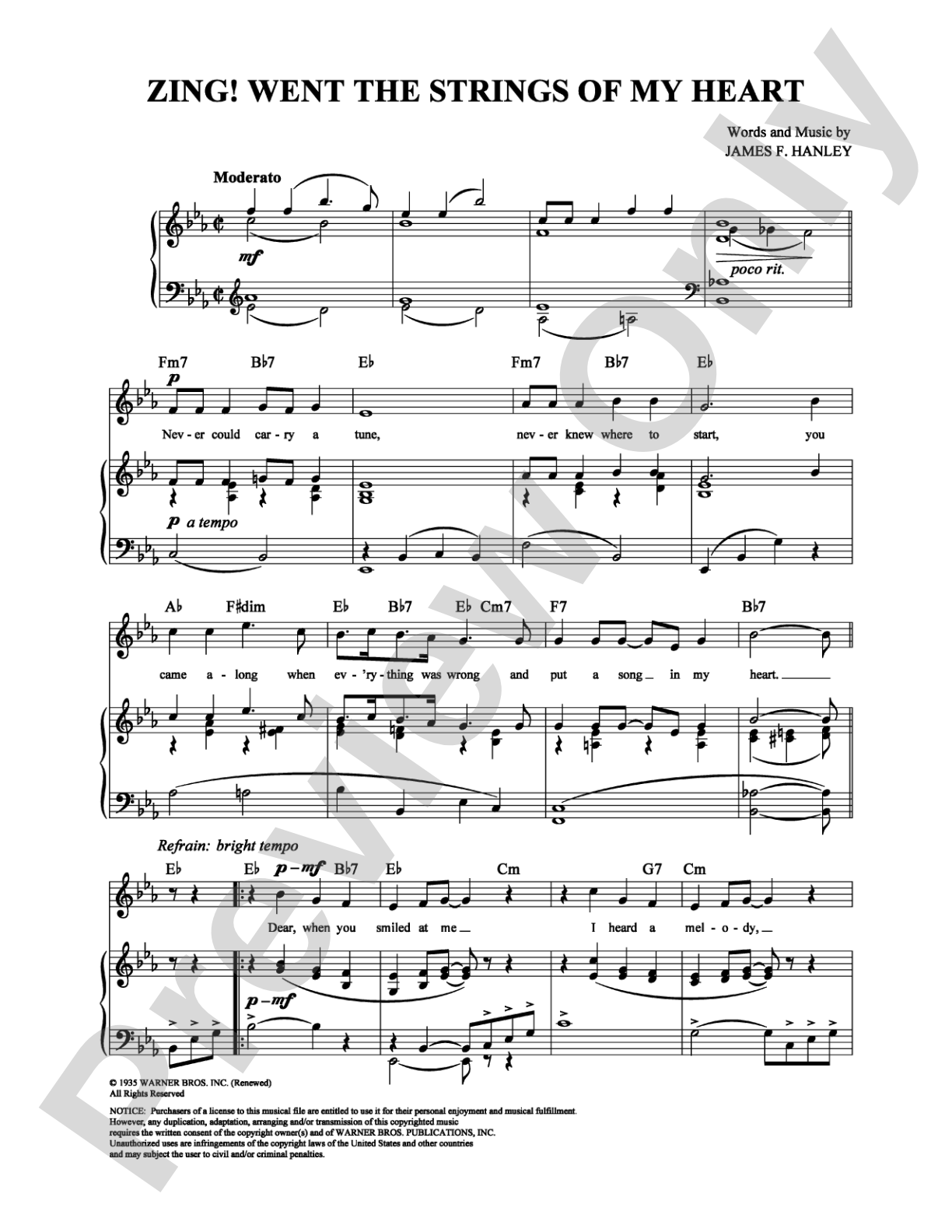
Zing! Went the Strings of My Heart: Piano/Vocal/Chords Digital Sheet Music

Zing! Went the Strings of My Heart: Piano/Vocal/Chords Digital Sheet Music

James F. Hanley, Judy Garland

Item: 00-PS-0005297

Digital Download
$3.99
Description

Zing! Went the Strings of My Heart: Piano/Vocal/Chords Digital Sheet Music isn't in MakeMusic Cloud just yet...but it could be. Let us know you'd like to see it, and you'll help shape what comes next. In the meantime, start a free trial and dive into thousands of interactive titles your students can play along with today.

Sample Audio
No sample audio found.
Sample Video
Additional Details
SKU: 00-PS-0005297

More about this title

About the Artist: Judy Garland

Judy Garland (1922-1969) was an American singer and actress whose interpretive gifts and technical command defined the golden age of American song. Her performances of standards and popular song revealed an instinctive understanding of lyrical phrasing, emotional authenticity, and vocal control that made her one of the most influential singers of the twentieth century.

For music students and teachers, Garland's recordings and arrangements serve as masterclasses in how to inhabit a song. Her approach to tempo flexibility, dynamic contrast, and text painting offers valuable lessons for singers learning to move beyond the printed page and discover their own interpretive voice.

Why we love this

Garland's signature recording of this James Hanley standard captures the song's sophisticated swing and romantic playfulness. The piano/vocal arrangement gives accompanists real musical partnership, with idiomatic voicings that reward careful listening and allow singers to explore how a mature vocalist phrases and colors a jazz-inflected melody.

What to expect

The song glows with a vintage romantic confidence: tender without sentimentality, swinging without cynicism. Garland's version invites singers to discover the small melodic surprises and harmonic shadings that make this standard enduring, all wrapped in a melody that feels both effortless and carefully shaped.

Who it's for

This arrangement suits singers preparing audition repertoire, teaching singers about interpretive choices in the American songbook, or accompanying students in jazz vocals and standards classes. Pianists will find the voicings and rhythmic accompaniment patterns instructive for accompanying singers in a jazz or popular idiom.

How to get the most out of it

  • Balance the syncopated rhythms in the accompaniment with the vocal line; the piano part should support rather than compete with the singer's interpretation of the melody.
  • Pay attention to how Garland handles the title phrase and other emphatic moments; experiment with subtle rubato and dynamic shaping to convey the song's warmth without dragging.
  • The chord symbols offer room for accompanists to add tasteful voicings and passing tones. Stay grounded in the harmonic function rather than filling every beat.
  • Consider the style as swing-tinged popular song rather than strict jazz or classical interpretation. Maintain forward motion while allowing space for lyrical expression.

How to use it

Feature this piece in a standards-focused recital, as a bridge between classical and jazz vocal repertoire, or within a program exploring American popular song. The recorded performance provides an excellent reference for singers unfamiliar with Garland's interpretation and offers historical context for discussions about vocal style and arrangement.

Skills your students will build

  • Interpreting jazz and swing phrasing in a pop standard
  • Collaborating between vocalist and pianist in a fixed arrangement
  • Reading and executing chord symbols and accompaniment figures
  • Shaping longer melodic phrases with dynamic control and rubato

You May Also Like