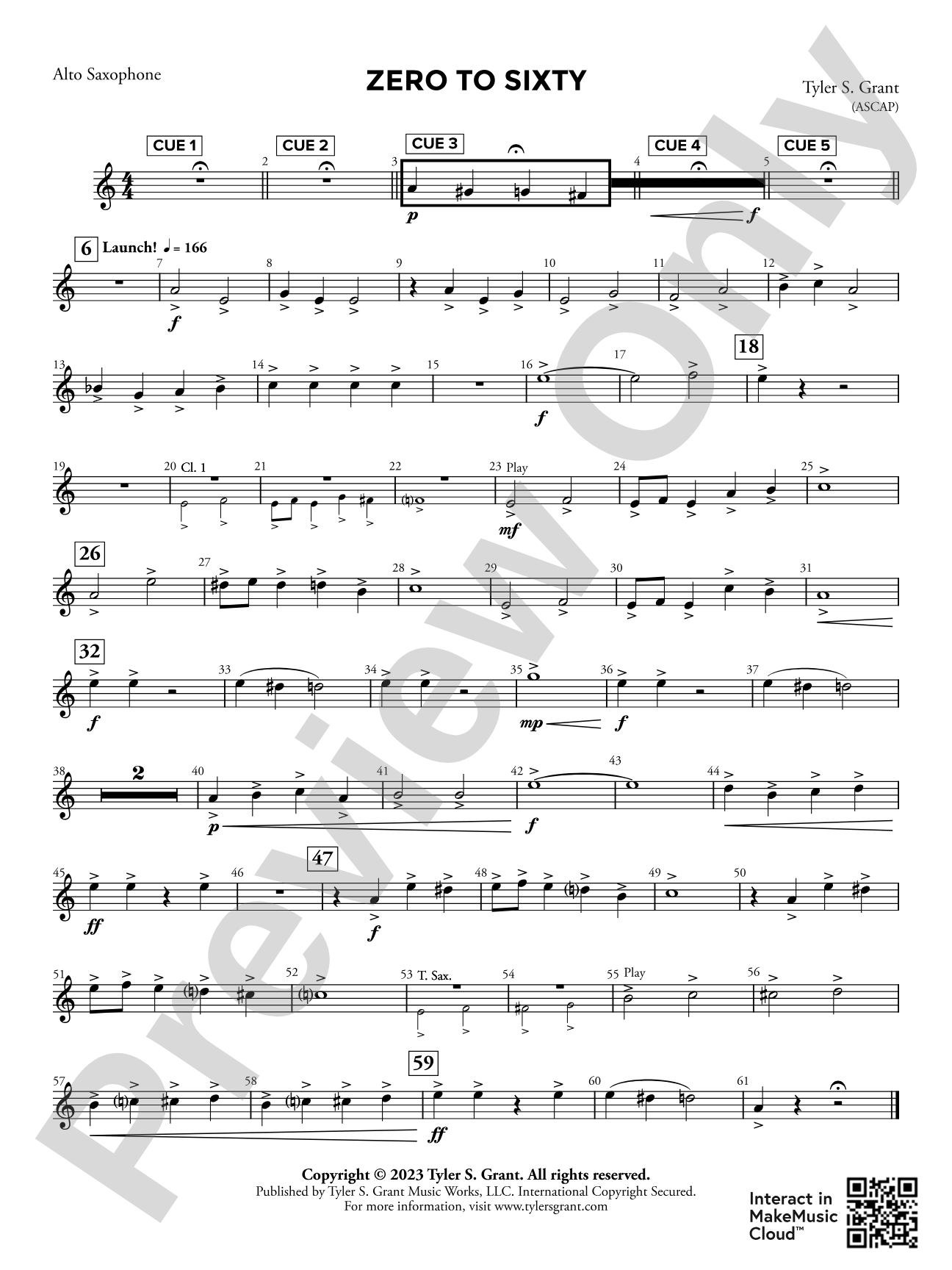
Zero to Sixty: 1st E-flat Alto Saxophone Sheet Music Preview

Zero to Sixty: 1st E-flat Alto Saxophone

By Tyler S. Grant

Grade: 1.5

Item: 98-PC-TGB030_AX1

Digital Download
$4.50
Description
Learning notes of the chromatic scale has never been so exciting! Take your students on an adrenaline-filled thrill ride with Tyler S. Grant's Zero to Sixty while reinforcing their technical skills. Fasten your seat belts and hold on! Recorded by the Atlanta Wind Symphony. (2:00)

Zero to Sixty: 1st E-flat Alto Saxophone isn't in MakeMusic Cloud just yet...but it could be. Let us know you'd like to see it, and you'll help shape what comes next. In the meantime, start a free trial and dive into thousands of interactive titles your students can play along with today.

Sample Audio
0:00
0:00
Sample Video
Additional Details
Series: Tyler S. Grant Music Works
Publisher: Tyler S. Grant Music Works, LLC.
SKU: 98-PC-TGB030_AX1

More about this title

About the Composer: Tyler S. Grant

Tyler S. Grant

Tyler S. Grant has built a distinctive voice in contemporary band literature through consistent commissions, publications, and performances at major venues including Carnegie Hall, The Midwest Clinic, and the Macy's Thanksgiving Day Parade. His compositions appear regularly on honor ensemble programs across the country and on curated repertoire lists from publishers and festivals worldwide. Grant earned his bachelor's degree in instrumental music education from the University of Alabama, where he studied conducting with Randall Coleman, and has maintained an active schedule as both a clinician and guest conductor in schools across more than 15 states.

Beyond the concert hall, Grant has contributed to music education through his work as an author for Alfred Music's Sound Innovations: Ensemble Development series and through appearances in publications such as School Band & Orchestra Magazine and The Instrumentalist. His 2014 competition-winning Panoramic Fanfare established his reputation among professional and collegiate ensembles throughout North America. He credits composer Brian Balmages as instrumental in shaping his artistic development.

Why we love this

Grant has engineered a piece that makes chromatic scale literacy genuinely engaging rather than a drill. The two-minute duration fits naturally into concerts without sacrificing musical substance, and the contest/festival designation signals that students will hear their own accomplishment clearly reflected in adjudication and audience response.

What to expect

Imagine the rush of acceleration in a high-performance vehicle translated to sound: energy builds, technical demands escalate, and the ensemble crosses the finish line together in triumph. The chromatic language propels the piece forward with kinetic momentum that feels modern and immediate.

Who it's for

Beginning concert bands at the 1.5 grade level will find this an ideal vehicle for reinforcing chromatic scale competency while experiencing genuine musical excitement. Directors seeking accessible contest material that doesn't condescend to young players will recognize an opportunity to build technical confidence alongside ensemble cohesion.

How to get the most out of it

  • Establish a steady pulse from measure one; the energy of this piece depends on rock-solid time that doesn't waver under the adrenaline.
  • Balance the technical passages so that individual chromatic lines stay audible without swallowing the harmonic structure underneath.
  • Use dynamic contrast strategically to shape the arc toward the climax rather than playing at high volume throughout.

How to use it

Program this during the middle section of a concert where you want an energy shift without overwhelming newer ensembles. Its compact length and technical focus make it ideal for a festival setting or as the closing piece of a sectional rehearsal to leave students with a sense of accomplishment.

Skills your students will build

  • Chromatic scale fluency across all instruments
  • Ensemble balance and blend in rapid, scalar passages
  • Maintaining intonation accuracy at faster tempos
  • Dynamic control and phrasing in technically driven material
  • Rhythmic precision under sustained forward momentum

You May Also Like