
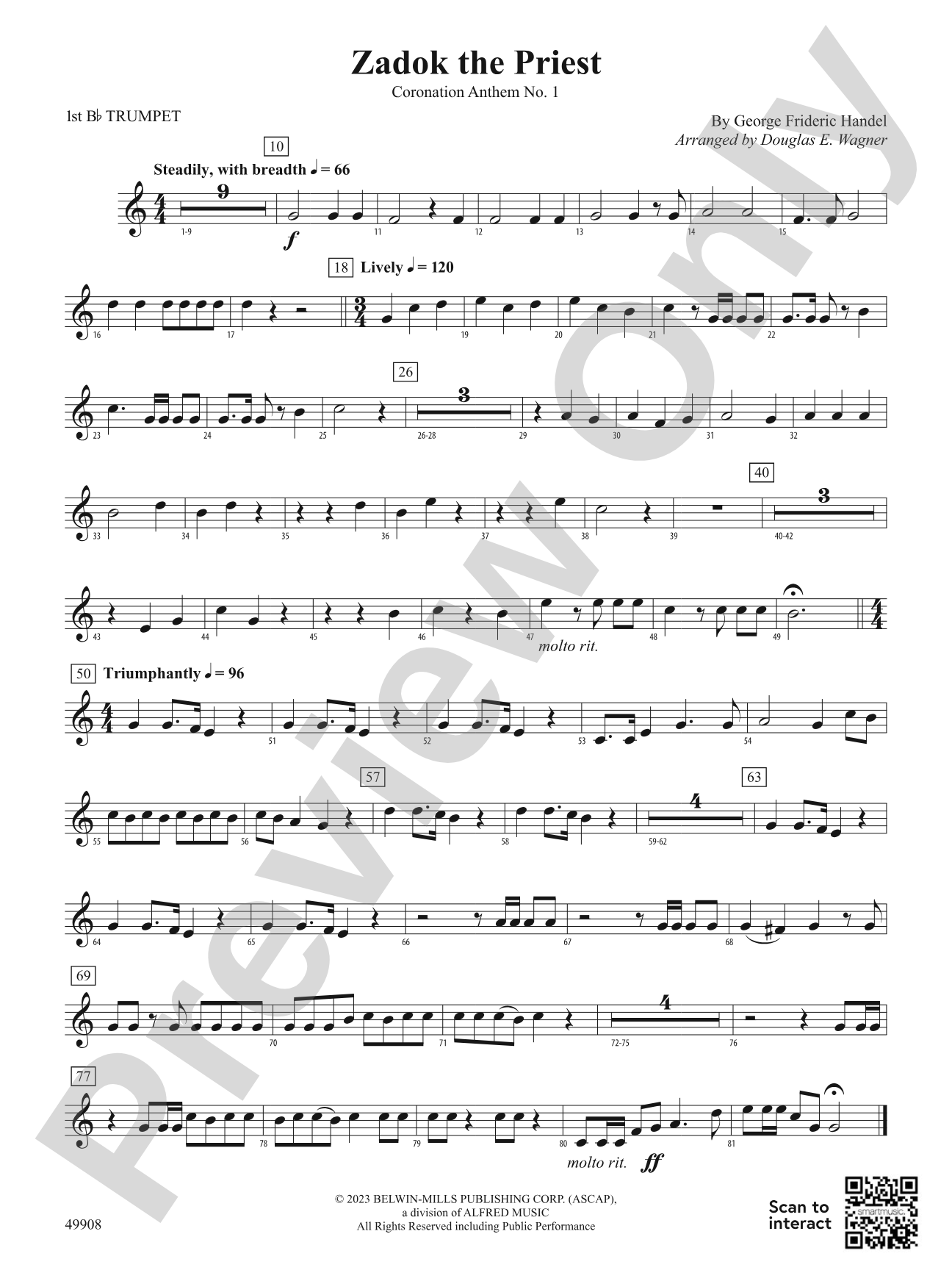

Zadok the Priest: 1st B-flat Trumpet
Coronation Anthem No. 1
George Frideric Handel / arr. Douglas E. Wagner
Grade: 2.5
Item: 00-PC-0018947_T1
$3.00
Pickup currently not available
Description
Zadok the Priest, the first of G. F. Handel's four Coronation Anthems, has been a cherished part of British coronation services from George II in 1727 to the current sovereign, Charles III. It is a magnificently resplendent work that embodies the essence of British pride and spirit. This terrific arrangement for string orchestra and piano by Douglas E. Wagner encapsulates the majesty of the original. This arrangement is also part of a larger festival setting with optional brass, timpani, and choir. Also available for S.A.T.B. (50210), S.A.B. (50211), S.S.A. (50212) with optional SoundTrax (50213) and SoundPax. (3:10)


Don't just read it, hear it, play along with it, and watch your students grow with it. In MakeMusic Cloud, Zadok the Priest: 1st B-flat Trumpet comes alive with professional accompaniment, adjustable tempo, and built-in practice tools that turn solo practice into real progress.
Open in the Player
Jump straight in and assign it today.
Start Your Free Trial
Open this title and explore the full library in minutes.
Sample Audio
1
1 Zodak the Priest (Coronation Anthem No
--:--
2
2 Zodak the Priest (Coronation Anthem No
--:--
1 Zodak the Priest (Coronation Anthem No
0:00
0:00
Sample Video
Additional Details
Series:
Belwin Intermediate String Orchestra
Publisher:
Alfred Music
SKU:
00-PC-0018947_T1
More about this title
About the Composer: George Frideric Handel
George Frideric Handel (1685-1759) was a German-born composer who became the dominant figure in English musical life during the 18th century. He mastered virtually every musical genre of his era, from opera and oratorio to instrumental works, and his music combined Italian melodic richness with German contrapuntal skill and English sensibility. His four Coronation Anthems, composed for George II's coronation in 1727, rank among the most significant ceremonial works in the English musical tradition and remain performed at state occasions to this day.
Handel's gift for writing music that is simultaneously accessible and architecturally sophisticated makes his work invaluable in music education. His melodies are immediately memorable, yet the harmonic language and structural clarity reward deeper study. For student orchestras, Handel's music offers the rare opportunity to engage with a true masterwork while developing fundamental ensemble skills.
Why we love this
Wagner's arrangement captures the ceremonial grandeur of Handel's original without sacrificing the clarity and momentum that make this anthem so stirring. At Grade 2.5, it remains accessible to developing string orchestras while preserving the harmonic sophistication and architectural integrity of the source material. The flexibility to perform it as a strings-and-piano piece or expand it with brass, timpani, and choir gives conductors the option to scale the piece to their ensemble's strengths and festival programming needs.
What to expect
Zadok the Priest radiates ceremonial magnificence and profound dignity. The opening melody unfolds with stately grandeur, supported by warm harmonic movement that feels both ancient and immediate. There is a quality of reverence in the work, yet also genuine joy and celebration, creating an atmosphere that is formal without being cold.
Who it's for
String orchestras at the intermediate level, including high school and community ensembles, will find this arrangement perfectly scaled to their abilities. Conductors looking for repertoire that combines historical significance with educational value will appreciate how thoroughly Handel's musical language teaches voice leading, harmonic function, and long-line phrasing.
How to get the most out of it
- Shape the opening theme with a gentle lift at the phrase endings, allowing the strings to breathe naturally rather than pressing through. This makes the ceremonial character more majestic than rushed.
- Balance the piano accompaniment so it supports the string texture without muddying the melodic line. The accompaniment should sit slightly behind the orchestral sound.
- Maintain rhythmic precision in the accompanying parts, particularly the repeated figures, so they provide a solid harmonic foundation rather than drawing attention.
- Build the crescendos gradually and allow full resonance at the climactic moments. Handel's music rewards generous, unhurried dynamic shaping.
How to use it
This arrangement works beautifully as a concert opener, where its ceremonial character establishes a formal and sophisticated tone for the program. It also serves as an excellent choice for spring festival performances, where adjudicators recognize the pedagogical and artistic merit of engaging with canonical repertoire. The flexibility to add brass and timpani makes it possible to grow the arrangement alongside your ensemble's development throughout the season.
Skills your students will build
- Sustaining long, even phrases in ensemble context
- Balancing melody and accompaniment within the string section
- Responding to subtle dynamic and tempo shaping
- Understanding harmonic function and voice leading through listening
- Maintaining rhythmic precision in repeated accompaniment figures
- Coordinating bowing in unison and divisi passages