
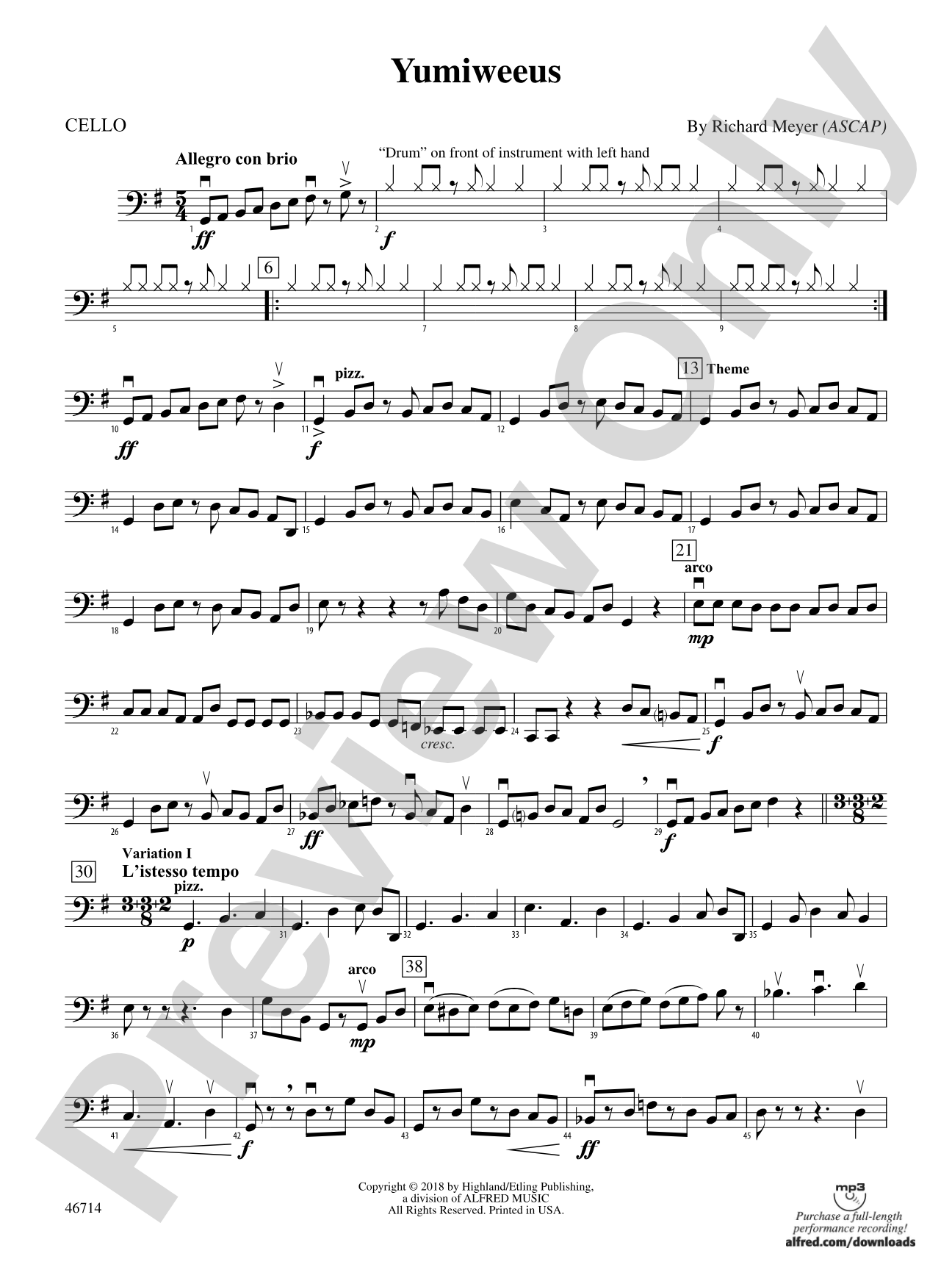

Yumiweeus: Cello
By Richard Meyer
Grade: 4
Item: 00-PC-0017849_VC1
$5.99
Pickup currently not available
Description
This joyful and jubilant piece by Richard Meyer has the sound of a celebration and a title that describes how music unites us all: "Yumiweeus." Hand drumming and a simple chant-like melody start the festivities, followed by an original theme and a set of six variations. Duets featuring the first stand players of every section introduce the first five variations, and a virtuosic final variation closes the piece. The changing meters and variety of key signatures and modes included here are sure to challenge all of your more advanced players. The measure of contrary motion that starts the piece is heard again between each variation and is meant to represent a "coming together to common ground."


Don't just read it, hear it, play along with it, and watch your students grow with it. In MakeMusic Cloud, Yumiweeus: Cello comes alive with professional accompaniment, adjustable tempo, and built-in practice tools that turn solo practice into real progress.
Open in the Player
Jump straight in and assign it today.
Start Your Free Trial
Open this title and explore the full library in minutes.
Sample Audio
1
Audio File
--:--
0:00
0:00
Sample Video
Additional Details
Series:
Highland/Etling String Orchestra
Publisher:
Alfred Music
Page Count:
124
SKU:
00-PC-0017849_VC1
More about this title
About the Composer: Richard Meyer

Richard Meyer brings three decades of string teaching experience to his work as both an educator and composer. During his 35 years directing string programs in California public schools, he expanded the orchestra at Oak Avenue Intermediate School from 29 students to 200, while also overseeing the city's elementary string curriculum. He led the Pasadena Youth Symphony Orchestra for 16 years, taking ensembles on performance tours across the United States, Europe, and Australia.
Beyond the rehearsal room, Meyer has shaped music education through innovation and composition. In 2009, he launched the "Giving Bach" program, which uses interactive concerts to reach special needs and underserved students throughout Southern California. His catalog includes over 190 published compositions and arrangements; he spent 16 years as string editor for Alfred Publishing Company and co-authored the String Explorer Series and Sight-read It for Strings. Meyer regularly serves as a guest conductor and clinician at national conferences and state honor orchestras.
Why we love this
Yumiweeus combines accessible energy with genuine compositional sophistication. The structure rewards your strongest players with duets and a virtuosic final variation while the framing device of contrary motion gives the piece architectural coherence that students will recognize and appreciate each time it returns.
What to expect
Yumiweeus erupts with infectious joy. The opening hand drumming and simple chant immediately signal celebration; as the original theme unfolds and variations multiply, the piece builds momentum and brilliance. The recurring measure of contrary motion functions like a refrain, bringing players back to common ground before launching into the next adventure.
Who it's for
Advanced Grade 4 string orchestras ready to tackle changing meters, modal writing, and varied key signatures. This work rewards ensembles with strong first-stand players capable of carrying featured duets and sections with technical demands.
How to get the most out of it
- Establish the hand drumming and chant-like opening with clarity and confidence; this rhythmic foundation anchors the entire piece and sets the celebratory tone that carries through all six variations.
- Pay careful attention to the meter and key signature changes throughout the variations. Prepare conductors' cues in advance so players understand where the transitions occur and can adjust their intonation accordingly.
- Feature your first-stand players prominently in the duets that introduce variations one through five. These passages are designed to showcase their musicianship and secure their leadership before moving into the next section.
- Build intensity toward the final variation without rushing. The virtuosic writing demands precision and rhythmic clarity; give your ensemble time to lock in the technical demands while maintaining the jubilant spirit.
How to use it
Program this as a concert closer when you want to end on an uplifting, energetic note that showcases your ensemble's technical sophistication. The 124-page conductor score and parts make it substantial enough for festival or contest programming, and the clear narrative arc of theme and variations creates natural programming shape alongside other Grade 4 repertoire.
Skills your students will build
- Reading and executing changing meters throughout a multi-section work
- Navigating multiple key signatures and modal writing with secure intonation
- Balancing ensemble sound during duet passages featuring individual section leaders
- Maintaining forward momentum and character through structural repetition (the recurring contrary motion measure)
- Executing technical passage work in the final variation with precision and rhythmic accuracy