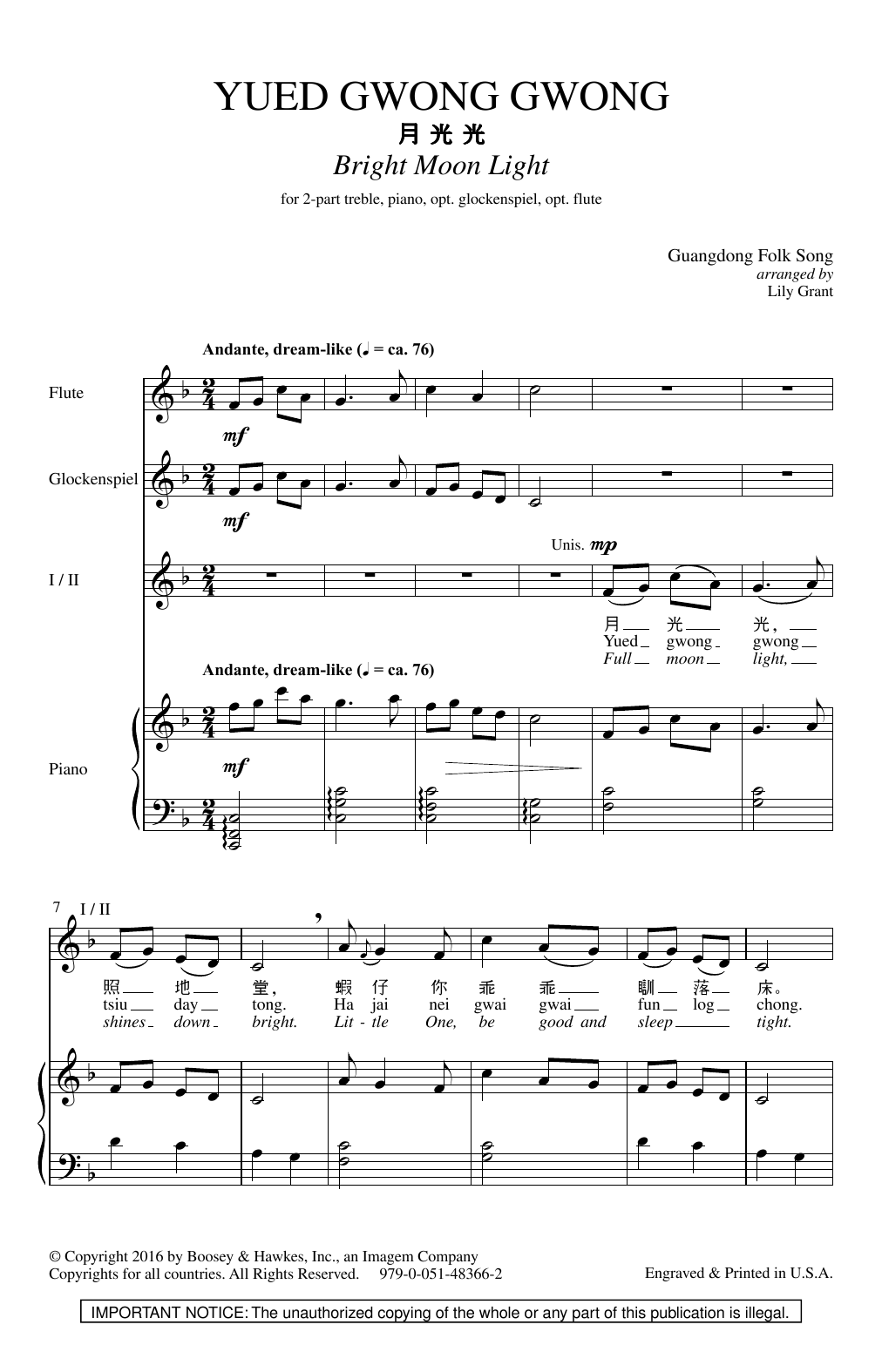
Yued Gwong Gwong (Bright Moon Light) Sheet Music Preview

Yued Gwong Gwong (Bright Moon Light): 2-Part Choral Octavo

As performed by Traditional Chinese Folk Song / Arranged by Lily Grant

Item: 35-DS00385602

Digital Download
$2.99
Description

Yued Gwong Gwong (Bright Moon Light): 2-Part Choral Octavo isn't in MakeMusic Cloud just yet...but it could be. Let us know you'd like to see it, and you'll help shape what comes next. In the meantime, start a free trial and dive into thousands of interactive titles your students can play along with today.

Sample Audio
No sample audio found.
Sample Video
Additional Details
Publisher: Hal Leonard
Page Count: 10
SKU: 35-DS00385602

More about this title

About the Artist: Traditional Chinese Folk Song

Chinese folk music represents one of the world's oldest continuous musical traditions, with roots stretching back thousands of years. These melodies have been passed down through generations, refined and reshaped by countless singers across regions and centuries. They carry the cultural identity of their communities while remaining accessible to musicians everywhere who seek authentic, meaningful repertoire.

Why we love this

Lily Grant's arrangement honors the luminous simplicity of this folk melody while making it genuinely singable for developing choirs. The two-part texture allows you to build vocal independence without overwhelming singers who are still finding their blend, and the cultural authenticity opens doors to conversations about music beyond the Western canon.

What to expect

The piece radiates the serene clarity of moonlight, with a melody that feels both ancient and immediately present. Bright yet contemplative, it invites singers into a reflective space while remaining joyful in its simplicity.

Who it's for

This arrangement works for middle school and high school choirs, including those with limited two-part experience. It also serves singers preparing for multicultural concert programming or directors seeking to expand their repertoire beyond European traditions.

How to get the most out of it

  • Shape phrases around the natural speech rhythm of the title text; avoid over-articulating consonants in ways that would feel foreign to the song's character.
  • Balance transparency in the two parts so listeners hear the interweaving melody rather than a dominant line with accompaniment.
  • Explore the brightness implied by the title through consistent vowel unification and a clear, focused sound without strain.

How to use it

Position this as a cultural contrast in a diverse concert, perhaps pairing it with Western art songs to demonstrate how universal musical instincts transcend tradition. It also fits beautifully into world music or interdisciplinary units exploring Asian cultures.

Skills your students will build

  • Singing in a non-Western tonal language with authentic phrasing
  • Part independence in two-voice writing
  • Blended ensemble sound while maintaining textural clarity
  • Cultural literacy and respectful interpretation of non-European repertoire

You May Also Like