Your Mother Should Know Sheet Music Preview

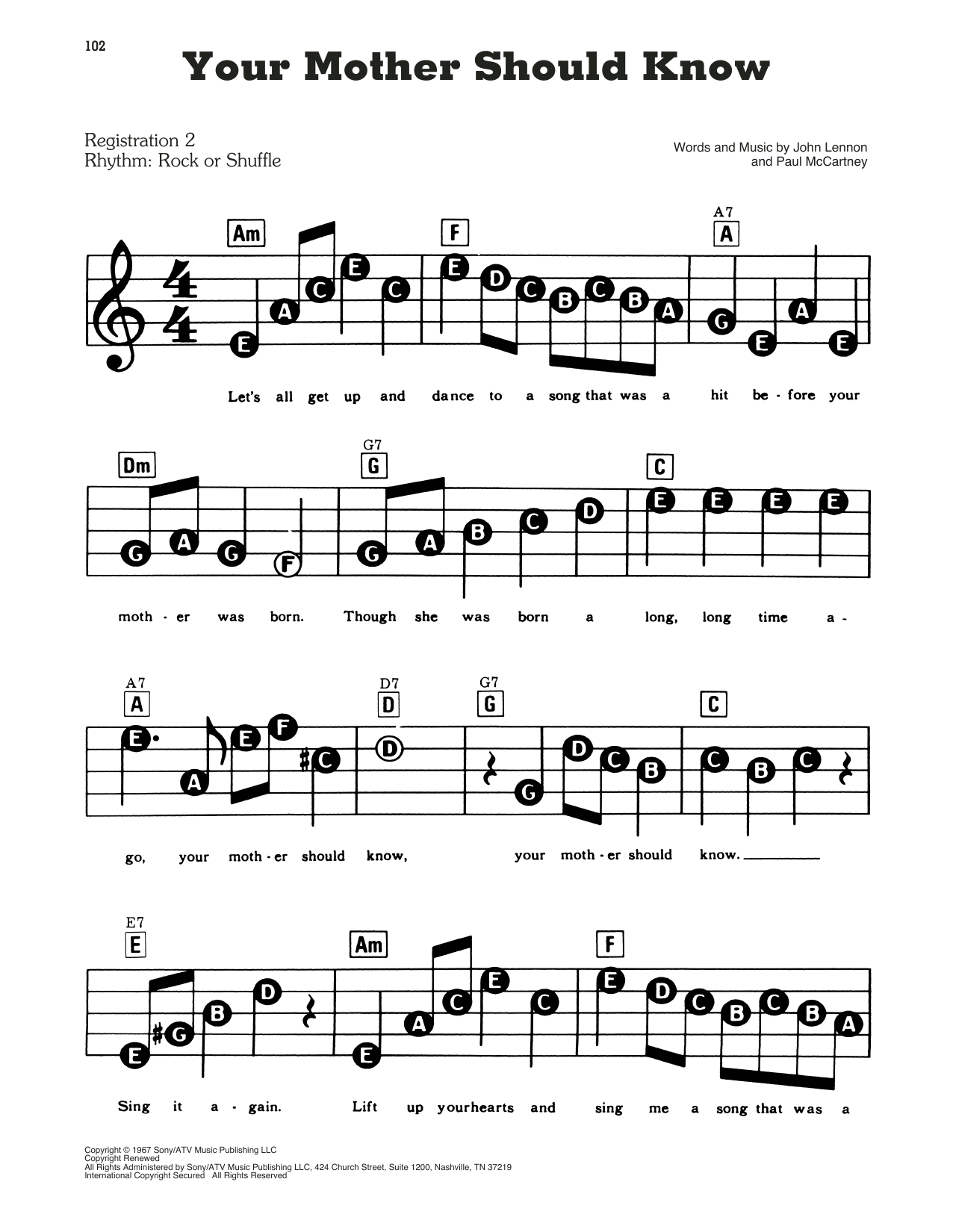
Your Mother Should Know: E-Z Play Today

As performed by The Beatles

Item: 35-DS00454632

Digital Download
$4.99
Description

Your Mother Should Know: E-Z Play Today isn't in MakeMusic Cloud just yet...but it could be. Let us know you'd like to see it, and you'll help shape what comes next. In the meantime, start a free trial and dive into thousands of interactive titles your students can play along with today.

Sample Audio
No sample audio found.
Sample Video
Additional Details
Publisher: Hal Leonard
Page Count: 2
SKU: 35-DS00454632

More about this title

About the Artist: The Beatles

The Beatles transformed popular music across the 1960s, moving from infectious pop melodies to increasingly sophisticated arrangements and studio experimentation. Their work spans from straightforward vocal harmonies and guitar-driven grooves to complex orchestrations and conceptual albums, making their catalog endlessly valuable for music education across skill levels.

Why we love this

This E-Z Play arrangement keeps the charm of a genuine Beatles hit without requiring advanced technique, letting students experience the band's gift for melody and harmonic movement on their own terms. The two-page format makes it accessible for early intermediate players while the familiar tune ensures genuine engagement rather than begrudging practice.

What to expect

Playful and light, with a nostalgic quality that feels almost music box-like in its simplicity. The tune has genuine charm without sentimentality, making it genuinely fun to perform rather than feel like a duty.

Who it's for

Early intermediate pianists who respond well to recognizable material and want to build fluency with functional harmonies. Students working through pop repertoire collections will find this a natural stepping stone between beginner melodies and more complex Beatles arrangements.

How to get the most out of it

  • Anchor the left hand movement steadily; the accompaniment pattern serves the song's forward momentum, so resist the urge to rush through chord changes.
  • Balance the melody line so it sits above the accompaniment texture without overpowering it. This requires touch control rather than just volume.
  • Treat the rhythmic phrases as conversational, allowing slight breathing space at natural phrase endings to let the tune breathe.

How to use it

Pair this with other era-appropriate pop repertoire for a concert segment exploring 1960s songwriting, or use it as a reliable encore that audiences consistently recognize and enjoy. It works equally well in a student recital program as a confidence builder or as a teaching piece for demonstrating how memorable melodies need only modest accompaniment support.

Skills your students will build

  • Accompanying melody with consistent left-hand patterns
  • Harmonic function in popular song structure
  • Phrase shaping without descriptive text cues
  • Stylistic awareness of pop versus classical approaches to the same material

You May Also Like