Buddy Guy stands as one of the most influential electric blues guitarists of the modern era, bridging traditional Chicago blues with rock and roll innovation. His expressive, high-energy playing style and willingness to push the instrument beyond conventional boundaries earned him a Grammy Lifetime Achievement Award and cemented his role as a mentor to generations of guitarists.
Why we love this
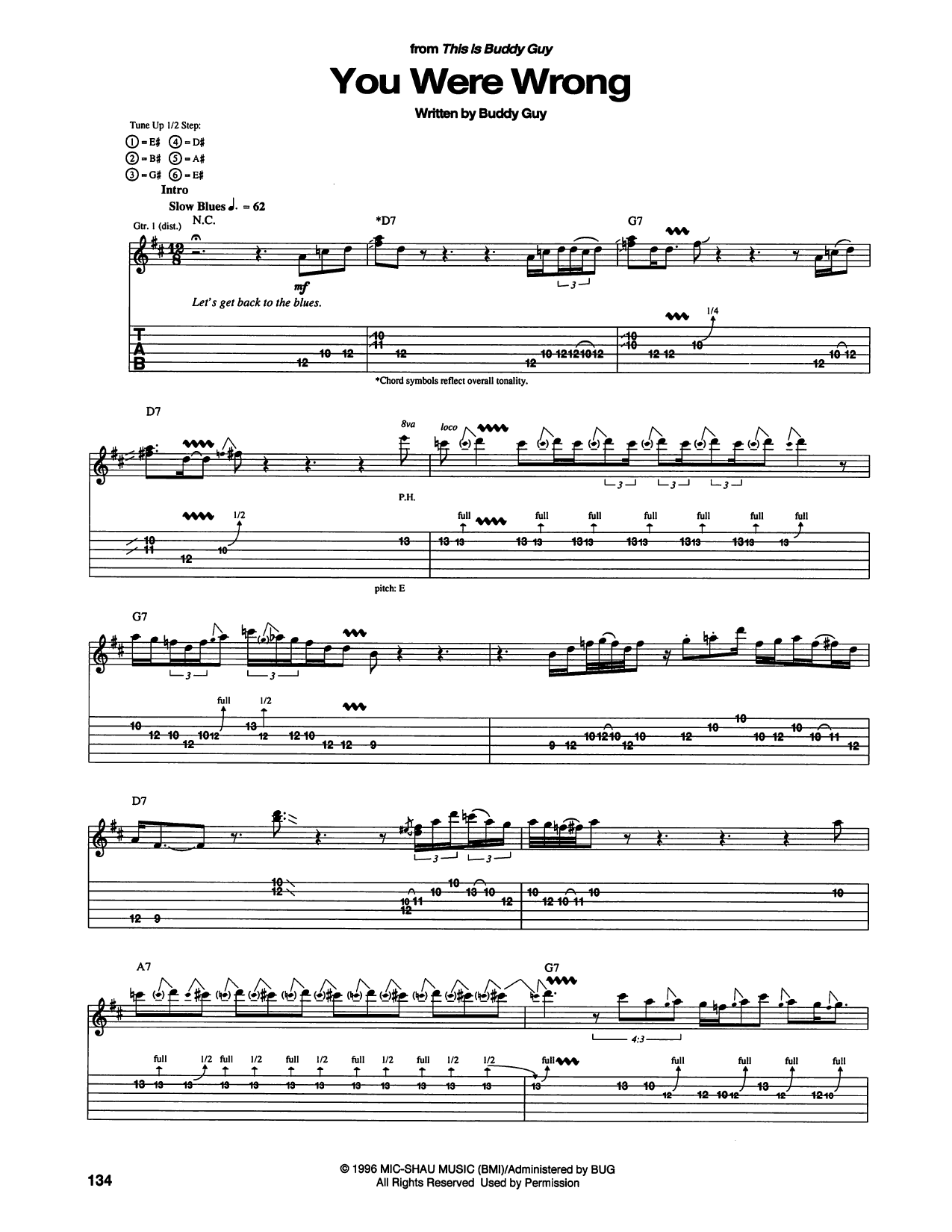
This tab captures the raw, improvisation-heavy approach that defines Buddy Guy's sound, giving students direct access to his phrasing choices and bending techniques. The 8-page layout provides enough content to explore his signature style without overwhelming players still developing their blues vocabulary.
What to expect
Energetic and conversational, as though the guitar is speaking directly to you with urgency and soul. The tab captures moments of controlled intensity followed by bluesy restraint, pulling between aggression and nuance in ways that feel spontaneous even when executed precisely.
Who it's for
Intermediate to advanced blues guitarists ready to step beyond basic pentatonic shapes and explore the sophistication of Buddy Guy's phrasing. Students seeking transcribed examples of authentic Chicago blues lead guitar will find concrete material to analyze and internalize.
How to get the most out of it
Pay close attention to the exact timing of bent notes; Buddy's phrasing often sits slightly behind or ahead of the beat for expressive effect, so match the tab's rhythmic placement exactly.
Experiment with your tone knob and pick dynamics to capture the vocal quality of his playing. Slight variations in attack and sustain make a dramatic difference in authenticity.
Study the fingering choices notated in the tab rather than defaulting to your own patterns. Buddy's left-hand positioning shapes his distinctive vibrato and response.
Work up to tempo gradually, focusing first on accuracy with the bend sequences and double-stops that appear throughout.
How to use it
Assign this as a listening and playing project in a blues history unit, pairing the tab work with recordings so students can hear how notation translates to actual performance. It works equally well as supplementary material for a guitarist preparing for a jazz or blues jam session, or as a model study for understanding how professional players approach song interpretation.
Skills your students will build
Advanced string bending and vibrato control
Reading and executing syncopated phrasing
Building blues vocabulary through transcription analysis
Understanding tension and release in blues soloing
Tone shaping through amp and equipment interaction
You May Also Like
Scan to Complete Your Purchase
Use your phone's camera to scan the code below
You'll log in on your phone and the order will be added to your account