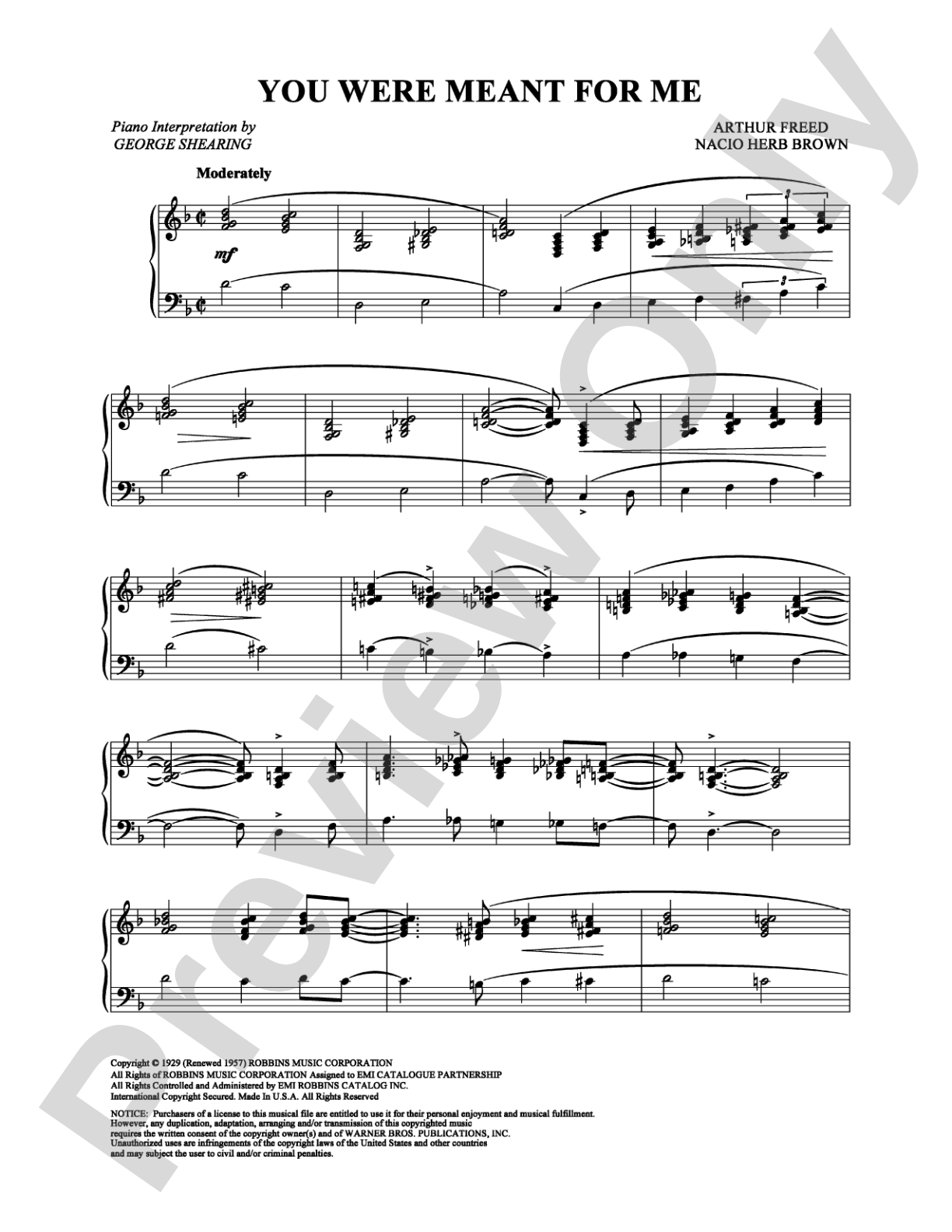
You Were Meant For Me: Piano Digital Sheet Music

You Were Meant For Me: Piano Digital Sheet Music

Nacio Herb Brown, George Shearing, Arthur Freed

Item: 00-PS-0007383

Digital Download
$3.99
Description

You Were Meant For Me: Piano Digital Sheet Music isn't in MakeMusic Cloud just yet...but it could be. Let us know you'd like to see it, and you'll help shape what comes next. In the meantime, start a free trial and dive into thousands of interactive titles your students can play along with today.

Sample Audio
No sample audio found.
Sample Video
Additional Details
SKU: 00-PS-0007383

More about this title

About the Artist: George Shearing

George Shearing (1919–2011) was a British jazz pianist and composer whose sophisticated harmonic approach and melodic sensibility shaped the sound of 1950s jazz. Blind from birth, Shearing developed an instantly recognizable style built on block chord voicings and lyrical improvisation, recording extensively for Columbia Records and leading his own quintets and big bands. His compositions and arrangements remain central to jazz education and represent a bridge between swing-era traditions and the modernism of bebop.

Why we love this

This standard showcases the exact harmonic language and voicing approach that made Shearing's arrangements so teachable and musically rewarding. Students encounter a piece that demands both solid comping technique and confident soloing over changes that are accessible yet sophisticated enough to sustain interest through multiple choruses.

What to expect

Warm, sophisticated, and thoroughly grounded in swing. The piece moves with an unhurried elegance that invites both reflection and playful improvisation, embodying the refinement that made Shearing's music accessible to jazz listeners while remaining genuinely substantial for musicians.

Who it's for

Jazz pianists developing their comping and soloing vocabulary, from intermediate students studying standards to advanced players seeking a quintessential example of mid-century jazz piano writing. This piece works well in recital settings, jazz combo programs, or as a teaching piece alongside analysis of Shearing's harmonic approach.

How to get the most out of it

  • Pay attention to the harmonic rhythm and voice leading in the left hand; Shearing's block voicings are the foundation of the sound, not just accompaniment.
  • Approach the melody with restraint in the first chorus, letting the harmony speak. Reserve embellishment and reharmonization for later choruses.
  • Lock into a steady swing feel rather than pushing the tempo; this standard benefits from relaxed pocket playing with clear articulation.
  • Use the changes as a roadmap for improvisation but respect the song's lyrical core. Shearing's style values melody even during solos.

How to use it

Program this in a jazz recital as part of a standards set, or pair it with other mid-century compositions to illustrate different approaches to similar harmonic vocabularies. It also serves as an excellent study piece in jazz history units covering the 1950s and the evolution of jazz piano.

Skills your students will build

  • Block chord voicing and upper-structure harmony on piano
  • Swing comping with clear harmonic rhythm
  • Solo improvisation over jazz changes
  • Rubato and phrasing in a lyrical jazz context
  • Reading and interpreting lead-sheet notation

You May Also Like