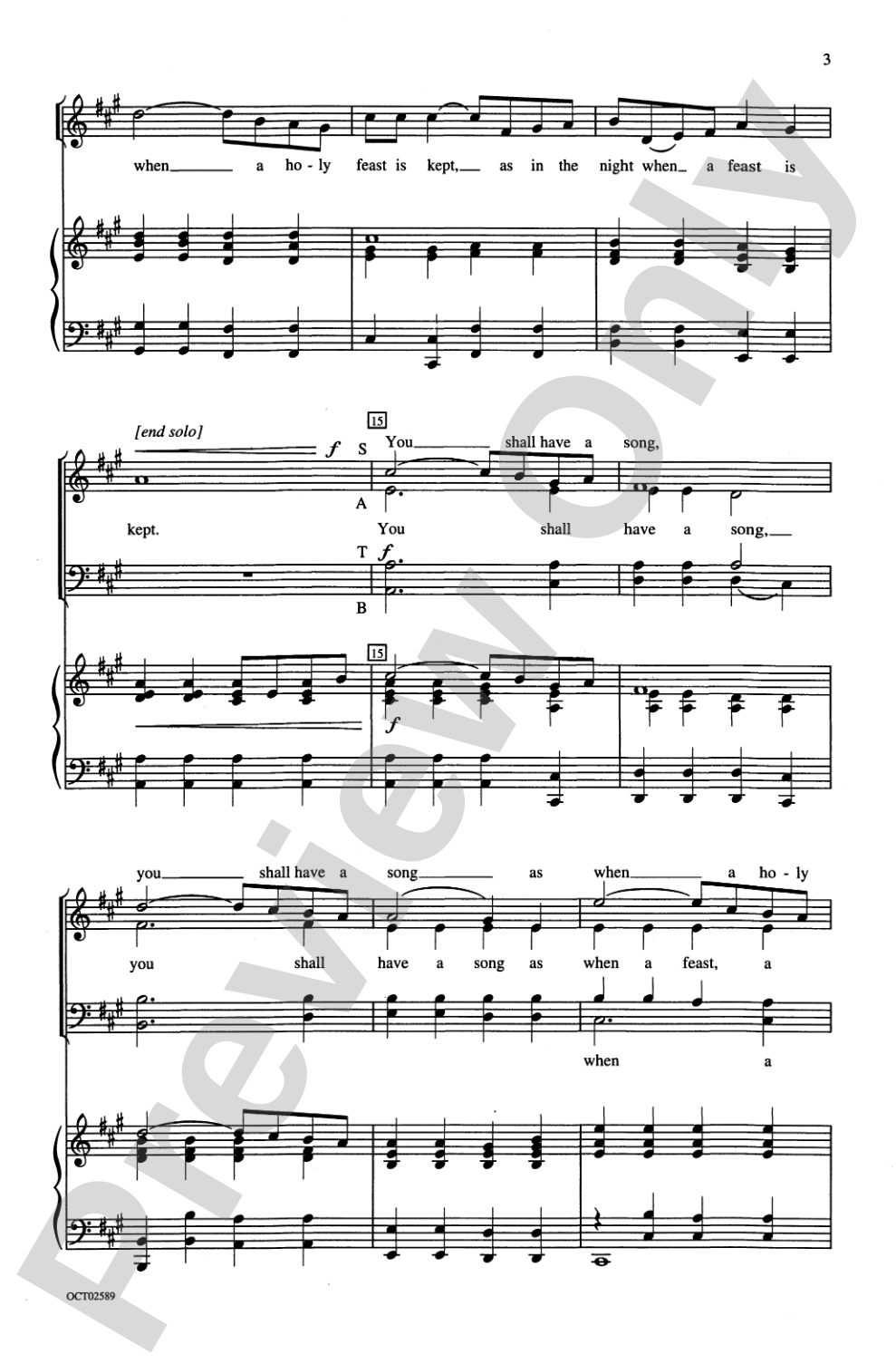
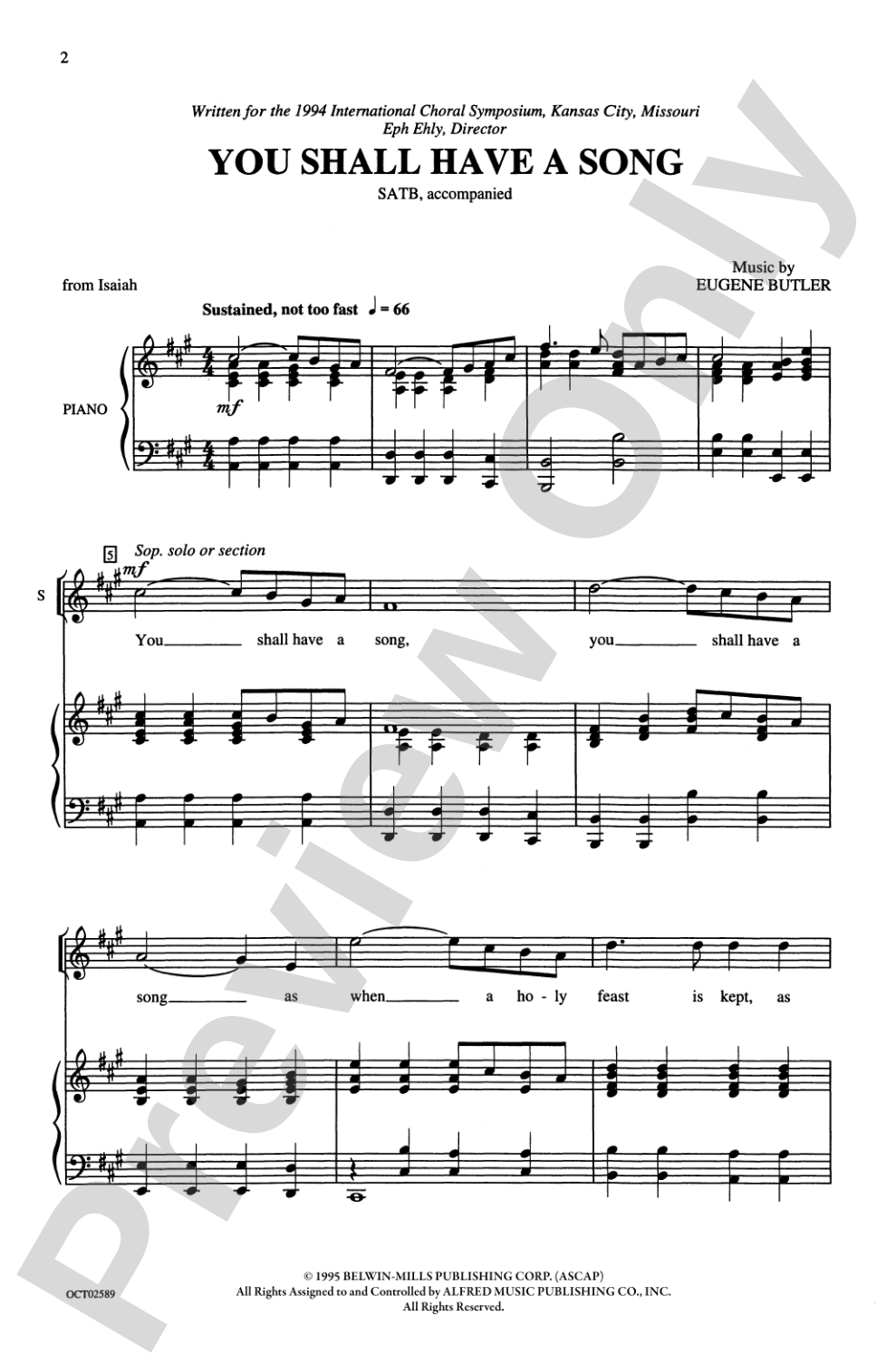
You Shall Have a Song Sheet Music Preview

You Shall Have a Song: SATB Choral Octavo

By Eugene Butler

Level: Moderate

Item: 00-PO-0005142

Digital Download
$2.25

Minimum order quantity: 20 copies

Description
Gorgeous, melodic and memorable, Gene's setting of the text from Isaiah is stunning. Its sonorous choral structures and soaring melody make this work an expressive must for the mixed chorus. A festival/contest work of great magnitude.

You Shall Have a Song: SATB Choral Octavo isn't in MakeMusic Cloud just yet...but it could be. Let us know you'd like to see it, and you'll help shape what comes next. In the meantime, start a free trial and dive into thousands of interactive titles your students can play along with today.

Sample Audio
No sample audio found.
Sample Video
Additional Details
Series: Alfred Archive Edition: Belwin Festival Series
Publisher: Alfred Music
Page Count: 8
SKU: 00-PO-0005142

More about this title

About the Composer: Eugene Butler

Eugene Butler

Eugene Butler has built a prolific and distinguished career across composition, conducting, education, and church music. He earned degrees from Oklahoma University (B.M.E.), Union Theological Seminary (M.S.M.), and the University of Missouri–Kansas City (D.M.A.), and has received major recognition including the Kansas Composer of the Year award and ASCAP Standard Music Panel recognition annually since 1972. His teaching excellence has been honored by multiple institutions, and he directed choral activities and music theory at Johnson County Community College while leading civic and church music programs in the Kansas City area.

With over 650 published compositions across 47 publishing houses, Butler's music circulates constantly in rehearsals and performances throughout the English-speaking world. He remains active as an adjudicator, clinician, and workshop leader, having conducted and taught in 39 states, three Canadian provinces, and England. His work spans sacred and secular contexts, and his pieces are written with the practical needs and capabilities of student and community ensembles firmly in mind.

Why we love this

Butler's gift for memorable melody and clean harmonic writing shines throughout this setting of Isaiah. The piece balances accessibility with genuine musical substance, giving singers something meaningful to express without overwhelming them technically, making it ideal for festival programming where impact matters.

What to expect

The piece unfolds with a sense of reverence and warmth, its melodic contours inviting singers into a full, resonant sound world. The text from Isaiah finds its voice in harmonies that feel both contemporary and timeless, with moments of genuine lyrical beauty that linger after the final chord.

Who it's for

Mixed choirs at the high school and community college levels seeking repertoire that combines accessibility with musical substance. Directors programming festival or contest shows will find this work engaging for singers while offering judges genuinely expressive material.

How to get the most out of it

  • Shape the melodic line with clear phrase direction rather than uniform dynamics; allow the soaring passages to breathe naturally without pushing the tempo forward.
  • Balance the parts carefully in sectional rehearsals; the sonorous harmonic structures depend on each voice hearing its relationship to the surrounding voices.
  • Let the text inform your phrasing and tone color. The Isaiah text carries weight that deserves attention to diction and consonant clarity.

How to use it

This work functions beautifully as a centerpiece in a sacred or spiritual music set, or as a standalone festival selection where you want to showcase your ensemble's musical maturity. Its moderate difficulty and 8-page length make it manageable without extensive rehearsal time while remaining substantial enough to stand as a complete musical statement.

Skills your students will build

  • Voice independence within full SATB texture
  • Sustaining line through extended phrases
  • Balance and blend across four independent vocal parts
  • Text expression and diction in sacred music
  • Reading accidentals and chromatic movement

You May Also Like