You're My Everything: Piano Digital Sheet Music

You're My Everything: Piano Digital Sheet Music

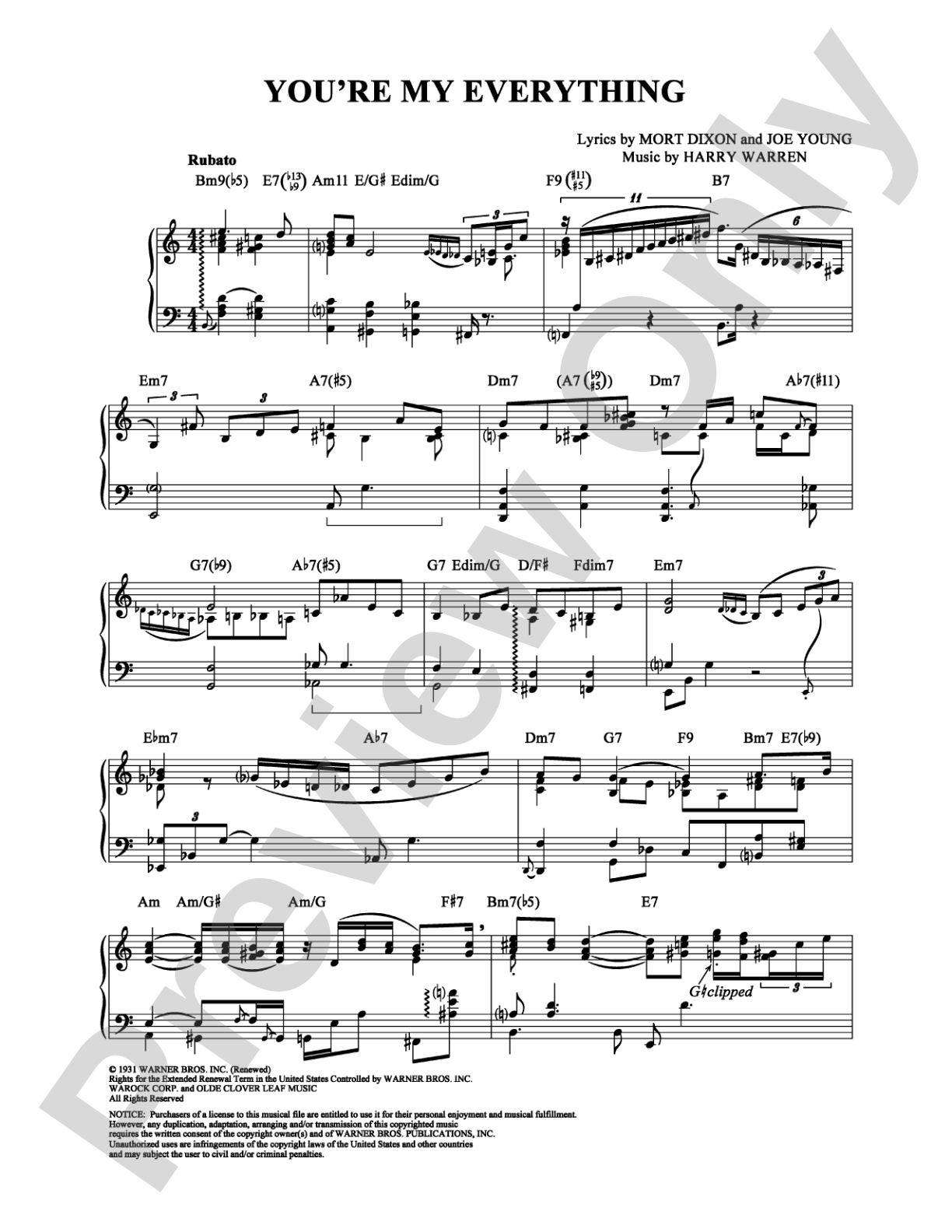
Harry Warren, George Shearing

Item: 00-PS-0001967

Digital Download
$3.99
Description

You're My Everything: Piano Digital Sheet Music isn't in MakeMusic Cloud just yet...but it could be. Let us know you'd like to see it, and you'll help shape what comes next. In the meantime, start a free trial and dive into thousands of interactive titles your students can play along with today.

Sample Audio
No sample audio found.
Sample Video
Additional Details
SKU: 00-PS-0001967

More about this title

About the Artist: George Shearing

George Shearing (1919-2011) was a British jazz pianist and composer whose sophisticated harmonic language and melodic sensibility shaped the sound of jazz piano for decades. Blind from birth, Shearing developed an instantly recognizable style built on lush voicings and a lyrical touch that made him equally comfortable in small group settings and large orchestral arrangements. His compositions and interpretations became staples of jazz standards repertoire, recorded by countless musicians and studied by pianists seeking to understand modern jazz harmony.

Shearing's influence extends far beyond his own recordings. His approach to chord extensions, block chord voicings, and rhythmic phrasing set a template that jazz educators continue to use when teaching voice leading and harmonic sophistication. His willingness to work across genres—from bebop to pop to classical crossover—demonstrated that serious musicianship and accessibility were not opposing forces.

Why we love this

Shearing's interpretation of this standard exemplifies the kind of sophisticated yet swinging jazz piano that students can actually learn from. The harmonic movement is rich enough to expand a player's understanding of chord extensions and voice leading, while the overall sensibility remains grounded in melody and groove rather than technical display.

What to expect

Elegant and warm, with a gentle swing that feels more like conversation than declaration. The piece opens with restraint and lyricism, allowing the melody to breathe while the harmony underneath suggests harmonic richness without ever overwhelming the tune. There's an intimacy here that makes this standard feel personally rendered rather than simply played.

Who it's for

Intermediate to advanced jazz pianists developing their harmonic vocabulary and learning to phrase standards with sophistication. Students preparing for jazz combo performance or those building repertoire in the Great American Songbook will find Shearing's approach both instructional and musically satisfying.

How to get the most out of it

  • Study the voicing choices carefully. Shearing's comping is precise and purposeful; every chord is voiced with intention. Spend time understanding why he voices certain movements the way he does rather than copying them blindly.
  • Balance the rubato with the underlying pulse. Even when the melody has rhythmic freedom, the harmonic foundation should suggest the groove. This creates sophistication without losing swing.
  • Listen closely to the recorded version before learning the lead sheet, then set it aside. Use the recording as a reference point for style and phrasing, not as a note-for-note transcription target.
  • Pay attention to dynamics and touch. Shearing's sound is refined and never harsh. The piano should sing, which means managing dynamics even at moderately loud volumes.

How to use it

This works beautifully in a jazz concert or recital as a solo feature piece, especially if the program includes other standards or swing-era repertoire. It's also an excellent choice for a student recital when you want to showcase tasteful playing and harmonic understanding without requiring flashy technique.

Skills your students will build

  • Voice leading through jazz chord extensions and substitutions
  • Phrasing melody with rhythmic flexibility while maintaining harmonic clarity
  • Reading and interpreting lead sheet notation with stylistic awareness
  • Building a personal interpretation of a standard while respecting the composer's intent

You May Also Like