
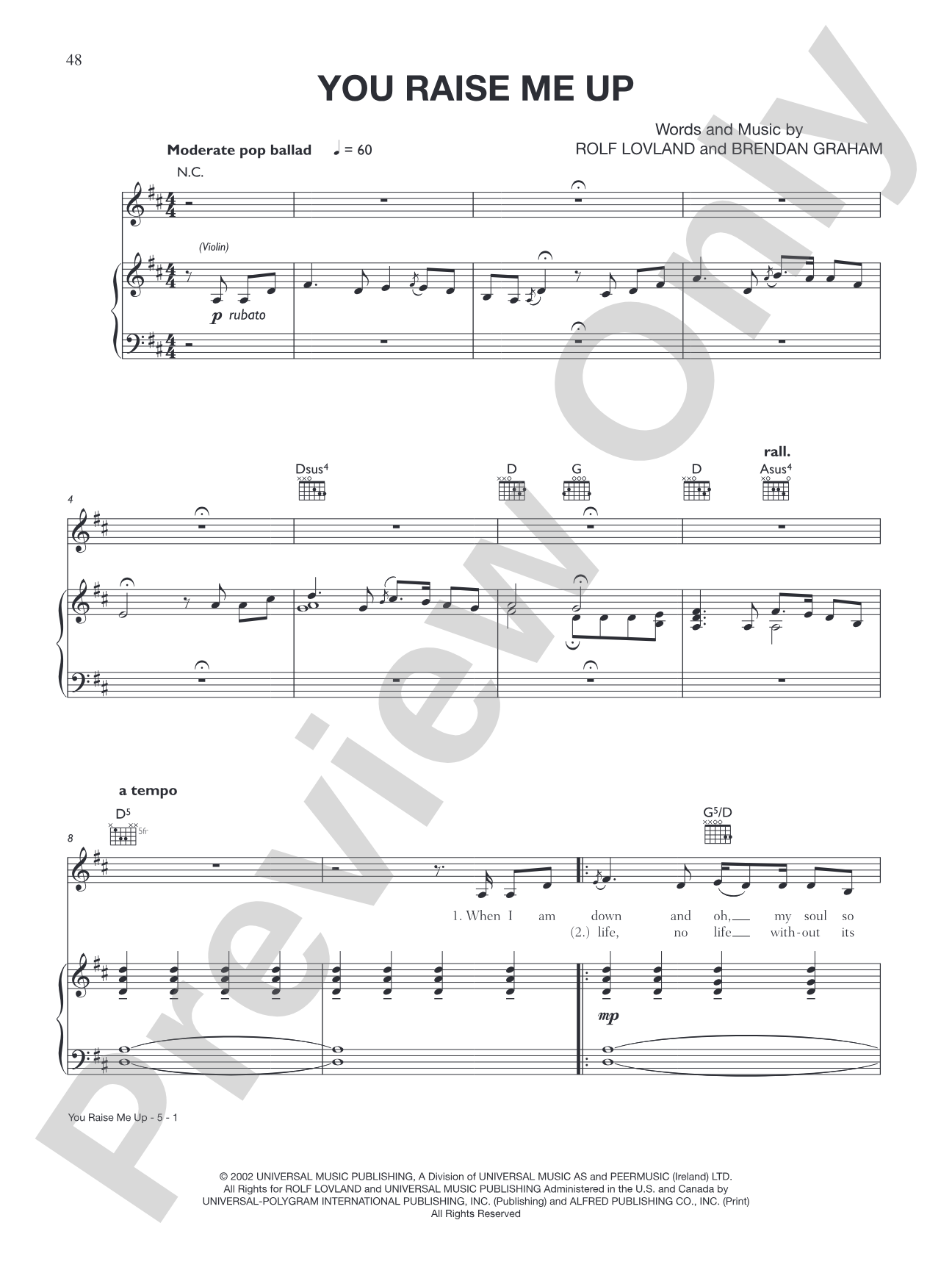

You Raise Me Up: Piano/Vocal/Chords
Celtic Woman
Item: 00-PS-0011043
$4.99
Pickup currently not available
Description
This songbook arranged for piano/vocal/chords contains music from Celtic Woman's The Greatest Journey: Essential Collection and four pages of color photographs. This compilation of their most-beloved and memorable songs includes "The Call," "Pie Jesu," "Ave Maria," "You Raise Me Up," and two bonus songs, "Mo Ghile Mear" and "Spanish Lady." Titles: Ave Maria * Beyond The Sea * The Butterfly * The Call * Danny Boy * Dúlaman * Green The Whole Year Round * Harry's Game * The Isle Of Inisfree * Mo Ghile Mear (Live from Slane Castle) * Orinoco Flow * Pie Jesu * Shenandoah (The Contradiction) * The Sky And The Dawn And The Sun * Somewhere * Spanish Lady (Live from Slane Castle) * The Voice * You Raise Me Up.


You Raise Me Up: Piano/Vocal/Chords isn't in MakeMusic Cloud just yet...but it could be. Let us know you'd like to see it, and you'll help shape what comes next. In the meantime, start a free trial and dive into thousands of interactive titles your students can play along with today.
Request This Title
Tell us you want it.
Start Your Free Trial
Explore everything that's ready to play right now.
Sample Audio
No sample audio found.
Sample Video
No sample videos found.
Additional Details
Publisher:
Alfred Music
Page Count:
112
SKU:
00-PS-0011043
More about this title
About the Composer: Rolf Lovland
Rolf Lovland is a Norwegian composer and pianist whose work has become synonymous with contemporary Celtic and world music. His compositions, often collaborating with lyricist Brendan Graham, blend classical training with folk traditions, creating pieces that resonate across genres and audiences.
Lovland's arrangements for Celtic Woman have reached millions globally, introducing classical crossover music to mainstream listeners. His skill in adapting traditional melodies and composing original works that honor cultural roots while remaining emotionally accessible has made him a significant voice in music education and performance.
Why we love this
This collection captures the hallmark sound that made Celtic Woman a cultural phenomenon: soaring melodies, rich harmonic language, and the ability to make both sacred and secular material feel emotionally genuine. Pianists working through this songbook encounter sophisticated arranging that respects vocal phrasing while giving the piano a real musical voice, not just accompaniment.
What to expect
These arrangements evoke the misty landscapes and emotional depth of Celtic tradition while maintaining the clarity and elegance of classical training. Each piece invites both technical refinement and heartfelt expression, creating a listening and playing experience that feels both grounded and transcendent.
Who it's for
This songbook serves pianists and singers preparing recitals, church musicians seeking accessible classical crossover repertoire, and music teachers looking for material that bridges folk tradition and art song. It works equally well for independent study and collaborative performance.
How to get the most out of it
- Balance the vocal line with the piano part; these arrangements are written so both voices share musical weight. Avoid accompanying passively.
- Lean into the natural rubato that Celtic melodies demand. The rhythmic flexibility of these pieces distinguishes them from strict classical repertoire.
- Use the chord symbols to explore voicing options and reharmonization, especially in repeated sections. Lovland's originals leave room for personal interpretation.
- Pay attention to the cultural context of each piece. "Danny Boy" and "Shenandoah" carry different emotional weight than "Pie Jesu" or "Ave Maria"; let that inform tempo and dynamics.
How to use it
Program selections from this collection as centerpieces for recitals celebrating world music or as bridges between classical and contemporary repertoire. These pieces work beautifully in church services, charity benefit concerts, or hybrid programs pairing classical standards with folk-inspired material.
Skills your students will build
- Accompanying skills that honor vocal phrasing and breath
- Reading and interpreting chord symbols for solo and collaborative contexts
- Understanding arranging conventions in classical crossover and world music idioms
- Managing rubato and flexible rhythmic interpretation in non-metered contexts
- Sight-reading a diverse range of global and sacred musical traditions