
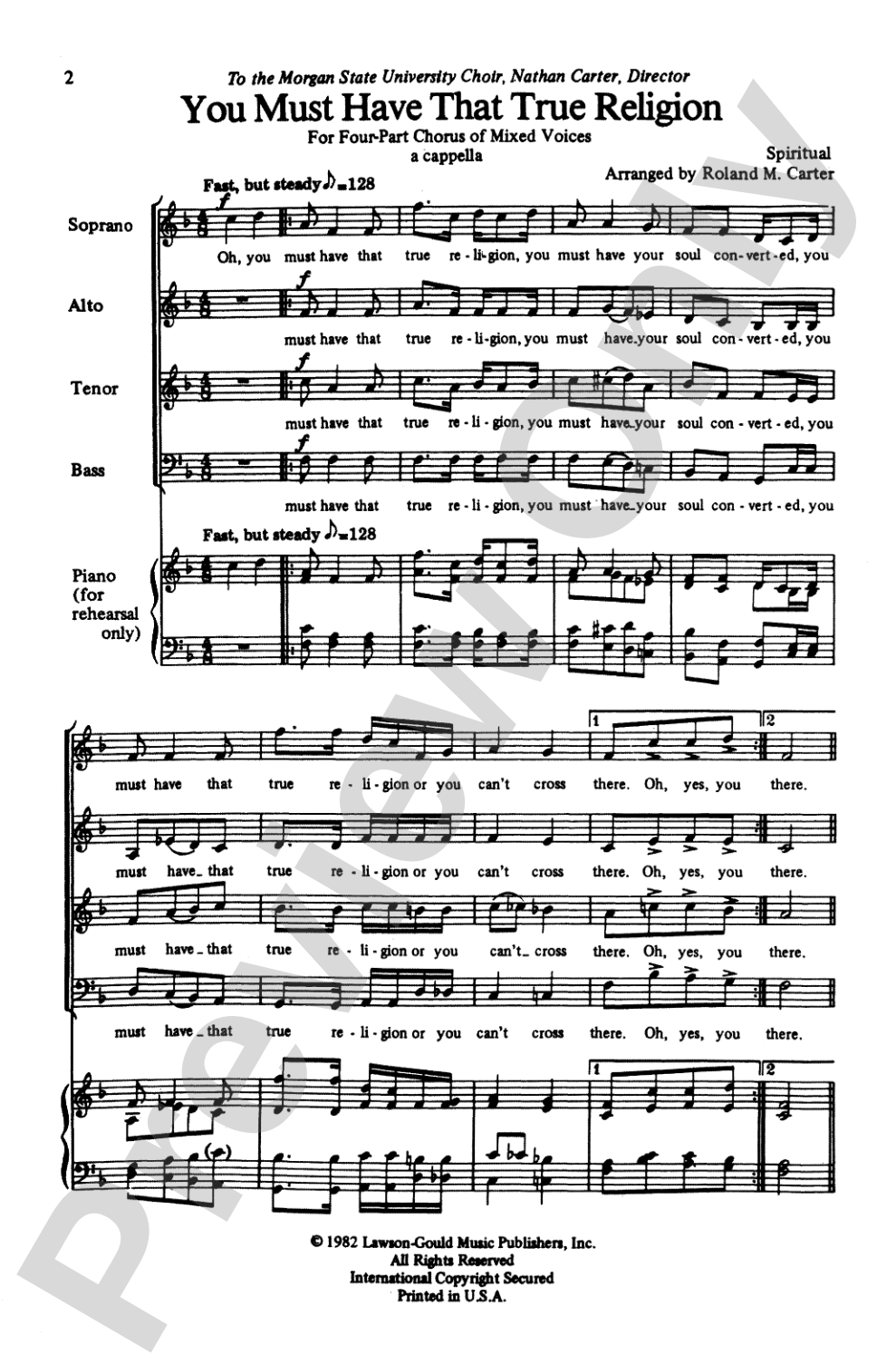
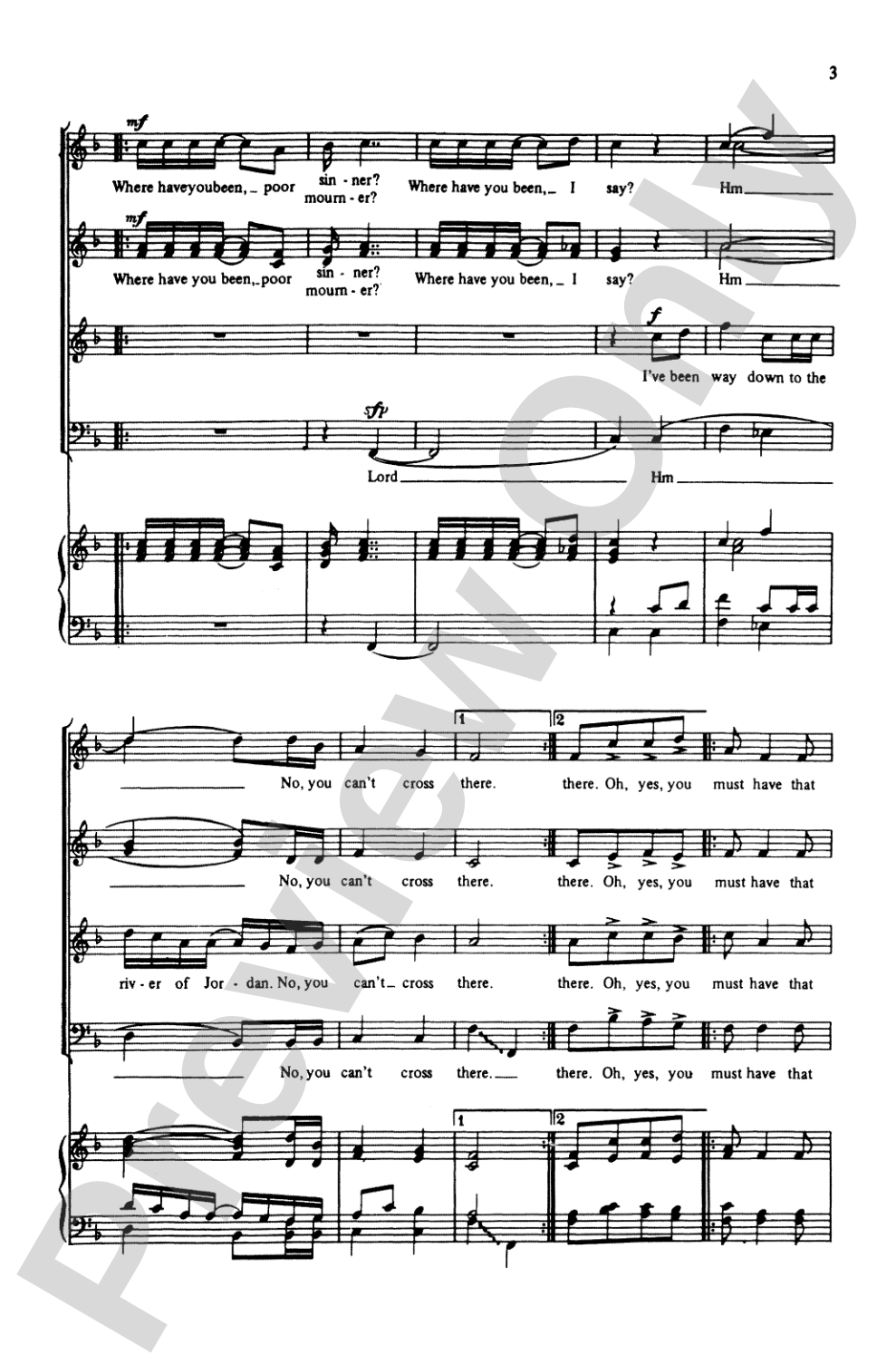

You Must Have That True Religion: SATB Choral Octavo
Spiritual / arr. Roland Carter
Item: 00-PO-0003025
$2.25
Minimum order quantity: 20 copies
Pickup currently not available
Related Items
You Must Have That True Religion: SATB Choral Octavo |
$2.25
|
View |
Description


You Must Have That True Religion: SATB Choral Octavo isn't in MakeMusic Cloud just yet...but it could be. Let us know you'd like to see it, and you'll help shape what comes next. In the meantime, start a free trial and dive into thousands of interactive titles your students can play along with today.
Request This Title
Tell us you want it.
Start Your Free Trial
Explore everything that's ready to play right now.
Sample Audio
No sample audio found.
Sample Video
No sample videos found.
Additional Details
Series:
Alfred Archive Edition: Lawson-Gould Music Publishers
Publisher:
Alfred Music
Page Count:
8
SKU:
00-PO-0003025
More about this title
About the Arranger: Roland Carter

Roland Carter brings decades of experience as a conductor, composer, and pianist to his work as an arranger and scholar of African American music. He founded MAR-VEL, a publishing house dedicated to amplifying the voices of African American composers and traditions, and currently serves as President of the National Association of Negro Musicians Inc. (NANM). His leadership in choral music spans from his tenure as chair of Hampton University's music department, where he conducted internationally recognized ensembles for nearly twenty-five years, to his current position as the Ruth S. Holmberg Professor of American Music at the University of Tennessee at Chattanooga.
Throughout his career, Carter has been recognized as a leading authority on the performance and preservation of African American musical heritage. His work has taken him from presidential inaugurations to intimate church settings, from scholarly presentations at national conferences to direct mentorship with individual singers. He has directed the Chattanooga Choral Society for the Preservation of African American Song and received numerous honors, including an honorary doctorate from Shaw University and National Honorary Membership in Phi Mu Alpha Sinfonia Fraternity.
Why we love this
This arrangement captures the spiritual's essential character while giving your singers clear, singable voicing that serves the text without obscuring it. Carter's deep knowledge of African American musical traditions comes through in every phrase; the work feels authentic rather than academic. A cappella format means your singers can focus entirely on the power of the message and the beauty of their ensemble sound.
What to expect
The spiritual tradition breathes through this arrangement with quiet urgency. There's conviction here, a clarion call wrapped in four-part harmony that invites listeners into something both familiar and transcendent. The a cappella texture lets every voice carry its own line while contributing to a unified message.
Who it's for
This octavo suits choirs at the high school through adult level who can navigate independent voice parts and manage the demands of a cappella singing. Directors preparing for concert or festival programming will find a piece that sits comfortably in standard rep while offering substantive repertoire grounded in American musical tradition.
How to get the most out of it
- Center your interpretation on the conviction in the text. The directness of "You Must Have That True Religion" demands that singers understand and inhabit the spiritual's call, not simply execute the notes.
- Allow the piece to breathe between phrases. The power of spirituals often lies in the space, the pause, the moment where meaning settles on the listener.
- Balance transparency with blend. In a cappella singing, intonation and vowel unity become visible; encourage your ensemble to listen inward and adjust without sacrificing individual voice quality.
- Consider the dynamic arc across all eight pages. Build momentum gradually rather than front-loading your energy; let the text itself guide the shape.
How to use it
Program this as a centerpiece for a concert focused on spirituals or African American choral traditions, or pair it alongside other sacred works to showcase musical depth. The piece also serves well in festival or competition contexts where it can stand on its own musical merit while reflecting the genuine repertoire your ensemble is learning.
Skills your students will build
- A cappella blend and intonation without instrumental support
- Expressive interpretation of text-driven spiritual arrangements
- Independent voice part reading in four-part voicing
- Understanding of African American musical heritage and performance traditions